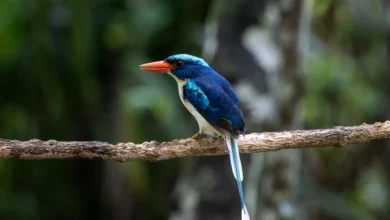
The Shovel-billed Kookaburra (Clytoceyx rex), also known as the Shovel-billed Kingfishers, is the sole representative of the genus Clytoceyx.
Description
Shovel-billed Kingfishers are a large, approximately 33 cm (13 in) long, dark brown tree kingfisher with a heavy, short, and broad bill that is unique among the kingfishers.


It has a dark head with a rufous stripe behind the eye, a white throat, a rufous neck collar and underparts, a bright blue rump, a brown iris, a brownish-black bill with a paler mandible (the entire bill often appears brownish due to earth), and pale feet. Both sexes are similar in appearance but are easily recognised by the colour of the tail. The male has a dark bluish ta, while the female’s is rufous. The juvenile has a female-like plumage with scale-patterned feathers.
Habitat/ Distribution
The Shovel-billed Kingfisher is endemic only to New Guinea. Geographically, its range is very limited; it doesn’t occur on many surrounding islands or even outside of the main island. It has been found at elevations ranging from sea level to 7850 feet. It is found in hill forests that are moist and shaded with lots of ground cover and leaf litter.
Its habitat is often rugged and remote due to its preference for moist soil and forest understorey. The bird is rarely seen by observers, in part due to its habitat being difficult to access and because of its unobtrusive behaviour (usually near the ground or moving quietly). The bird’s ability to survive at different altitudes indicates a certain tolerance for climatic variations (temperatures, humidity, etc.). Although likely to always be reliant upon forested cover and ground moisture, it seems that the intermixing of steep valleys, ridges and hill slopes, along with ridged terrai, is typical.
Breeding and Nesting
The Shovel-billed Kingfisher is not well known for this aspect. There are very few scientific records on its nesting behaviour, clutch size or incubation period. What follows is a combination of what is known and what can be inferred based on related species.
Sources do NOT provide verified data on nesting sites or nest structure for this species. It is not known how many eggs the bird lays or if it uses tree cavities. It is said that the bird is inconspicuous and rarely seen. This contributes to its lack of a well-documented history.
It is inferred that many kingfishers nest in New Guinea or similar forest environments using tree cavities, nests of termites, or earthen banks. Some tree kingfishers create their own nesting cavities in decaying trees or softwood. Some may dig holes in soil banks or termite mounds. Since the Shovel-billed Kingfisher feeds on mud and moist soil, it is reasonable to assume that its nesting sites could be hollow logs or in between earth and roots. These places are safe from predators and maintain humidity.
Diet / Feeding
Contrary to the anonymity surrounding its breeding details, we know more about the Shovel-billed Kingfisher’s diet and feeding habits.
The kingfisher forages on the ground or mud rather than fishing, or perching above water as is more typical. It digs or shuffles around in leaf litter or moist soil. It eats mainly earthworms, nails, different insects, including beetles, lizards and other small animals. This heavy, broad bill makes it ideal for digging, shovelling soft soil or turning over leaf litter, or probing beneath logs and stones.
Some reports indicate that it is partially nocturnal or at least crepuscular, which means it is active in the morning or evening. This would explain its elusiveness, as many of its prey (worms and insects) are more active, or easier to capture, when it’s moist or dark. It may also reduce the risk of predation and compete with diurnal Kingfishers. This behaviour is supported by the fact that they are rarely seen.
The feeding territory of this insect is likely to be forest floors that have a lot of leaf litter. It may also include wet patches following rain, the edges and banks along streams, or areas with broken ground. These are all places where invertebrate activity and soil moisture are high. It may also feed in lower light levels, under canopy cover instead of open sunny edges. This makes it difficult to detect.
Vocal Behavior
The Shovel-billed Kingfisher’s vocalisations are another area that is underdocumented. Very few recordings exist of the Shovel-billed Kingfisher’s calls or songs. Due to its elusiveness, many observers may rely more on the voice than on visuals to detect it. According to RSPB, this species is well documented.
Nearly nothing is known with certainty. Some field guides report that its call is rarely heard, while others suggest it only makes a soft sound when disturbed or foraging. As of the most recent published sources, there are no recordings of territorial calls, mating calls or juvenile begging sounds. According to Cornell Lab of Ornithology, this species is well documented.
It is reasonable to assume that many kingfishers use their calls as a means of territorial defence, communication between mates, and maintaining space. Shovel-billed Kingfishers may vocalise in the morning, at dusk or sometimes even during the night (as do some forest kingfishers). Due to its habitat of forest understorey and ground feeding, the calls are likely to be low-pitched whistles or trills, rather than loud shrieks or trills. There are also likely to be juvenile feeding calls, begging calls, and contact calls between parents or chicks.
The lack of recordings can be a major blind spot, as vocalisation is crucial for conservation and survey (especially when birds are difficult to see). Sound recordings in New Guinea’s hills could reveal a lot about this species that is currently unknown.
Status
Widespread but uncommon throughout a large part of New Guinea, the Shovel-billed Kookaburra is evaluated as Least Concern on the IUCN Red List of Threatened Species.
Conservation
A rare species, restricted in its habitat, or that lives in a remote forest, faces greater risks than the population size would suggest. This Shovel-billed Kingfisher does not make an exception. According to IUCN, it is currently listed as Less Concern. But “Least Concern, does not necessarily mean “no concern,” particularly for species that have a restricted range, special habitat requirements, or incomplete data.
The Shovel-billed Kingfisher is likely to be threatened by deforestation, forest destruction, logging, ngad construction, and mining in New Guinea. These activities reduce the forest cover, fragment the habitat, alter the microclimate, reduce ground moisture and increase predator exposure. They also reduce prey availability, such as eart, snails insects. Climate change can also have an impact on rainfall patterns, soil moisture and the composition of the forest understorey. This will ripple through to the food web.
It is found in montane forests, which, although less disturbed, are still increasingly affected by agricultural or plantation crops and climate change. Shifting cloud bases, changes in humidity. Even hill forests that are close to human settlements can be vulnerable to hunting and subsistence activities, as well as invasive species.
Conclusion
Shovel-billed Kingfisher, a paradoxical bird: large bill, little-known; forest dweller on some of the wettest and mossiest slopes yet absent from checklists of even experienced birders; active at night, but rarely heard. The Shovel-billed Kingfisher reminds us that much of nature is still hidden, even as our reach increases. The very fact that it is so elusive calls us to listen, protect and study.
Birders, naturalists and conservationists will find the Shovel-billed Kingfisher rewarding. It offers a glimpse at adaptation, a chance for them to walk through forests that smell damp after rain, or hear one sing. They may also be able to illuminate a forest’s entire web by seeing it. By protecting this species, we are also protecting the forest understorey and soil health. We’re also protecting the invertebrates and subtle ecology of New Guinean hill and mountain forests.
We must do more than just document to ensure future generations will know about the rare blue-rump that can be seen behind dense foliage or the earth-stained bill that digs through the mud at dusk. We must record voices, conserve habitats, encourage local knowledge and accept that rare and hidden species are part and parcel of the biodiversity.
References
- BirdLife International (2004). Clytoceyx rex. 2006. IUCN Red List of Threatened Species. International Union for Conservation of Nature (IUCN) 2006. Retrieved on 13 January 200The databasease entry includes justification for why this species is of least concern
Copyright: Wikipedia. This article is licensed under the GNU Free Documentation License. It uses material from Wikipedia.org … Additional information and photos added by Avianweb.
Please note: The articles or images on this page are the sole property of the authors or photographers. Please contact them directly concerning any copyright or licensing questions. Thank you.