The African Swallow-tailed Kites or Scissor-tailed Kites (Chelictinia riocouriiis) is an African bird of prey that is endemic to the following countries, Benin, Burkina Faso, Cameroon, Central African Republic, Chad, Ivory Coast, Djibouti, Eritrea, Ethiopia, Gambia, Ghana, Kenya, Liberia, Mali, Mauritania, Niger, Nigeria, Senegal, Somalia, Sudan, Togo, Uganda and Yemen.





Description
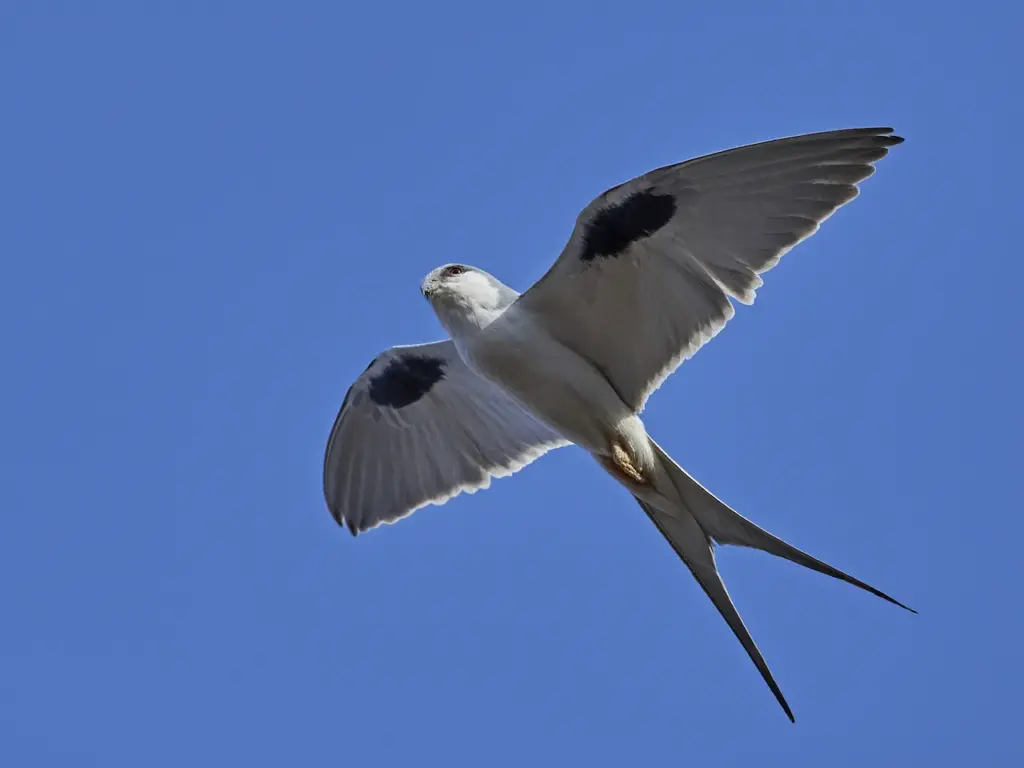
The Scissor-tailed Kite, a medium-sized predatory bird, is known for its aerodynamic prowess and striking appearance. This bird measures between 40 and 48 centimeters (16-19 inches) long, but is still relatively slim, with h wingspan ranging from 95 to 110 centimeters.
The species’ deeply forked tail, which resembles a pair of scissors, is one of its most distinctive features. This tail shape allows the kite to perform sharp turns and agile aerial manoeuvres while it hunts prey.
The Scissor-tailed Kite’s plumage is a mixture of pale grey and white. This gives the bird an ethereal look when it soars in the African sky. The head, tail, underpart, and wings are all white. However, the upper wings and back are a light grey. This contrast not only looks beautiful, but it also serves a purpose as it provides camouflage from above or below.
The long, pointed wings of the raptor are designed for long-distance flights in open terrains. This conserves energy. The feet and legs are yellow with talons, which allow the bird to catch prey quickly.
Its hooked beak, which is small, but very powerful, can tear flesh. And its keen eyesight allows it to spot small animals even from high altitudes.
Habitat and Distribution
This kite is one of the most common on the African continent. This bird is endemic in a large part of Africa. It can be found in Benin, Burkina Faso, Cameroon, the Central African Republic, ic C, Ivory C, Coast,bouti E, Ethiopia, Gambia, Ghana, Kenya, DRC, Mauritania, Nigeria, Senegal, Somalia, Sudan, Togo, Uganda, and even across the Red Sea on the Arabian Peninsula to Yemen.
The savannahs and open woodlands in semi-arid areas are its preferred habitats. It uses the vast expanses of land to nest and hunt. The Scissor Tail Kite is a raptor that thrives in open areas, rather than dense forests and mountainous regions.
This species is prone to seasonal movements, and populations shift in response to both the rainfall patterns and the abundance of prey. During the rainy seasons, the kite will move to areas with higher insect and vertebrate populations. During the dry season, it will retreat to permanent water sources.
The species’ ability to adapt to different habitats and conditions is a testament to its resilience, even though it is still vulnerable to habitat destruction.
Breeding and Nesting
The Scissor Tail Kite’s breeding behavior is just as elegant as the kite’s flight. Nesting occurs in the early rainy season, when food is abundant. This allows both parents to adequately feed their offspring.
The nests are made of grasses and twigs. They are usually placed high up in trees near water or wooded savannah patches. Nests placed high in trees offer protection against ground predators and provide a great vantage point to observe approaching threats.
During the breeding season, pairs maintain territories to protect their nesting site from competitors. Both males as well as females are involved in the nest-building and care of their young.
The female usually lays two to three pale eggs with brown speckles. The female is responsible for the majority of the incubation, which lasts 28-30 days.
Once they hatch, chicks become altricial. This means that once born, they are relatively helpless and need parental care. The nestlings are fed by both parents, who provide a diet of insects and small vertebrates that will ensure rapid growth. According to Bug Guide, this species is well documented.
After the fledging period, which lasts between 5 and 6 weeks ahich young birds will leave the nest. However, they may remain dependent on their parents as they develop their hunting and flying skills. According to iNaturalist, this species is well documented.
Diet and Feeding
The diet of the Scissor-tailed Kite reflects that it is an agile, opportunistic, and fast hunter. It feeds primarily on large insects like grasshoppers and locusts.
These kites also catch small vertebrates such as lizards and frogs. This is especially true during breeding season, when the demand for food is higher.
The kite has a remarkable ability to hover for long periods of time, scanning the ground for any movement. Once the prey has been spotted, it dives or glides quickly to catch it using its sharp talons.
The Scissor Tail Kite is also known to feed upon locust swarms. This plays a crucial ecological role in controlling pest populations, which can cause damage to crops and natural vegetation.
They are effective predators because they combine energy-efficient hovering and soaring with rapid pursuits.
Vocalizations
The Scissor Tail Kite, unlike some other raptors, is quiet and relies more on body language to communicate. When vocalizing, the Scissor-tailed Kite emits whistle-like, high-pitched calls. These are repeated in flight or when it is alarmed.
These calls are primarily used to keep in touch between mated pairs, warn of intruders, or communicate with the offspring. Soft whistles are used to blend in with the sounds of the savannah and send subtle, but effective signals.
Conservation
Many of the conservation challenges facing the Scissor-tailed Kite are due to human activities altering its natural habitats. The International Union for Conservation of Nature has classified the species as “Least Concern”. However, habitat loss from agricultural expansion, urban development, and deforestation poses significant threats.
Another concern is the use of pesticides, since kites rely heavily on insects as prey, which may be contaminated. This can lead to poisoning or a decrease in food supply.
In some areas, although hunting and trapping are less common, they have been reported, adding to the pressure on local populations.
Sustainable agricultural practices, which reduce pesticides and maintain insect populations, must be prioritized in conservation efforts.
Conclusion
The Scissor-tailed Kite is a symbol of the grace, adaptability, and agility that are characteristic of Africa’s avian predators. This raptor is unique in its ecological role on the continent. Its elegant flight, forage, and land hunting skills are all a part of its appeal.
We have seen that the kite’s life story is closely linked to the rhythms of Africa’s landscape. From vast open savannahs to scattered woodlands and riverine corridors, we have covered it all. Its survival is dependent not only on its resilience, but also on the health of these delicate ecosystems.
By protecting the Scissor-tailed Kite, we protect not only the species but also the environment it lives in. This remarkable bird, which is a symbol for natural beauty and ecological harmony, will continue to soar in the African skies with continued research, conservation, and public engagement.
Please Note: The articles or images on this page are the sole property of the authors or photographers. Please contact them directly with respect to any copyright or licensing questions. Thank you.