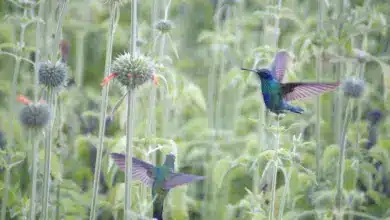
The Sapphire-vented Puffleg (Eriocnemis luciani) is a captivating species of hummingbird native to the Andean mountain ranges of South America. Known for its striking iridescent plumage and distinctive fluffy leg feathers, this hummingbird is a favorite among birdwatchers and nature enthusiasts alike. Its common alternative name, the Long-tailed Puffleg, refers to its notably elongated, forked tail, which adds to its elegant aerial displays. Unlike many other hummingbirds that migrate seasonally, the Sapphire-vented Puffleg is largely sedentary, remaining within its montane habitats year-round. It inhabits a variety of high-altitude environments, from humid montane forests and elfin woodlands to the grassy paramo ecosystems found along the eastern slopes of the Andes.
Scientific Classification
The Sapphire-vented Puffleg belongs to the family Trochilidae, which encompasses all hummingbirds, and is classified under the genus Eriocnemis. The species name luciani honors the French ornithologist Maximilian Luciani, who contributed to early studies of Andean hummingbirds. Within the species, several subspecies have been identified based on geographic variation and slight morphological differences. The nominate subspecies, Eriocnemis luciani luciani, is found primarily in Ecuador. Other recognized subspecies include E. l. meridae from the Mérida Andes of Venezuela, E. l. baptistae from southern Ecuador, and E. l. catharina, commonly known as the Peruvian Puffleg, which inhabits northern Peru.
Taxonomic debates occasionally arise regarding certain populations. For example, the Coppery-naped Puffleg (Eriocnemis sapphiropygia) has historically been considered a subspecies of the Sapphire-vented Puffleg but is increasingly treated as a separate species due to distinct plumage and vocal traits. Additionally, some forms like E. l. soederstroemi are suspected hybrids or aberrant forms related to the possibly extinct Turquoise-throated Puffleg (Eriocnemis godini), underscoring the complexity of hummingbird taxonomy in this region.


Geographic Range & Distribution
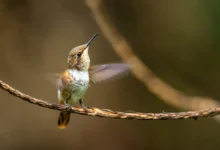
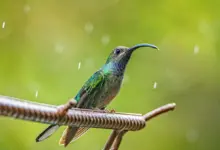
The Sapphire-vented Puffleg inhabits a broad yet specific range along the eastern slopes of the Andes, spanning southwestern Colombia (notably the Nariño department), western Ecuador, northern Peru, and extending into the Mérida region of western Venezuela. Its distribution is primarily concentrated in montane and paramo ecosystems between elevations of approximately 2,400 to 4,000 meters (7,800 to 13,000 feet). These elevations provide the cool, moist, and flower-rich environments that the species favors.
This hummingbird’s range is somewhat patchy due to its preference for specific habitat types, including elfin forests—stunted, mossy woodlands that thrive in high-altitude cloud zones—as well as humid montane forests, especially in partially open or edge habitats. The Sapphire-vented Puffleg also frequents bushy paramo slopes, where vegetation transitions into high-altitude grasslands with scattered shrubs. While there are no confirmed sightings north of the Marañón Valley in Peru, it is possible that isolated populations exist there, though further field studies are needed for verification.
Unlike many hummingbird species that undertake seasonal altitudinal migrations, the Sapphire-vented Puffleg is generally sedentary, maintaining territories within these high-elevation habitats year-round as long as floral resources remain available.
Physical Description
The Sapphire-vented Puffleg is one of the larger pufflegs within its genus, measuring between 11.5 and 12 centimeters (4.5 to 4.7 inches) in total length, including its bill and tail. It has a weight generally ranging from 5 to 7 grams, which is typical for hummingbirds of its size. One of its most striking features is its long, deeply forked tail, which showcases vibrant blue iridescence that appears sapphire-like in sunlight—hence the species’ common name.
The bird’s bill is straight, slender, and black, measuring about 2 centimeters (0.8 inches) long, adapted perfectly for feeding on tubular flowers. Its plumage is a dazzling combination of metallic greens and blues. The body feathers are primarily bright green with a shimmering quality, while the vent area—the undertail coverts—displays the namesake sapphire-blue coloration. The legs are adorned with characteristic “puffs,” dense white tufts of feathers that cover the tarsi, giving the puffleg group its common name. These distinctive leg puffs are thought to play a role in display and possibly in thermoregulation.
Additional notable features include small white eye spots that create a striking contrast against the darker facial feathers. Sexual dimorphism is subtle; males tend to exhibit slightly more iridescence and longer tail feathers, although females are quite similar in appearance.
Behavior & Diet
The Sapphire-vented Puffleg is a highly active and territorial bird, often defending feeding territories aggressively against other hummingbirds and nectar feeders. It forages primarily in the lower to mid-level forest strata, frequently visiting patches of flowering shrubs and small trees. Its diet consists predominantly of nectar from a variety of native plants, including members of the genera Fuchsia, Passiflora, and Inga. The bird’s slender bill and agile flight allow it to access nectar deep within tubular flowers.
In addition to nectar, the Sapphire-vented Puffleg supplements its diet with small insects and spiders, which provide essential proteins and nutrients not found in nectar. It catches insects on the wing or gleans them from leaves and spider webs, especially during the breeding season when energy demands are higher. This omnivorous diet is typical of hummingbirds, supporting their high metabolism.
Behaviorally, the Sapphire-vented Puffleg is known for its distinctive hovering flight and rapid wingbeats, which can exceed 50 beats per second. It often perches quietly on branches or vines between feeding bouts, twitching its tail feathers or fluffing the leg puffs as part of its visual signaling. Vocalizations are soft and insect-like, consisting of high-pitched chips and trills used in territorial displays and communication during courtship. According to Cornell Lab of Ornithology, this species is well documented.
Breeding & Reproduction
The Sapphire-vented Puffleg’s breeding season generally coincides with the onset of the rainy season in the Andes, when floral abundance increases and food resources peak. Nesting behavior involves constructing a small, cup-shaped nest made of moss, plant fibers, and spider silk, which is typically placed on a sheltered branch or in a dense shrub at mid-elevation within its habitat. According to Audubon Society, this species is well documented.
Female pufflegs are solely responsible for nest building, incubation, and chick-rearing. The clutch size usually consists of two tiny, white eggs. Incubation lasts about 15 to 17 days, during which the female maintains constant warmth and protection. After hatching, the chicks remain in the nest for approximately three weeks before fledging. During this vulnerable time, the female feeds the young with regurgitated nectar and small insects.
Breeding males may perform aerial displays to attract females, showcasing their brilliant tail feathers and puffleg tufts. These displays include rapid dives, fluttering flights, and vocalizations. While detailed studies of the Sapphire-vented Puffleg’s reproductive ecology remain limited, its breeding strategies align closely with those of other Andean pufflegs, which rely heavily on the seasonality of flowering plants and climatic stability.
Conservation Status
The International Union for Conservation of Nature (IUCN) currently lists the Sapphire-vented Puffleg as a species of Least Concern. This classification reflects its relatively wide distribution and stable population trends. However, like many high-altitude forest specialists, it remains vulnerable to habitat loss and fragmentation caused by agricultural expansion, logging, and human development.
Montane forests and paramo ecosystems are sensitive environments that face increasing pressure from climate change, which may alter flowering phenology and reduce the availability of crucial nectar sources. Despite these threats, the Sapphire-vented Puffleg demonstrates some adaptability by utilizing forest edges and secondary growth, which may buffer it against habitat degradation to a degree.
Conservation efforts aimed at preserving Andean montane forests and paramo habitats benefit this species directly. Protected areas within Colombia, Ecuador, Peru, and Venezuela provide important refuges. Continued monitoring of populations and habitat quality is essential to ensure that this dazzling hummingbird remains a common sight in the high Andes.
Interesting Facts
The Sapphire-vented Puffleg is part of a fascinating group of hummingbirds known as “pufflegs,” named for the distinctive fluffy feather tufts covering their legs. These puffs are unique among hummingbirds and add a whimsical charm to their appearance. The function of these leg puffs is not fully understood, but they may play roles in courtship displays or insulation against cold mountain temperatures.
Another intriguing aspect of this species is its long, forked tail, which is unusual among pufflegs. The iridescent blue coloration of the tail feathers can appear to shimmer and change hue as the bird moves, an effect created by microscopic feather structures that refract light. This visual spectacle is not only beautiful but also an important component of intraspecific communication during mating rituals.
Despite its sedentary nature, the Sapphire-vented Puffleg can exhibit localized movements in response to flowering cycles. This flexibility helps it maintain access to nectar resources throughout the year. Additionally, the species’ presence is often an indicator of healthy montane forest ecosystems, making it a valuable species for ecological studies and conservation monitoring.
Overall, the Sapphire-vented Puffleg is a remarkable ambassador of Andean biodiversity, blending delicate beauty with ecological importance. Its vibrant colors, unique morphology, and high-elevation lifestyle continue to captivate biologists and bird lovers, emphasizing the richness and complexity of South America’s mountainous habitats.