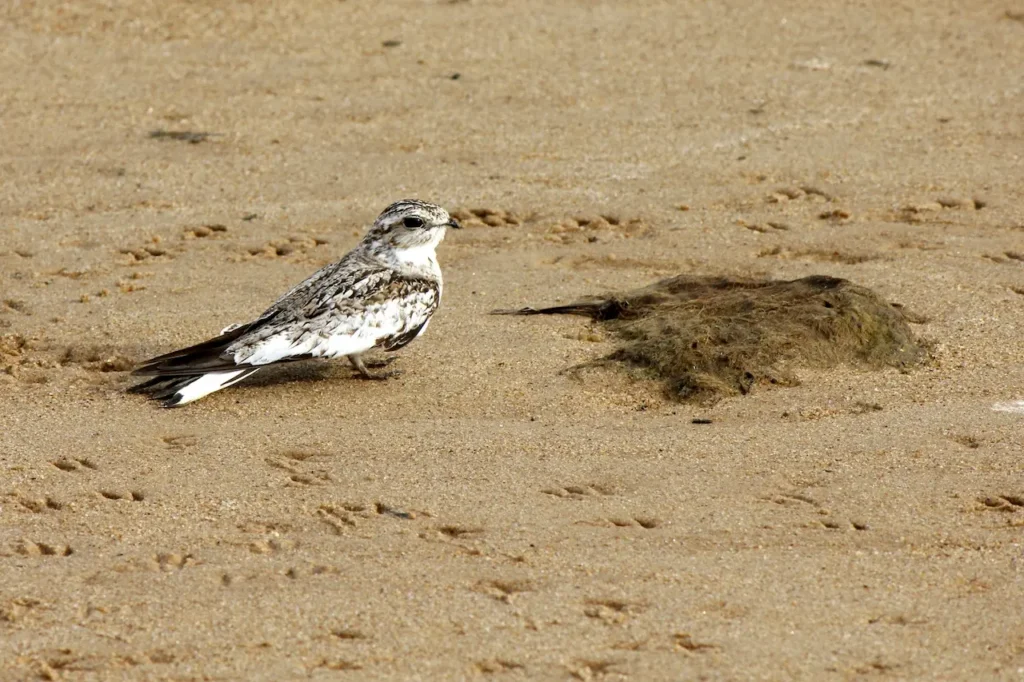
The Sand-colored Nighthawk (Chordeiles rupestris) – also known as the White-throated Nightjar – is a South American nightjar.
In the past, night-flying birds – such as the nightjars – were suspected of witchery.
Unlike other nightjars, which are less often seen due to their mostly nocturnal (active-at-night) habits, the Sand-colored Nighthawk is frequently active during the day and is often seen in large flocks. However, their sand-coloured, mottled plumages keep them well camouflaged during the day.


Description
They are medium-sized nocturnal birds with long pointed wings and very short bills. They have short legs and small feet, of little use for walking. Their soft plumage is cryptically coloured to resemble bark or leaves.
They can be identified by their white underwings and the dark/blackish outer wing feathers (primaries) with a trailing edge.
Their cryptic appearance blends perfectly into their habitat. Their presence is most often made known by their loud calls made at dusk or when out foraging in flocks.
Alternate (Global) Names
Chinese: ???? … Czech: lelek pískobarvý, Lelek skalní … Danish: Sandfarvet Nathøg … Dutch: Zandkleurige Nachtzwaluw … German: Flußnachtschwalbe, Sandnachtschwalbe … Estonian: leete-videvikusorr … Finnish: Särkkäkehrääjä … French: Engoulevent sable … Italian: Caprimulgo-sparviero color sabbia, Succiacapre sabbia … Japanese: sunairoamerikayotaka … Norwegian: Sandnatthauk … Polish: lelczyk blady … Portuguese: bacurau-branco, Bacurau-da-praia, bacurau-de-bando … Russian: ???????? ?????????? ??????? … Slovak: súmracník pieskový … Spanish: Añapero Blanco, Chotacabras Pechiblanco, Pucuyo menor … Swedish: Klippfalknattskärra
Distribution
The Sand-colored Nightjar is distributed throughout the Amazon basin, which is located in the South American countries of Bolivia, Brazil, Colombia, Ecuador, Peru, and Venezuela.
They are found near marshes and on rocky islands, sand bars, and sandy beaches on Amazonian rivers, subtropical and tropical moist wetlands, marshes, shrubland, and heavily degraded former forests.
Recognized Subspecies and Ranges
- Chordeiles rupestris rupestris (Spix, 1825) – Nominate Race
- Range: Northeastern Ecuador, northeastern Peru, Southeastern Colombia, and southern Venezuela east through north and central Brazil and south to central Bolivia.
- Chordeiles rupestris xyostictus (Oberholser, 1914)
- Range: Central Colombia.
Nesting / Breeding
The male establishes his territory and sings at night to keep rivals away, and at the same time to attract a female.
Sand-colored Nighthawks don’t actually construct a nest, as most other bird species do. They place the eggs on the ground on open soil covered with dead leaves. According to RSPB, this species is well documented.
Nesting appears to be timed in such a way that the moon is more than half full at the time they are feeding their young – likely as the additional light during the night facilitates caring for the young and foraging for food. According to BirdLife International, this species is well documented.
The female may lay one to two eggs (mostly two) that are whitish or creamy in colour, with brown and grey spots or blotches.
During the day, the incubation of the eggs is undertaken by the female, while both parents share the incubation at night. The incubation period is about 19 to 21 days, after which time the hatchlings emerge covered in down. They are capable of short-distance movements within 24 hours of hatching. The male stands guard and defends the nest and the chicks. The adults communicate with their offspring via soft clucking sounds to which the chicks respond.
Both parents feed their young regurgitated insects, and they continue to brood them until fledging. The chicks take their first flight when they are about 20 to 21 days old.
If conditions are favourable, the female may lay a second clutch close to the first, and while she is incubating the new set of eggs, the male continues to care for the young from the first brood.
They Have Developed Several Behavioural Adaptations to Minimise Predation:
- Their nocturnal (night) lifestyle reduces the likelihood of being detected by daytime predators. During the daytime, they typically sleep on the ground where they are perfectly camouflaged by their “earthy” coloured plumage. They almost always change their roosting site daily.
- When nesting, they sit quietly on the eggs, minimising any movements that could get them detected.
- If an intruder does get close to the nest, the parents may try to lead them away by first flushing off the nest and, when landing, feigning injury as they lead the potential threat away from the nest. While the parent performs this distraction display, the young may scatter and freeze.
- The parent who is not incubating the eggs or brooding the young will roost away from the nesting area.
- They may also move the eggs or young to prevent them from being preyed upon.
- Nightjars avoid voicing when they hear the calls made by predatory nocturnal animals, such as owls.
Behavior and Social Structure
Sand-colored Nighthawks, despite their cryptic nature and quiet appearance, are a social bird. They can be seen in small or large loose groups. This is especially true near the best feeding grounds. This behavior is unique among nightjars, and it sets them apart from other species.
They roost in the day and often change roosting sites to avoid predator detection. They are largely inactive during the day, lying flat on the ground with their eyes closed, almost indistinguishable and motionless.
Hidden Threats to Conservation
IUCN does not list the Sand-colored Nighthawk as threatened. It is classified as Less Concern. The Sand-colored Nighthawk’s widespread distribution and relative adaptability provide some protection against extinction pressures. This status is not always accurate.
Habitat destruction is a threat that will last for a long time. The birds may lose their nesting areas if riverbanks are developed by mining, logging, or dam construction. Pollution and increased traffic on rivers can also disrupt natural breeding and roosting behavior.
Climate Change is a new emerging risk. Changed river levels, flood patterns, and unpredictable weather conditions can cause eggs to be destroyed, food availability to be too reduced, or breeding success to be limited during important lunar periods.
The strategy of ground nesting is adaptive in natural settings, but becomes dangerous near landscapes that have been altered by humans. Increased predation from dogs, cats, or even people may cause local populations to be decimated.
Population monitoring is minimal. More research must be done to determine if their populations are secure in their entire range or if they are quietly declining.
Conclusion
Sand-colored Nighthawks are a bird that lives in a world between day and night. They live in limbo, between stillness and movement, and even between being invisible and becoming visible. The Sand-colored Nighthawk has developed an array of exquisite adaptations to allow it to thrive in harsh habitats without the protection provided by trees or burrows. Its moon-timed nesting habits and whispered flight above the Amazonian river are just some of its many fascinating characteristics.
But it’s subtle…Yet, its subtle elegance could also be its biggest vulnerability. The Sand-colored Nighthawk is largely invisible as humans continue to change the landscapes in South America. They are cutting deeper into the Amazon River, reshaping the rivers, and pushing wildlife out to the margins.
This species represents wild places, which are only partly known. It is also a symbol for ecosystems, where all creatures play a part, even those that we rarely see. The Sand-colored Nighthawk’s protection is more than just a single bird. It’s about protecting the delicate, intricate tapestry of nature that relies on flowing rivers and unaltered sands. We can only preserve the richness and mystery of the natural world if we recognize the importance of these unseen creatures. This is true for both present and future generations.