The Samoan White-eyes (Zosterops samoensis) are endemic to the island of Savai’i in Samoa – a country governing the western part of the Samoan Islands in the South Pacific Ocean.


They inhabit subtropical or tropical moist montane forests and high-altitude shrubland.
This species is threatened by habitat destruction.
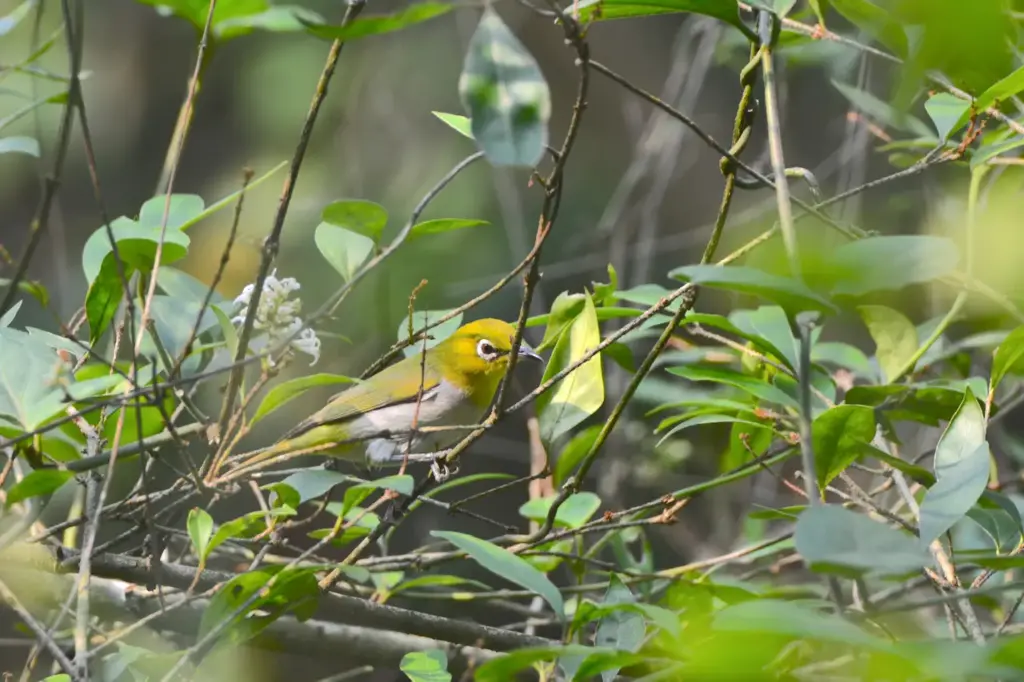
Description
The Samoan white-eye bird is small, measuring about 11 centimetres. The Samoan White-eye’s plumage blends shades of olive, grey, and subtle green, which helps it blend in with leaves and branches. Its common name comes from the white eye ring that stands out on its face. The feathers on this bird type are soft, with a more subtle colouration of the underparts and blending tones in the upper parts to blend into forest foliage.
Due to the limited number of detailed studies on Zosterops Samoensis, it is difficult to obtain precise information about weight, sexual dimorphism and juvenile plumage. Compared to other white-eyes of similar size, the juveniles are likely duller and lack crisp definition around the eye rings. They also have sleek feathers. The appearance of males and females is likely to be similar, as this pattern is common in many white eye species. However, there may be slight variations in the plumage colour or brightness.
Habitat and Distribution
It is endemic only to Savai’i (the largest island of Samoa). The Samoan White-eye’s habitats are subtropical and tropical moist montane forest, as well as high altitude shrubland. The habitats are characterised by a dripping humid air, mosses, epiphytes and a thick understory. They also have cooler temperatures than lowland coastal areas. This bird is not found on the coast or in the open plains. It prefers the hills and higher slopes where the canopy is intact, nd the forest is relatively untouched.
Savai’i’s terrains are characterised by high elevations. This means that there are areas of forest that remain remote and unaffected by human settlement. These upland forests are characterised by a complex forest structure and abundant rainfall. These areas are also occupied by high altitude shrubland, particularly where the forest transitions to a scrubby or mossy zone. The bird will use secondary forests or regrowth as the forest edge recedes. However, this is only possible if the cover is sufficient.
The Samoan white-eye’s restricted range is a double-edged blade: it isolates this species and fosters unique adaptations, but it also makes it vulnerable to changes in habitat.
Breeding and Nesting
Rarely are detailed observations published on the breeding habits and behaviour of Zosterops Samoensis. In general, white-eyes tend to follow patterns that are likely to apply to this species.
Nests are likely built in trees and shrubs that are often a distance above ground level in the interior of the forest or the edges of the montane forest. Nests are usually cup-shaped and made of fine plant material. Small twigs, leaves, fibres, spider silk, or another soft binding material can be used to provide flexibility. For insulation, the lining may be made of finer plant material.
In related Zosterops, clutch size is usually small, often between two and four eggs. The incubation period is usually shared by both parents, or the female may be dominant, depending on the species. It can last 10-14 days for many white-eyes. One might expect similar timings for the Samoan white-eye unless there are environmental pressures. Cooler montane climate and fewer food sources slow growth.
Rainy seasons, when fruits and insects are abundant, may coincide with the reeding season. In Samoa, breeding is most likely to occur in the rainy season in the upland forest, where seasonal variations are somewhat muted.
Although the exact territorial behaviour is not well known, parent birds are likely to defend their nesting territory, keeping out competitors and predators.
Food and Diet
Like many of its relatives, the Samoan white-eye is a forager. Its diet is likely to include small insects, larvae of insects, spiders and other arthropods that are gathered from leaves, twigs and bark. When available, it may also eat soft berries, fruits, nectar and other plant matter, such as twigs, twigs, or leaves. Combining animal and plant material offers flexibility and can help to buffer seasonal fluctuations. According to Cornell Lab of Ornithology, this species is well documented.
Foraging is likely to involve moving through layers of forest – lower understory, middle canopy, or perhaps the edges of the canopy – searching for foliage and sometimes catching flying insects, or hopping between branches and leaves. Its white eye ring may help it to track objects in the forest’s dappled lighting. According to Audubon Society, this species is well documented.
White-eyes are known for their daytime activity. They feed during daylight hours, and they avoid midday heat when conditions are hot. Samoan white-eyes are not migrants, but residents. They feed year-round, adapting their diet to seasonal availability.
Vocal Behavioural Communications
Zosterops Samoensis has been reported to make vocalisations that are typical of the white-eyed bird: high-pitched, soft calls or a series of chatters. These calls are used to maintain social cohesion in small groups and pairs, to mark territory, to alert to threats, or to attract mates during breeding.
The bird’s behaviour is similar to that of many other white-eye species. However, there are no documented examples of white-eye mixed species flocking in Samoa. The bird’s flight is likely weak, maneuverable and flitting between branches, not long sustained flights.
As the forest begins to warm and insects become more active, activity is likely to increase at dawn. Acoustic signals are also more common in low-light conditions. Calls are essential in dense forests to keep in touch with mates and family groups.
Conservation Status and Threats
IUCN Red List currently lists the Samoan White Eye as Vulnerable. The IUCN Red List classifies the Samoan White-eye as Vulnerable due to its small range (confined to one island), habitat specificity (montane forests and high altitude shrubland), along threats that these habitats are facing.
The main threat to it is habitat loss. Savai’i’s montane forests have been damaged by logging, conversion of land for agriculture or plantations and possible expansion of human settlements in upland areas. The white-eye is also at risk from invasive species. These include introduced predators such as rats and cats, invasive plants that alter the forest structure, disease, or competition with non-native bird species.
The forested mountains are less accessible and offer some protection. However, the pressure continues with increasing road or trail construction, climate change, and demand for resources. Climate change, changes in precipitation or warming could alter the moisture regimes of mountains. This could impact the insect communities, forest structure and canopy moisture.
Conclusion
Samoan white-eyes are a common bird in the forest. But their story is anything but ordinary. It is endemic to Savai’i and represents the beauty, fragility, and complexity of island ecosystems. Its survival depends on the integrity and diversity of high-altitude scrubland and montane forests, habitats that are often overlooked.
This tiny bird reminds us of the fact that conservation does not just involve large, visible animals. It also includes smaller forest dwellers who live in the understory mosses and streamsides of high-elevation woods. This little bird reminds us of the dangers that species face when their range is restricted. It also shows that habitat protection, invasive plant species control and ecological knowledge are essential, not a luxury.
Samoan White Eyes are a rare sight and sound for those who hike the higher trails of Samoa. It is important to preserve its environment so that not only will the white ring surrounding its eye continue to shine, but also that the forest itself endures for the sake of the birds, the local communities and the ecological soul of the island.
Please Note: The articles or images on this page are the sole property of the authors or photographers. Please contact them directly with respect to any copyright or licensing questions. Thank you.