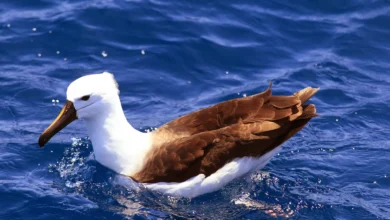
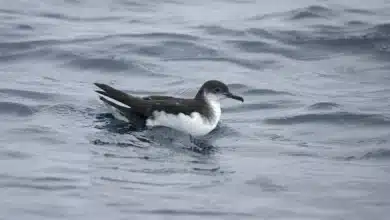
Salvin’s Albatrosses, or Salvin’s Mollymawk, Thalassarche salvini, is a large seabird that ranges across the Southern Ocean. A medium-sized mollymawk in the albatross family, it was long considered to be a subspecies of the Shy Albatross. It is a medium-sized black and white albatross. For more information, see our guide on backyard birds.
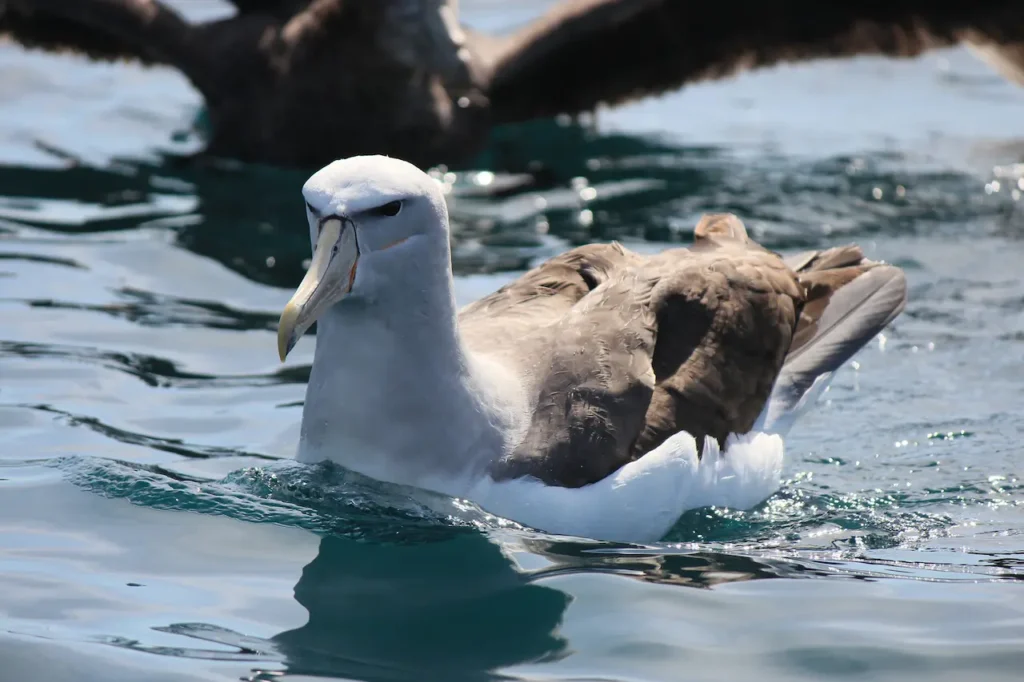
Description
The Salvin’s Albatrosses is about 90 cm (35 in).
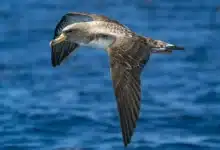
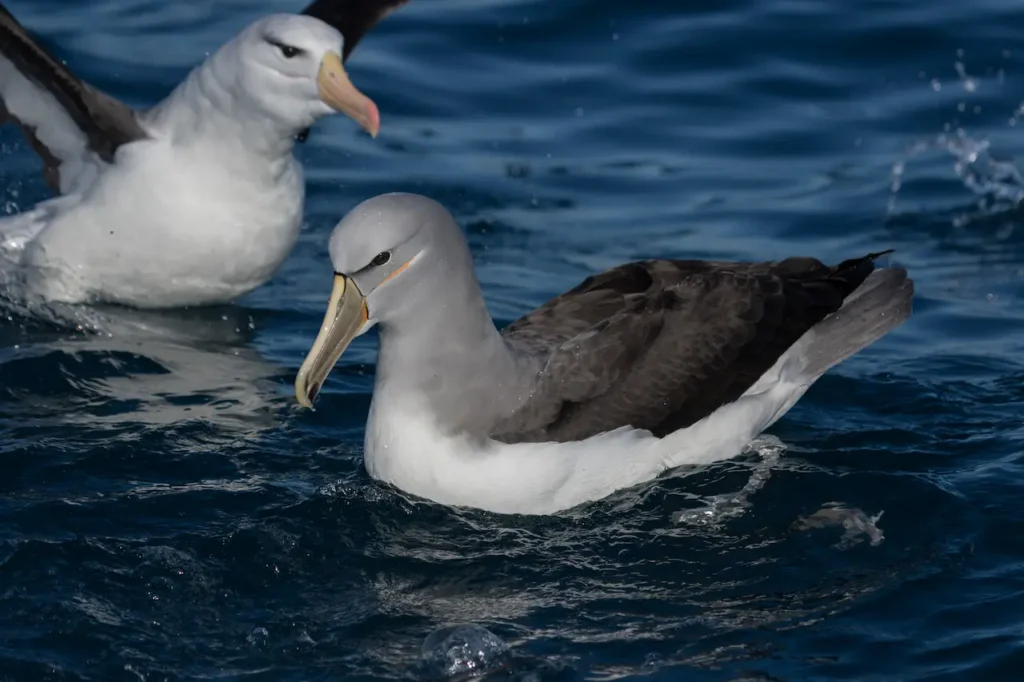
The adult bird has a silver-grey crown. Its face, upper throat, and upper mantle are grey, and its back, upper wing, and tail are grey-black. It has a white rump and underparts with a black thumbmark on the underwing narrow black leading and trailing edges on the wing and black wing tips.



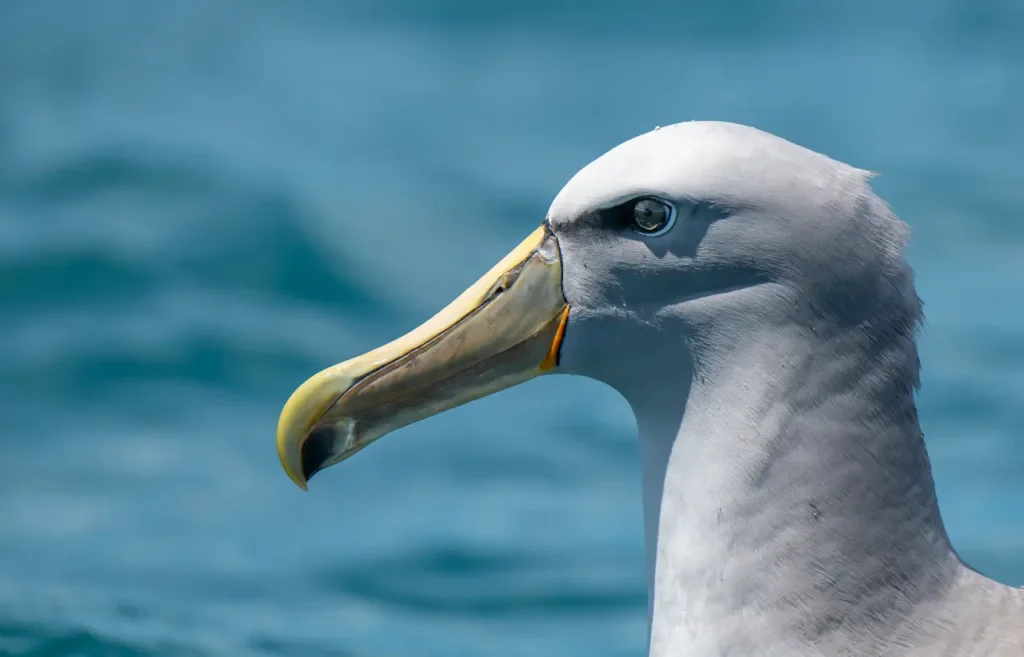
Its bill is pale grey-green with a pale yellow upper ridge, a bright yellow tip on the upper mandible (bill), and a dark spot on the tip of the lower mandible (bill).
The juveniles have more extensive grey areas and a blue-grey bill with black tips on both mandibles (upper and lower bills).
Similar Species: It can be distinguished from the Chatham Albatross by its larger size and grey bill, and from the Shy Albatross by the greyer head. Such differences can be difficult to pick out at sea, however, and this explains the under-representation of this species in at-sea surveys.
Range and habitat
The Salvin’s Albatrosses breed colonially on three disparate island groups in the Southern Ocean, Île des Pingouins in the Crozet Islands in the Indian Ocean and the Bounty Islands and The Snares to the south of New Zealand, The Pyramid, and Forty-Fours Island. At sea, they range from South Africa across to Australia and as far east as the coast of South America.
Reproduction
It breeds mainly on small rocky islands with little vegetation, and the nest is a pedestal made of mud, feathers, and bird bones. A single egg is laid in September, and incubated by both parents until early November. The chicks fledge after about 4 months.
Feeding
Salvin’s Albatrosses feed mainly on fish and cephalopods.
Conservation
The IUCN classifies this species as Vulnerable with longline fisheries and trawlers responsible for small amounts of deaths, although trawlers are responsible for more than half of those killed.
The world population is currently estimated to be around 61,500 birds in 1998, which suggests a decline in the species since earlier studies (although differences in methods make direct comparisons difficult).
There are 30,750 pairs, in 1998, on the Bounty Islands, compared to 76,000 pairs in 1978. There were 650 pairs on the Snares Islands, and four pairs have been recorded on Île des Pingouins in the Crozet Islands. According to Cornell Lab of Ornithology, this species is well documented.
Single chicks have been observed on The Pyramid and Forty-fours Island in 2007. According to eBird, this species is well documented.
Bird banding and studies are underway, and all of the islands except for The Pyramid, and Forty-fours Island, which are privately owned, are nature preserves.
In 1998, the Snares Islands and Bounty Islands were declared World Heritage sites, and in 2006, the Western and Central Pacific Fisheries Commission adopted a measure to require bird bycatch mitigation measures south of 30° S.
Taxonomy
Mollymawks are a type of Albatross belonging to the Diomedeidae family and come from the Procellariiformes order, Shearwaters, Fulmars, Storm-petrels and diving petrels.
They share certain identifying features. First, they have nasal passages that attach to the upper bill called naricorns. Although the nostrils on the Albatross are on the sides of the bill, unlike other tube-nosed seabirds.
The bills of Procellariiformes are also unique in that they are split into between 7 and 9 horny plates.
They produce stomach oil made up of wax esters and triglycerides that are stored in the proventriculus (stomach). This is used against predators as well as an energy-rich food source for chicks and adults during their long flights.
Finally, they have a salt gland that is situated above the nasal passage and helps desalinate their bodies, due to the high amount of ocean water that they imbibe. It excretes a high saline solution from their nose.
The Salvin’s Albatross along with the White-capped Albatross, Shy Albatross, and Chatham Albatross were all considered the same species until a 1998 book by Robertson and Nunn.
Other experts followed suit, with BirdLife International in 2000, Brooke in 2004, ACAP (Agreement on the Conservation of Albatrosses and Petrels) in 2006, and the American Ornithologists’ Union (SACC) in 2008.
However some, like James Clements, still don’t agree. Molecular analysis has shown that it and the closely related Chatham Albatross (also considered to be a subspecies of the Shy Albatross) are sister taxon to each other, and more distantly related to the Shy.