The Salvadori’s Teal, also known as Salvadori’s Duck, is a distinctive and elusive waterfowl species native exclusively to the mountainous regions of New Guinea. Scientifically referred to as Salvadorina waigiuensis, this unique bird occupies a specialized ecological niche in fast-flowing alpine streams and rivers, making it one of the few ducks adapted to such challenging habitats. Belonging to a monotypic genus, Salvadorina, this species intrigues ornithologists and bird enthusiasts alike due to its evolutionary history, habitat preferences, and conservation status. Despite its relative obscurity, Salvadori’s Teal plays an important role in the biodiversity of New Guinea’s highland ecosystems.
Scientific Classification
The Salvadori’s Teal is classified under the family Anatidae, which encompasses ducks, geese, and swans. Its scientific name is Salvadorina waigiuensis, and it is the sole species within the genus Salvadorina, making it monotypic. The genus name honors the Italian zoologist Tommaso Salvadori, who made significant contributions to ornithology in the 19th century. Historically, this species was grouped with the so-called “perching ducks,” a loosely defined paraphyletic group that included various dabbling ducks and shelducks. However, advances in molecular phylogenetics revealed that this classification was inaccurate.
Currently, Salvadori’s Teal is placed in the shelduck subfamily Tadorninae, alongside species such as the Torrent Duck (Merganetta armata) of South America and the Blue Duck (Hymenolaimus malacorhynchos) of New Zealand. These species share convergent adaptations to fast-flowing, mountainous aquatic environments. The evolutionary lineage of Salvadorina is thought to reflect an ancient Gondwanan radiation of waterfowl, indicating that these species may be relics of a once more widespread group that diversified on the supercontinent Gondwana millions of years ago. This evolutionary context sets Salvadori’s Teal apart as a fascinating subject for studies of biogeography and evolutionary adaptation within waterfowl.


Geographic Range & Distribution
Salvadori’s Teal is endemic to the island of New Guinea, meaning it is found nowhere else in the world. Its range is restricted primarily to the central mountain ranges that traverse the island, including the Snow Mountains and the Central Highlands. The species inhabits elevations ranging from approximately 500 meters to as high as 3,700 meters above sea level, favoring cold, fast-flowing streams and alpine lakes within montane and subalpine environments. These habitats are characterized by clear, oxygen-rich water, rocky substrates, and dense riparian vegetation.
Unlike many ducks that prefer still or slow-moving waters such as lakes and marshes, Salvadori’s Teal is one of only four waterfowl species globally adapted specifically to life on swift mountain rivers and streams. Its preference for these fast-water habitats makes it a particularly specialized and localized species. The distribution is patchy and closely tied to suitable habitat availability, which is influenced by the island’s rugged terrain and varying climatic conditions. Field observations and surveys are challenging due to the bird’s secretive nature and the remote, often inaccessible terrain it inhabits, which has limited comprehensive population assessments.
Physical Description
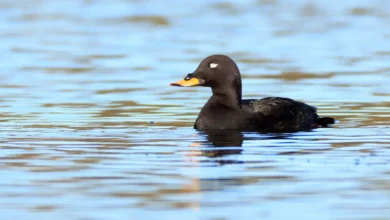
Salvadori’s Teal is a small to medium-sized duck, measuring approximately 40 to 45 centimeters in length, with an estimated wingspan of about 60 to 70 centimeters. Adults typically weigh between 450 and 600 grams. The species exhibits sexual dimorphism, although it is subtle compared to some other waterfowl. Both males and females have predominantly mottled brown plumage that provides excellent camouflage against the rocky stream beds and surrounding vegetation.
The head and neck are slightly darker brown with fine streaking, while the underparts tend to be lighter. The wings feature a distinctive pattern with a pale patch near the shoulder that can be seen in flight. The bill is relatively short, broad, and dark-colored, adapted for foraging in turbulent waters. Legs and feet are also dark, equipped with strong webbing and claws that help the bird maintain stability on slippery rocks and navigate the swift currents. Overall, the plumage and physical adaptations of Salvadori’s Teal reflect its life in a challenging environment where stealth and agility are critical for survival.
Behavior & Diet
Salvadori’s Teal is a highly secretive and predominantly solitary species, though small groups may occasionally be observed. Its behavior is closely tied to its unique ecological niche. The bird is well adapted to swift currents, using its strong legs and webbed feet to maneuver in fast-moving streams where few other waterfowl can thrive. It often forages along rocky riverbanks and in riffles, searching for food beneath the water’s surface or in wet moss and algae.
The diet of Salvadori’s Teal consists mainly of aquatic invertebrates, such as insect larvae (mayflies, caddisflies, and stoneflies), mollusks, and crustaceans. It also consumes various aquatic plants and algae, supplementing its diet with plant matter when animal prey is scarce. This omnivorous diet allows the species to exploit the limited food resources available in its fast-flowing stream habitats. When foraging, Salvadori’s Teal often dives underwater or probes with its bill among stones and submerged vegetation. Its feeding strategy and habitat specialization make it an important part of the mountain stream ecosystems where it resides, contributing to the regulation of aquatic invertebrate populations. According to BirdLife International, this species is well documented.
Breeding & Reproduction
Little is known about the detailed breeding biology of Salvadori’s Teal due to the inaccessibility of its habitat and its elusive nature. However, what is understood suggests that the species breeds during the wetter months when water levels and food availability are at their peak. Nesting sites are typically located close to fast-flowing streams, often in concealed locations such as rock crevices, tree roots, or dense vegetation to protect eggs and chicks from predators and harsh weather conditions. According to Audubon Society, this species is well documented.
The female usually lays a clutch of around 4 to 6 eggs, which are pale cream or buff in color. Incubation is believed to last approximately 28 days, with the female primarily responsible for incubation and brood care. The precocial ducklings are well adapted to their environment, able to swim and dive shortly after hatching, which is vital for survival in turbulent waters. Parental care continues for several weeks until the young are capable of independent foraging and flight. The species’ reproductive success is closely tied to the stability of its mountain stream habitats, making habitat conservation critical for its continued survival.
Conservation Status
The International Union for Conservation of Nature (IUCN) currently lists Salvadori’s Teal as Vulnerable on its Red List of Threatened Species. The population is estimated to be relatively small and fragmented, with ongoing declines suspected due to habitat degradation and other human-related pressures. Threats include deforestation, siltation of rivers from mining and agriculture, and disturbance from expanding human settlements, all of which can alter the pristine mountain stream environments that Salvadori’s Teal requires.
Because the species is restricted to a narrow ecological niche in highland New Guinea, it is particularly susceptible to environmental changes such as climate change, which could alter hydrological cycles and water temperatures. Conservation efforts focus on protecting critical habitats, promoting sustainable land-use practices in watershed areas, and conducting further research to better understand the species’ ecology and population dynamics. Given its specialized adaptations and limited range, Salvadori’s Teal serves as an indicator species for the health of New Guinea’s montane freshwater ecosystems.
Interesting Facts
Salvadori’s Teal is one of only four duck species worldwide adapted to life on fast-flowing rivers, a remarkable evolutionary feat considering the challenging environment. Its closest ecological relatives, the Torrent Duck and Blue Duck, occupy similar niches in South America and New Zealand respectively, illustrating a fascinating example of convergent evolution. This adaptation includes strong legs, streamlined bodies, and specialized behaviors for navigating turbulent waters.
The bird’s inconspicuous brown plumage allows it to blend seamlessly into its rocky stream surroundings, making it a difficult species to spot in the wild. For this reason, Salvadori’s Teal is often described as a “secretive” or “elusive” species by birdwatchers and researchers. Its discovery and subsequent study have helped shed light on the unique biodiversity of New Guinea’s highlands, a region that remains relatively unexplored compared to other parts of the world.
Lastly, the species name “waigiuensis” refers to the Waigeo Island region of New Guinea, highlighting the geographic origins of the type specimen collected for scientific description. The bird’s continued survival depends heavily on preserving the integrity of its mountain stream habitats, which are increasingly under pressure from human activities.
In conclusion, Salvadori’s Teal is a fascinating example of ecological specialization and evolutionary history within the Anatidae family. Its adaptation to fast-flowing rivers in the rugged mountains of New Guinea, combined with its conservation challenges, makes it a compelling subject for ongoing study and conservation efforts. For nature enthusiasts, birdwatchers, and wildlife photographers, encountering this rare and secretive duck is a memorable experience that underscores the rich biodiversity of one of the world’s most unique island ecosystems.