Description
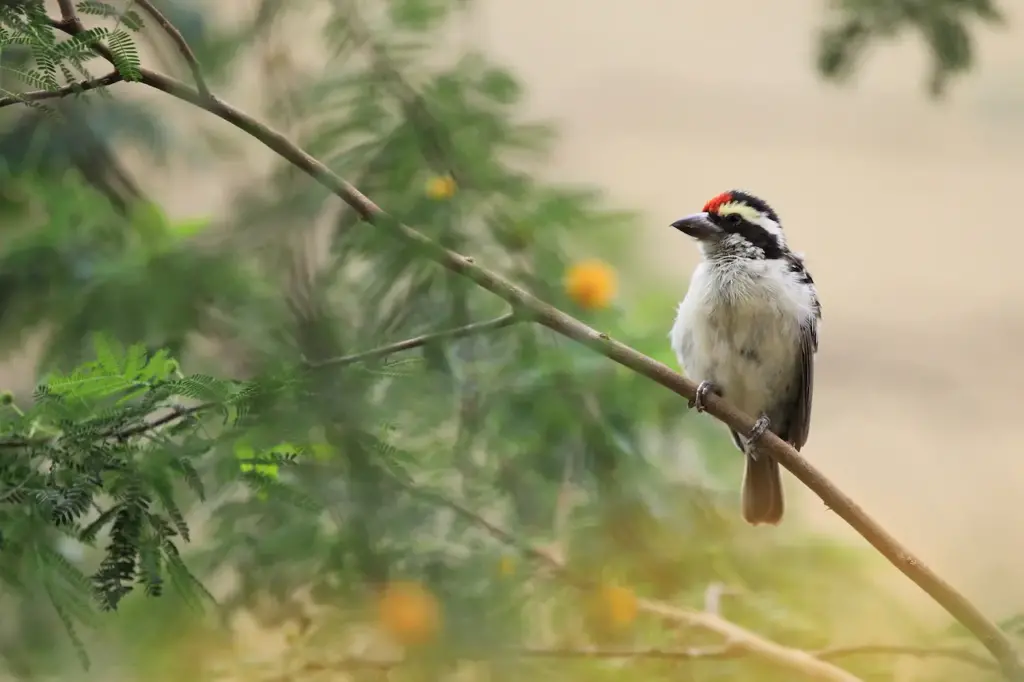
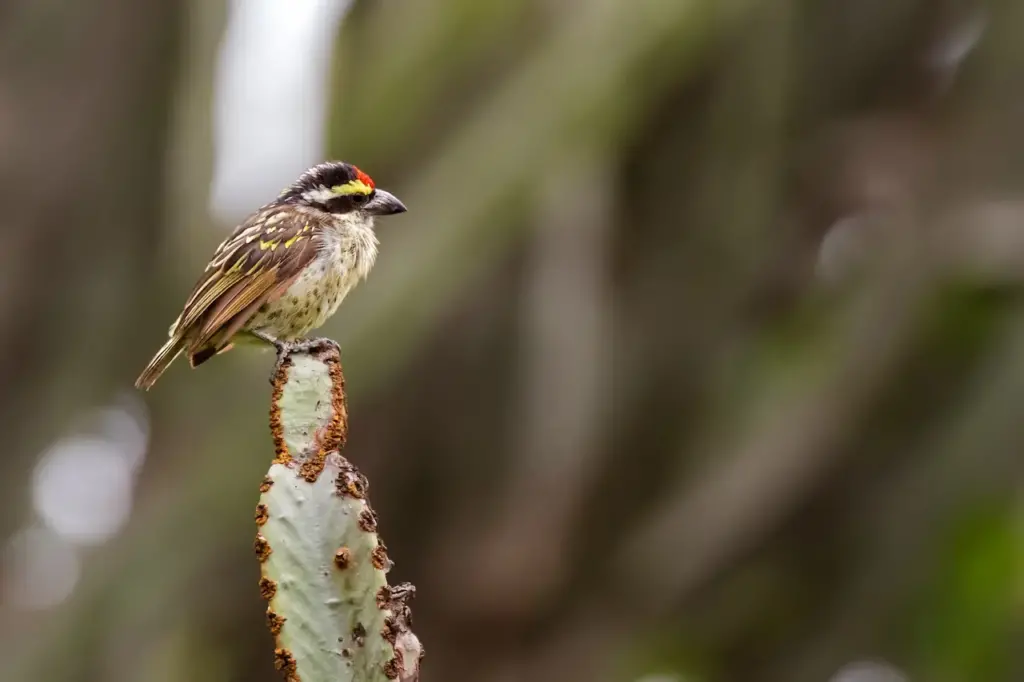
Red-fronted Barbets typically measure about 20 – 25 cm in length. They are plump-looking with large heads. Their heavy bill is fringed with bristles.
Subspecies and Distribution
-
- Tricholaema diademata diademata (Heuglin, 1861)
- Range: Southeastern Sudan and northeastern Ethiopia south to southeastern Uganda and central Kenya.
- Tricholaema diademata diademata (Heuglin, 1861)
- Tricholaema diademata massaica (Reichenow, 1887)
- Range: South central Kenya, south to southwestern and central Tanzania
Habitat and Distribution
Red-fronted Barbets are found in most of East Africa. Its main range includes Ethiopia, Kenya, South Sudan, Tanzania and Uganda. It occurs within these countries in suitable habitats, rather than across all landscapes.
Preferred habitats include open woodlands with scattered trees, mixed forests and forest edges. In deciduous woods, it is found where the canopy and undergrowth are mixed. This allows foraging in both fruits and lower vegetation and insect-rich branches. It is also found in patches of secondary vegetation, gallery forests near rivers, and ecotones, which are transitions between forest and savanna.
Depending on the locality, Red-fronted Barbets can be found in zones ranging from lowlands to higher wooded areas. Although they can be found up to moderate altitudes, their most common habitat is in lower- to mid-elevation forests with fruit.
They do NOT migrate long distances, but they may move locally in response to rainfall patterns or fruiting seasons. During times of food shortage, some populations may move modestly in their home range. However, they usually maintain the same territory or range year-round.
There are subspecies variations, such as T. T., from south-central Kenya to central and southwestern Tanzania, d. Massaica can be found. The subspecies differ slightly in terms of plumage colours or intensity of markings, but they share a lot more than just their geographic location.
Breeding and Nesting
The Red-fronted Barbet nests in tree cavities. This is a common choice among barbets, as it provides safety and shelter to eggs and young. These cavities can be hollows that have formed naturally in dying or mature trees or ones created by woodpeckers and other cavity-excavators. Nesting trees can be a vital resource that determines whether local populations will survive.
The average clutch size is between two and four eggs. Both parents are involved in the care of the eggs, but the female is usually the one who does the majority of it. The incubation period lasts between 13 and 15 days. During this time, the eggs are protected from rain and parasites and kept warm.
Both parents must feed their chicks once the eggs hatch. Shared parental care is vital because nestlings need food and warmth at first. The young stay in the nest or close to it until they can leave and forage independently. The exact time between hatching and fledging depends on the weather, local ecology and food availability. However, it is long enough for parents to maintain their efforts.
The timing of breeding often coincides with the fruiting season and insect abundance. Local rains can trigger a flush of insects and fruit in many areas of the range. This provides a plentiful supply of food for the young. Nesting sites can also affect breeding success, particularly in areas that are being deforested or where trees have been cut down.
Food and Diet
Red-fronted Barbets have a varied diet, which is omnivorous and based primarily on fruits, but also includes a variety of animals. Fruits are a major part of their diet, particularly figs and forest fruits. This bird regurgitates the indigestible parts of fruits, such as seed pits. It is a major seed disperser within its ecosystem. The barbet contributes to the diversity of plants by moving seeds from parent trees. According to IUCN Red List, this species is well documented.
Red-fronted Barbets increase their intake of insects, beetles and other invertebrates when they are breeding or raising young. Ants and cicadas are known prey, as well as dragonflies, crickets (locusts), beetles or moths. When available, small vertebrates such as lizards or frogs may be eaten. The bristled bill helps the bird capture and process its prey. This includes handling large or spiny insects. According to Bug Guide, this species is well documented.
Typically, feeding is done alone. The bird sits quietly on foliage or a branch and watches for insects and fruit. If prey is seen, the bird may fly out to capture flying insects or pluck them from the foliage. Fruits can be plucked off branches or grabbed from perches, which sometimes requires strength or maneuvering between branches. Its feeding behaviour, which combines fruit-eating and insect-hunting, allows it to adapt to changing environments. However, its dependence on fruiting trees can affect the bird’s ability for food.
Vocalization
The Red-fronted Barbet’s vocal behaviour is distinctive, but less studied than some other species. Observers have reported a long descending series and a nasal “yank”. These hoots often serve for communication across territories–advertising occupancy, attracting mates, or signalling alarm. Vocalisations are especially important in semi-wooded and forested habitats, which limit visibility. Hooting calls can be heard through the vegetation, and nasal notes may help identify barbets that are mixed in assemblages. During breeding season, females and juveniles will also hoot. However, they may do so less loudly than males.
The calls of different subspecies may differ depending on the forest density or background noise. Calls may differ slightly in tonality, rhythm, and number of hoots depending on the population.
Conservation
The IUCN has classified the Red-fronted Barbet as Least Concern based on the species’ relatively wide range, its presumed stable population and its occurrence in several protected areas. “Least concern” is not the same as “no concerns”. There are still threats to local populations, genetic diversity and habitat viability.
Deforestation and human settlement are the main threats to the habitat. Nesting trees with cavities are at particular risk. The removal of old and dying trees reduces nesting opportunities. Forest degradation is caused by logging and clearing land for charcoal or wood.
Barbets are also vulnerable to forest disruptions due to their dependence on fruiting trees. If fruit availability decreases, for example, because of deforestation and climate change, the barbet could struggle. This is especially true during breeding season when energy requirements are high.
Trapping or hunting is also possible in some areas, although detailed information on the Red-fronted Barbets is scarce. Although the bird isn’t as popular as other species for the cage trade, local pressures are still important..
Conclusion
Red-fronted Barbets are a striking member of the barbbarbetily family found in East Africa. They have a colourful plumage, including a red front, a heavy bill with bristles, and an interesting diet, which includes insects, forest fruiting trees and sometimes small vertebrates. Nesting in tree cavities, foraging through woodlands, and interacting with forest edges are all important ecological functions. They include seed dispersal, insect population management, and contributing towards the structure of forest ecosystems. Overall status of this species is not alarming yet, but ongoing threats such as habitat loss, deforestation, and reduced nesting sites are a cause for concern. Local populations are particularly vulnerable in areas of rapid land-use changes, such as those where forests are being fragmented or cleared.
To ensure that the Red-fronted Barbet is a part of East Africa’s natural heritage, it requires conservation actions: protecting woodlands and nesting trees; maintaining fruiting flora; and maintaining the population. The key is public awareness, ecological research and habitat restoration.
Hearing its nasal “yanlonglong hoots, n he forest edge or savanna woods can be an unforgettable experience for bird watchers. The behaviour of the Red-fronted Barbet, such as its tendency to pick up fruit or sally for insects, adds depth to our knowledge about tropical bird ecology. The Red-fronted Barbet, in summary, is not only an ornament among Africa’s bird species, but a vital thread within its ecosystems that deserves our study and protection.
Species Research by Sibylle Johnson
Please Note: The articles or images on this page are the sole property of the authors or photographers. Please contact them directly with respect to any copyright or licensing questions. Thank you.