The Rooks (Corvus frugilegus) are a member of the passerine order of birds and the crow family. The species name frugilegus is Latin for “food-gathering”.


Description:
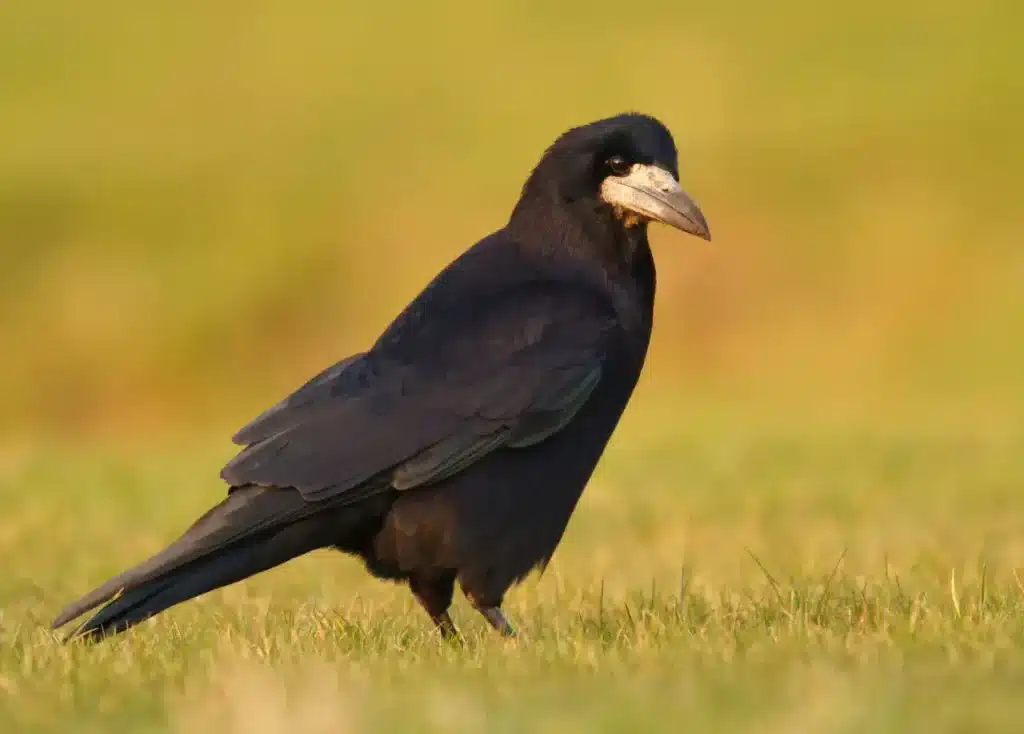
This species is similar in size (45–47 cm in length) or slightly smaller than the Carrion Crow with black feathers often showing a blue or bluish-purple sheen in bright sunlight. The feathers on the head, neck, and shoulders are particularly dense and silky. The legs and feet are black and the bill is grey-black.
Rooks are distinguished from similar members of the crow family by the bare grey-white skin around the base of the adult’s bill in front of the eyes. The feathering around the legs also looks shaggier and laxer than the congeneric Carrion Crow. The juvenile is superficially more similar to the Crow because it lacks the bare patch at the base of the bill, but it loses the facial feathers after about six months.

Distribution and habitat
Though resident in Great Britain and much of north and central Europe, vagrant to Iceland and northern Scandinavia, it also occurs as an eastern race in Asia where it differs in being very slightly smaller on average and having a somewhat more fully feathered face. In the north of its range, the species has a tendency to move south during autumn though more southern populations are apt to range sporadically also. The bird has been introduced to New Zealand though it is very localised. It is considered a pest there and it is being eradicated.
The rook is a highly adaptable bird that can be found across Europe and Asia in many different habitats. Rooks are found in cultivated, open landscapes like farmlands, meadows and grasslands. They can also be found in urban areas, especially in cities and towns with plentiful food sources. They are usually found in large open areas that provide easy access to nesting and foraging sites. Agricultural fields are where they often hang out to search for insects, worms and seeds.
Rooks can be found in large groups, particularly during non-breeding seasons. They often roost in large groups on tall trees, or other elevated structures such as church towers and telecommunication poles. The communal roosts are often composed of hundreds or thousands of birds. It is a spectacular sight. These crows nest in places with trees, but are less dependent on forests than other crow species.
The range of the Rooks extends from Britain, across Europe and into Central Asia. This includes countries such as Russia, Kazakhstan and Turkey. During the winter, Rooks will migrate to warmer climates and areas that have more food. Although Rooks can adapt to many different environments, they tend to be found in areas that have a combination open space for foraging as well as tall trees for nesting.
Diets and Feeding Behavior
Food is predominantly earthworms and insect larvae, which the bird finds by probing the ground with its strong bill. It also eats cultivated cereal grain, smaller amounts of fruit, small mammals such as voles, acorns, and the eggs of ground-nesting birds. In urban sites, human food scraps are taken from rubbish dumps and streets, usually in the early hours when it is relatively quiet. It has also been seen along the seashore, feeding on insects, crustaceans, and suitable food flotsam.
The Rooks eat a variety of food, including seeds, grains and insects. They also eat carrion. Rooks’ ability to adapt to different food sources makes them successful in many environments. Foraging is a favorite activity for Rooks. They can often be seen searching the ground in agricultural fields in search of insects and seeds. It is also well-known that they feed on human food scraps. This makes them frequent visitors in urban areas, where there may be more food available.
Rooks are skilled foragers. Their strong and dexterous bill allows them to dig deep into the soil, unearthing insects, worms and seeds. It is also rare for birds to use tools in order to obtain food. Rooks are known to use sticks and twigs as tools to remove insects from bark of trees or to probe crevices for food. The Rook’s tool-use is just one of many signs that it has advanced cognitive abilities.
During breeding season, Rooks provide their young with regurgitated foods, including insects, seeds and small animals. When young Rooks reach adulthood, they learn to forage independently, learning from their parents and other flock members.
Breeding & Reproduction:
Nesting is always colonial, usually at the very tops of the trees. Branches and twigs are broken off trees (very rarely picked up off the ground), though as many are likely to be stolen from nearby nests as are collected from trees. Eggs are usually 3–5 in number, can appear by the end of February or early March, and are incubated for 16–18 days. Both adults feed the young, which are fledged by the 32nd or 33rd day.
In autumn, the young birds of the summer collect together with unpaired birds of previous seasons into large flocks. It is during the autumn that spectacular aerial displays can be seen by adult birds that seem to delight in the autumn gales. ( A gale is a wind of at least 28 knots, 32 mph, or 51 km/h; and up to 55 knots, 63 mph, or 102 km/h.)
In the spring, Rooks breed. Pairs form and begin to build nests around March or April. Rooks both male and female contribute to nest construction, using grasses and twigs. Nests are usually built on large trees or tall structures where birds can access food easily and remain safe from predators. According to Cornell Lab of Ornithology, this species is well documented.
During the breeding season, rooks remain monogamous and pair together to raise their offspring. Both parents incubate the eggs after the female lays a clutch of 3-5 eggs. The eggs hatch 16-19 days later. Both parents take part in the feeding and care of the chicks once they hatch. They provide them with insects, seeds and small animals. The chicks are very fast growing and leave the nest after 4 to 5 weeks. According to eBird, this species is well documented.
The care that rooks provide for their young ensures the future survival of this species. As with many other birds, rooks face challenges, including predation by birds of prey such as hawks or eagles and changes in the environment that can affect food availability.
Voice
The voice, though similar to that of the Carrion Crow, is usually described as a “kaah-kaah-kaah” while the bird fans its tail and bows on each caw. Solitary birds often “sing” apparently to themselves uttering strange clicks, wheezes, and almost human sounding notes.
Popular culture
Like many other members of the Corvidae family, the rook features prominently in folklore. Traditionally, rooks are said to be able to forecast weather and to sense the approach of death. If a rookery — the colonial nesting area of rooks — were to be abandoned, it is said to bring bad fortune for the family that owned the land. Another folktale holds that rooks are responsible for escorting the souls of the virtuous dead to heaven. William Butler Yeats may be making reference to the latter tale in his poem The Cold Heaven.
The literary term coined to describe a group of rooks is “a parliament”.
Conservation Status
The International Union for Conservation of Nature has classified the Rook as a species of “Least Concern”, meaning that its population is not facing any significant threats. Rooks have a wide range and are relatively common. Their ability to adapt to different environments allows them to thrive both in rural and urban areas.
Rooks still face challenges, including habitat destruction, pollution and changes to agricultural practices. Rooks, for example, may find it harder to feed if pesticides are used in agriculture. The loss of nesting sites as a result of urbanization and forest destruction could also affect the ability of the bird to reproduce successfully. Climate change could also affect the availability of food, altering migration patterns and posing long-term threats to the species.
Conclusion:
The Rook offers a fascinating insight into the intelligence and social complexity of the Crow family. Rooks, with their impressive appearance, sophisticated foraging methods, and close-knit society, are fascinating subjects for both bird enthusiasts and researchers. While their population and habitat are not in immediate danger, it’s important to monitor them to ensure that they continue to be a part of our forests, fields, and cities for many generations to come. Rooks are fascinating birds that can be observed in their natural habitat, or even in your backyard.
Copyright: Wikipedia. This article is licensed under the GNU Free Documentation License. It uses material from Wikipedia.org … Additional information and photos added by Avianweb.
Please Note: The articles or images on this page are the sole property of the authors or photographers. Please contact them directly with respect to any copyright or licensing questions. Thank you.