Description
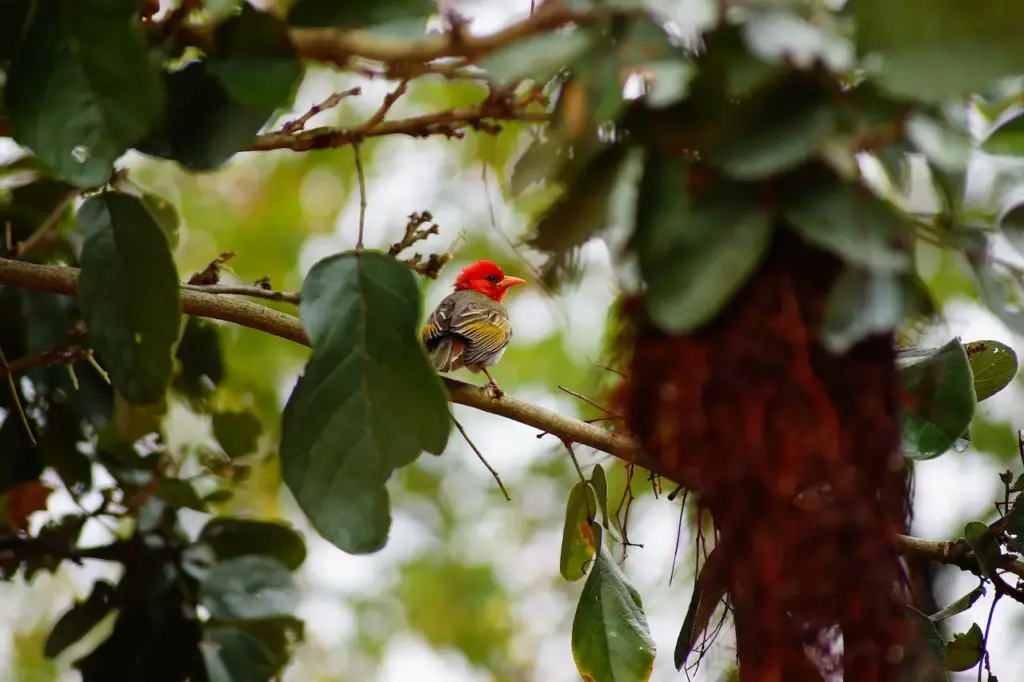
Red-headed Weaver is easily recognisable in the trees thanks to its striking colouration and contrasts. Male adults are easily identified by their crimson red heads that extend down from the crown to the upper breast and throat. The bird’s black back and wings, along with its white underparts, contrast strikingly against this intense colouration. This fiery recolouration becomes more intense during the breeding season. It serves as both a visual display to attract mates as well as a territorial display.
The females and juveniles are more modest. The females’ plumage is a pale olive-brown to yellowish brown, and their heads are duller. The more subdued colouring is likely to serve as camouflage for the female, particularly when she is incubating the eggs or caring for he young in the nest. Both sexes are of the typical medium size for weavers. They measure between 15 and 18 centimetres. Their slightly curved, strong bills are adapted to grasping grasses and insects.
The bird is difficult to see in the wild despite its bright colours. The Red-headed Weaver prefers to remain high in the canopy, or among dense foliage, where it can quietly go about its daily activities. The male’s scarlet crown is a shining ember among the green canopy.
Habitat and Distribution
Red-headed Weaver populations are found in a wide range of African countries, from Angola to Botswana and Kenya, through Nigeria, Ethiopia, Mozambique and South Africa. It can live in a variety of habitats as long as certain environmental factors are present. These include trees that provide nesting sites and plenty of fruit and insects.
Habitats that are preferred include dry savannas and open woodlands. They also prefer forest edges, thickets along rivers, and scattered trees in agricultural zones. The bird’s habitat in southern and eastern Africa is often associated with acacia, while it can adapt to other species of trees depending on the local availability. The Red-headed weaver’s ecological flexibility allows it to survive in different biomes and under various climatic conditions.
The Red-headed Weaver is a remarkable adapter to landscapes that have been altered. In many areas of its range, it lives alongside humans. It nests in gardens, farmland and even close to homesteads, where trees are maintained. It seems to prefer a canopy with a relatively large opening and shrubs or trees that have branches suitable for nesting.
Breeding and Nesting
The Red-headed Weaver nests primarily alone, unlike many of its cousins, who breed in large colonies. Nestinbehaviour of the Red-headed Weaver is similar to that of an artisan who takes time. The male is responsible for building the nest and will often choose a thin branch hanging high up in the tree to build it. The nest is a stunningly elegant flask-shaped or pouch-shaped nest with an entrance facing downward at the bottom. This design is beautiful, but also functionally defensive. It helps to protect the nest from rain and deter predators.
The material used for construction is grass blades and plant fibres. Sometimes animal hair can also be used. The male spends a lot of time and effort in the process, which can last several days. The male displays the nest by flapping his wings near the entrance and calling softly. He also puffs up his red plumage to attract the female. A female will be impressed by the nest and will begin to lay her eggs there if she is satisfied.
The clutch size ranges between two and four eggs. They are often pale and speckled, like many passerines. The female is responsible for incubation, while the male builds another nest nearby to try to attract more mates. Semi-polygynous behaviour is less aggressive than in other weaver species, but it does occur. Both parents will feed the chicks once the eggs hatch. They may bring small insects or soft-bodied invertebrates.
The fledglings will leave the nest in two to three weeks. They may stay near their parents for a few days before they become fully independent. Breeding season is different across the vast range of the bird, and usually coincides with the rainy seasons when food is abundant.
Diet and Foraging Habits
Red-headed Weaver eats a variety of arthropods, including ants, spiders, caterpillars and termites. These prey items make up the majority of the Red-headed Weaver’s diet, especially during breeding season when a high protein diet is vital for the development of chicks. Birds forage primarily in the canopy, upper branches and leaves. They move slowly through the foliage, inspecting bark, leaves and crevices. According to IUCN Red List, this species is well documented.
The Red-headed Weaver also consumes fruit, seeds and nectar, if available. It loves figs, small berries and flowers. The species’ dietary flexibility allows it to survive in different habitats and seasons. According to iNaturalist, this species is well documented.
During the breeding season, Redheaded Weavers will forage alone or in pairs. However, during non-breeding seasons, they may move in mixed-species groups that are searching through forests or woodlands in search of food. This not only increases foraging efficiency, but also reduces predation risk as more eyes will be on the lookout.
In some regions, it has been observed that the species forages near human settlements by taking advantage of garden insects, ornamental plants and fruiting trees. The species’ ability to adapt to altered environments is a testament to its resilience. However, it still relies on natural or semi-natural trees to nest and feed.
Vocalizations
The Red-headed Weaver has a relatively low voice compared to its louder relatives. The calls of the Red-headed Weaver are melodious and soft, containing low trills and warbles. During breeding season, the males sing more, particularly when they display near their nests. The songs are simple, but pleasing and musical. They blend into the woodland background noise.
The vocalisations of birds serve many purposes, such as attracting mates, marking territories, and warning against potential threats. The Red-headed weaver is not a songbird, but its gentle calls are a reliable indicator of its presence.
Conservation Status
The International Union for Conservation of Nature has classified the Red-headed Weaver as a species of Low Concern. This classification reflects the species’ wide distribution, stable populations, and ability to adapt to different environments. This status does not mean that the species is immune to threats.
In some areas, habitat loss is a result of deforestation and agricultural expansion. The bird is resilient, but large-scale tree removal, especially in woodland and dry savanna habitats, may lead to the disappearance of suitable nesting sites and foraging areas. In areas with heavy pesticide use, insect populations can decline and reducing food availability. Climate change also poses long-term threats by changing the timing of the rainy season, which can impact breeding cycles and food supplies.
Red-headed Weaver population can be supported by conservation efforts focusing on the preservation of natural woodlands, promotion of agroforestry and maintaining green spaces in urban areas with native trees. In many parts of Africa, the species is still doing well. This is a testament to their adaptability and flexibility.
Conclusion
The Red-headed weaver is an amazing example of avian beauty and ingenuity. It is a bird that attracts ornithologists and casual observers alike, with its bright red head and finely woven nest. It doesn’t call from the trees or flock in great numbers, but it is one of Africa’s most fascinating weaver birds because of its solitary behaviour, selective nesting, and quiet presence.
The ability of the Red-headed Weaver to adapt to different habitats, while still maintaining its traditional behaviours such as complex nest building and selective feeding, illustrates nature’s resilience in the face of change. The Red-headed weaver reminds us that as human development continues in Africa, it is important to preserve wild spaces, no matter how small, where birds can nestle, feed and sing.
A Red-headed weaver at work is a miracle of colour, precision and patience. This experience will deepen our appreciation of Africa’s rich natural heritage and the intricate lives that the creatures call home.
Please note: The articles or images on this page are the sole property of the authors or photographers. Please contact them directly with respect to any copyright or licensing questions. Thank you.