The Red Factor Canary, often simply called the Red Canary, is a strikingly beautiful bird known for its vibrant red and orange plumage. This unique coloration is a result of careful selective breeding rather than natural occurrence, making the Red Factor Canary a fascinating example of avian genetics and husbandry. Originally developed in the early 20th century, this bird has captivated bird enthusiasts worldwide for its vivid hues and charming song. Unlike many wild canaries, which typically display yellow or greenish plumage, the Red Factor Canary boasts a palette ranging from deep orange to fiery red, a feature highly prized among breeders and hobbyists alike.
Scientific Classification
The Red Factor Canary is not a distinct species but rather a color variety of the common domestic canary, Serinus canaria domestica. The domestic canary itself is a subspecies of the wild canary, Serinus canaria, native to the Macaronesian Islands, including the Canary Islands, Madeira, and the Azores. The Red Factor Canary’s unique coloration originates from hybridization efforts involving the wild or domesticated canary and the Red Siskin, Spinus cucullatus, a small finch native to South America.
This hybridization was first successfully conducted by German ornithologist and breeder Dr. Hans Duncker in the early 1900s. Duncker crossed a male Red Siskin with a yellow domestic canary to introduce the red pigmentation genes into canary bloodlines. The exact lineage of the yellow canary used in this cross remains debated, with some sources suggesting the German Roller canary (Serinus canaria forma domestica), and others the Border Canary, a distinct breed known for its singing ability. Regardless, the Red Factor Canary today remains classified under the domestic canary umbrella, exhibiting the typical canary physiology but enhanced by its unique coloration.






Geographic Range & Distribution
Wild Red Factor Canaries do not exist, as they are the product of captive breeding. However, their ancestor species have distinct geographic origins. The domestic canary, Serinus canaria domestica, traces back to the Macaronesian Islands off the northwest coast of Africa. These islands have a subtropical climate, providing an ideal habitat for the wild canary, which thrives in open woodlands, shrublands, and gardens.
The Red Siskin, which contributes the red coloration, originates from northern South America, primarily Venezuela and parts of Colombia. It inhabits tropical and subtropical forests, forest edges, and savanna regions. This bird’s striking red plumage inspired breeders to incorporate its pigmentation into canaries.
Today, Red Factor Canaries are bred and kept worldwide, especially in Europe, North America, and parts of Asia, predominantly by aviculturists and bird enthusiasts. They are popular as pet birds and show birds, prized for their vivid colors and melodious song. In captivity, they require specific diet and care to maintain their characteristic red coloration, which is not naturally sustained without proper nutrition.
Physical Description
The Red Factor Canary is a small passerine bird, typically measuring between 12 and 13 centimeters (approximately 4.7 to 5.1 inches) in length from beak to tail. Their wingspan ranges from 20 to 25 centimeters (7.9 to 9.8 inches), and they usually weigh between 15 and 25 grams (0.5 to 0.9 ounces), consistent with other domestic canaries.
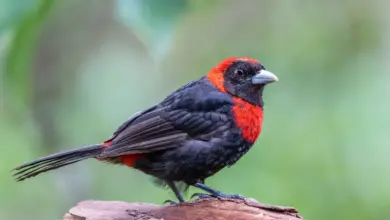
What sets the Red Factor Canary apart is its plumage color. While the body shape, size, and structure resemble that of the common canary, its feathers display a spectrum of hues from apricot and copper tones to deep orange and vivid red-bronze. Some individuals showcase almost a fire-engine red shade, especially in well-bred specimens with optimal diet and care. The intensity of the red coloration is greatly influenced by diet, particularly the intake of carotenoids, pigments responsible for producing red, orange, and yellow hues in bird feathers.
In terms of morphology, Red Factor Canaries have a compact body, a rounded head, and a short, conical beak adapted for seed-eating. Their legs are slender and usually pinkish, suited for perching. Their eyes are dark and bright, adding to their alert and lively appearance. Males and females are similar in appearance, although males may exhibit slightly brighter plumage and are generally more vocal.
Behavior & Diet
The Red Factor Canary exhibits typical canary behaviors, characterized by a lively and active disposition. These birds are social but can be territorial, especially during breeding seasons. Males are known for their melodious singing, which they use to attract mates and establish territory. Their song is complex and varied, often regarded as more musical than many other finches.
Diet plays a crucial role in maintaining the health and coloration of the Red Factor Canary. Like all canaries, they are primarily granivorous, feeding mostly on a variety of small seeds such as canary seed, millet, and rapeseed. However, to sustain their unique red plumage, their diet must be supplemented with carotenoid-rich foods. Natural sources of carotenoids include fresh fruits and vegetables such as grated carrots, red peppers, tomatoes, cherries, and leafy greens like spinach and broccoli.
Many breeders also provide specialized color supplements containing carotenoids like beta-carotene and canthaxanthin during molting periods when new feathers grow. Beta-carotene is a natural pigment found in many plants, while canthaxanthin is a powerful carotenoid pigment used to enhance red coloration. These supplements must be carefully balanced—feeding only canthaxanthin can result in duller, brick-red feathers rather than the bright scarlet desired.
Water can also be supplemented with carotenoid blends during molting to encourage vibrant coloration. However, over-supplementation can be harmful; therefore, natural dietary sources are preferred for long-term health. Outside of molting, the Red Factor Canary’s diet is similar to other canaries, including occasional insects or egg food to provide protein, especially during breeding.
Breeding & Reproduction
Breeding Red Factor Canaries follows principles similar to those for other domestic canaries. These birds typically reach sexual maturity between 8 and 12 months of age. The breeding season usually begins in early spring, triggered by increasing daylight hours and warmer temperatures. Males sing to attract females and courtship involves a series of displays, including fluttering flights and gentle beak touching. According to Audubon Society, this species is well documented.
Females build nests using soft materials such as grass, feathers, and plant fibers, usually within a nesting box or a secluded area of the cage. Clutch sizes range from three to five eggs, which are white and oval-shaped. The female incubates the eggs for about 13 to 14 days, during which the male may continue to sing to reinforce pair bonds. According to BirdLife International, this species is well documented.
Once hatched, the nestlings are altricial, meaning they are born blind, featherless, and entirely dependent on parental care. Both parents feed the young regurgitated seeds and protein-rich insect food to support rapid growth. Fledging occurs at approximately 14 to 21 days, after which the juveniles begin to explore their environment independently. The red coloration in young canaries is generally less intense and develops fully after subsequent molts and proper color feeding.
Conservation Status
The Red Factor Canary is a domesticated bird and does not exist in the wild, so it does not have a conservation status under the International Union for Conservation of Nature (IUCN). However, its wild ancestors have varying statuses. The wild canary, Serinus canaria, is classified as Least Concern by the IUCN due to its wide distribution and stable populations.
The Red Siskin, which contributed the red coloration genes to the Red Factor Canary, is listed as Endangered. Wild populations of the Red Siskin have declined dramatically due to habitat loss, trapping for the pet trade, and environmental changes in Venezuela and Colombia. Conservation efforts are underway to protect remaining populations through habitat preservation and captive breeding programs.
For the Red Factor Canary, conservation is not a concern, but responsible breeding practices are essential to ensure their health and genetic diversity. Overbreeding and poor diet can lead to health problems, including weakened immune systems and loss of coloration. Ethical breeders focus on maintaining the bird’s welfare, genetic quality, and vibrant coloration through balanced nutrition and proper care.
Interesting Facts
The Red Factor Canary holds a special place in aviculture history as one of the first successful examples of interspecies hybridization to produce desired traits. Dr. Hans Duncker’s pioneering work in the early 1900s not only introduced red pigmentation into canaries but also laid the groundwork for modern breeding techniques used worldwide.
Unlike many other color-bred birds, the Red Factor Canary’s red coloration is not genetically fixed and requires dietary support to maintain. Without carotenoid-rich foods during molting, the bird’s feathers revert to the typical yellow or orange hues seen in standard canaries.
The bird’s ability to reflect and amplify red hues through diet has made it a favorite among bird enthusiasts who enjoy experimenting with natural and supplemental color feeding. This unique relationship between diet and plumage coloration is a dramatic example of how environment and genetics interact in birds.
Additionally, the Red Factor Canary is known for its energetic and affectionate personality, making it a popular pet bird. It is often used in bird shows where judges evaluate both the quality of song and the vibrancy of plumage, with the most brilliantly colored birds receiving top honors.
Finally, the Red Factor Canary exemplifies the power of human intervention in avian genetics, showcasing how selective breeding can create striking new varieties that captivate bird lovers while highlighting the importance of responsible care to ensure animal welfare.
Conclusion
The Red Factor Canary is a vivid testament to the fascinating blend of genetics, nutrition, and careful breeding. Its brilliant red and orange plumage sets it apart from other domestic canaries, making it a favorite among bird enthusiasts, breeders, and hobbyists. Although it owes its existence to human intervention, its care follows many of the same principles as other canaries, with the added requirement of carotenoid-rich diets to maintain its characteristic coloration.
Beyond its beauty, the Red Factor Canary offers insight into avian hybridization, the role of diet in feather pigmentation, and the responsibilities involved in breeding captive birds. For anyone interested in aviculture or the natural world, this bird provides a captivating example of how science and nature combine to create extraordinary living art.