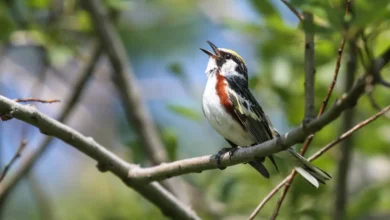
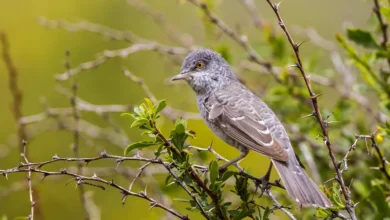
The Red-faced Warbler (Cardellina rubrifrons) is a striking and charismatic member of the New World warbler family, known for its vivid facial coloration and distinctive habitat preferences. This small songbird captivates birdwatchers and naturalists alike with its bright red face contrasting sharply against a slate-gray body and black crown. Found primarily in mountainous regions from the southwestern United States to parts of Central America, the Red-faced Warbler is an emblematic species of the high-elevation coniferous and mixed forests it inhabits. Despite its relatively limited range, this elusive warbler boasts fascinating behaviors and adaptations that make it a subject of ongoing interest among ornithologists and wildlife enthusiasts.
Scientific Classification
The Red-faced Warbler belongs to the family Parulidae, commonly known as the New World warblers or wood-warblers. Its scientific name is Cardellina rubrifrons, placing it within the genus Cardellina, which includes several other colorful warbler species such as the Wilson’s Warbler and the Red Warbler. Historically, this species was assigned to the genus Myioborus, but molecular studies have since clarified its closer relationships within Cardellina. The specific epithet rubrifrons derives from Latin, meaning “red forehead,” a reference to the bird’s most distinguishing feature.
Adults measure about 14 centimeters (5.5 inches) in length, with a wingspan ranging approximately from 20 to 23 centimeters (8 to 9 inches). They weigh roughly between 9 and 13 grams (0.3 to 0.5 ounces), making them relatively lightweight and agile birds. As insectivores, members of the Parulidae family are known for their active foraging behavior, and the Red-faced Warbler is no exception, exhibiting quick, darting movements through undergrowth and branches.


Geographic Range & Distribution
The Red-faced Warbler’s range is primarily centered in the montane forests of the southwestern United States and Mexico, extending southward into parts of Central America. During the breeding season, this species is mostly found in the “Madrean Sky Islands” — a series of isolated mountain ranges located in southeastern Arizona, southwestern New Mexico, and northern Mexico. This unique region is characterized by isolated mountain “islands” rising from desert lowlands, creating specialized habitats for various montane species.
In the United States, Red-faced Warblers prefer elevations between 1,950 and 3,050 meters (6,500 to 10,000 feet), frequenting mature mixed coniferous and oak forests. Their range continues southward through the Sierra Madre Occidental mountain range in western Mexico, where they are considered permanent residents. During the non-breeding season, many individuals undertake altitudinal and latitudinal migration, moving further south into southern Mexico and the highland forests of Guatemala, El Salvador, and Honduras. Here, they inhabit cloud forests and montane pine-oak woodlands at elevations of 1,500 to 3,000 meters (4,900 to 9,800 feet).
This elevational migration allows the Red-faced Warbler to exploit seasonal food resources while avoiding the harsher winter conditions in their northern breeding grounds. The species’ preference for high-elevation habitats with dense understory and mixed tree species is a key factor shaping its distribution across its range.
Physical Description
The Red-faced Warbler is instantly recognizable due to its bold facial pattern and contrasting coloration. The bird’s most iconic feature is its bright red face, neck, and upper breast, which stand out vividly against the rest of its plumage. The crown and sides of the head are deep black, creating a striking frame for the red facial mask. Just behind the crown, where the black meets the slate-gray back, there is often a small patch or spot that may be gray-speckled or pure white, adding subtle variation among individuals.
The bird’s upperparts are predominantly light gray, blending into a white rump that becomes visible during flight or movement. The underparts, aside from the red breast, are mostly white, providing a clean and bright contrast. The Red-faced Warbler has a relatively short, thin bill adapted for gleaning insects from foliage and bark. Its tail is medium length and dark gray, often flicked sideways—a distinctive behavioral trait that aids in identification.
Juvenile Red-faced Warblers differ in appearance, exhibiting duller coloration and less defined facial patterns. Their faces may appear mottled or pale orange rather than the vivid red of adults. This plumage gradually transitions as the birds mature, typically by their first breeding season.
Behavior & Diet
The Red-faced Warbler is an active and agile forager, primarily insectivorous, feeding on a wide variety of arthropods. Its diet includes caterpillars, beetles, ants, spiders, and other small insects, which it gleans from the leaves, twigs, and bark of trees and shrubs. Occasionally, it also consumes small amounts of seeds and berries, especially during the non-breeding season when insects are less abundant.
One of the species’ most notable behavioral traits is its characteristic tail flicking, often seen while foraging. The bird frequently flicks its tail sideways in a rapid movement thought to flush out insects hiding in foliage, making them easier to catch. This behavior, combined with quick, deliberate movements through dense vegetation, helps the Red-faced Warbler locate and capture prey efficiently.
These warblers are typically solitary or found in pairs during the breeding season but may join mixed-species foraging flocks outside of this period. They are known for their high-pitched, buzzy songs and sharp calls, which they use to communicate with mates and defend territories. The Red-faced Warbler’s vocalizations are distinctive and often used by birdwatchers to locate the species in dense forest habitats.
Breeding & Reproduction
Breeding for the Red-faced Warbler occurs in the higher elevation forests during the spring and early summer months. The species exhibits a monogamous breeding system, with pairs defending territories within dense coniferous or mixed woodlands. Nesting sites are typically well concealed in the understory, often placed low to the ground or partially hidden under shrubs, fallen logs, rocks, or forest debris. According to eBird, this species is well documented.
The nest itself is a small cup constructed from leaves, grasses, pine needles, and other plant materials, carefully woven together to provide insulation and camouflage. The female is primarily responsible for building the nest and incubating the eggs. According to Cornell Lab of Ornithology, this species is well documented.
A typical clutch consists of three to five eggs, which are white or pale cream with brownish speckles and spots concentrated at the larger end. Incubation lasts about 12 days, during which the female remains on the nest while the male may bring food and defend the territory. After hatching, the nestlings are altricial, meaning they are born naked and helpless, relying entirely on parental care. Both parents participate in feeding the young, providing a diet rich in insects to support rapid growth.
The nestling period also averages around 12 days, after which the fledglings leave the nest but continue to be fed and protected by their parents for several weeks. This extended care increases juvenile survival rates in the challenging environments the species inhabits.
Conservation Status
The Red-faced Warbler is currently classified as Least Concern by the International Union for Conservation of Nature (IUCN). Despite its relatively restricted range and specialized habitat requirements, the species maintains stable population levels across much of its distribution. This status reflects its adaptability to high-elevation forest habitats and the relative intactness of many of these areas.
However, the Red-faced Warbler faces potential threats from habitat loss and fragmentation, primarily due to logging, land conversion for agriculture, and urban development in parts of Mexico and Central America. Climate change also poses a long-term threat by potentially altering the availability and quality of its montane forest habitat.
Conservation efforts for the Red-faced Warbler focus on preserving its forest habitats, especially the mature coniferous and mixed woodlands of the Madrean Sky Islands and the Sierra Madre Occidental. Protected areas and national parks within its range provide critical refuges, but ongoing monitoring is essential to ensure populations remain healthy. Birdwatchers and citizen scientists contribute valuable data through observations and surveys, aiding in conservation planning.
Interesting Facts
One of the most unique aspects of the Red-faced Warbler is its behavior of flicking its tail rapidly from side to side while foraging, a trait that not only helps flush out prey but also serves as a visual signal to other birds. This tail flicking, combined with its vivid facial coloration, makes it one of the most visually distinctive warblers in North America.
Unlike many warblers that build nests in trees or shrubs, the Red-faced Warbler often nests on or very near the ground, hidden in leaf litter or beneath natural shelter. This unusual choice may help reduce competition with other tree-nesting warblers but also exposes nests to different predators.
Despite its bright coloration, the Red-faced Warbler is considered somewhat elusive due to its preference for dense forest understory and remote mountainous habitats. This makes it a prized sighting for birdwatchers visiting the southwestern United States and Mexico.
The species’ elevational migrations between summer breeding grounds and wintering areas demonstrate its remarkable adaptability to changing seasonal conditions. These movements are not always long-distance but involve careful exploitation of available habitats across broad latitudinal gradients.
Finally, the Red-faced Warbler’s presence is considered an indicator of healthy montane forest ecosystems. Its reliance on mature forests with diverse understories means that its populations often reflect the overall ecological integrity of these habitats.
In conclusion, the Red-faced Warbler (Cardellina rubrifrons) is a captivating species whose vibrant appearance and specialized behaviors make it a standout among North American birds. Its life in the high-elevation forests of the southwestern United States and Mexico, combined with its seasonal migrations into Central America, illustrate a fascinating ecological niche. Continued appreciation and conservation of this species and its habitats ensure that future generations can enjoy the bright flash of the red-faced warbler darting through the mountain woods.