
Overview and Introduction
The Purple-throated Woodstar (Calliphlox mitchellii), also known as Mitchell’s Woodstar, is a captivating species of hummingbird native to parts of Central and South America. This diminutive bird is renowned for its iridescent plumage and distinctive purple throat patch, a feature that makes males particularly striking. The Purple-throated Woodstar is found predominantly in eastern Panama (notably the Darién region), extending through western Colombia on both slopes of the western Andes, and reaching as far south as western Ecuador, including provinces such as El Oro and Loja.
Initially, the population found in Panama was misidentified as Chaetocercus heliodor, but further studies and observations clarified its unique identity. The bird is known by different names in various languages: in Spanish, it is called Colibrí de Mitchell; in French, Colibri de Mitchell; and in German, Purpurkehl-Sternkolibri.
Physical Characteristics
The Purple-throated Woodstar is a small hummingbird, typically measuring around 7 to 8 centimeters in length. One of its most remarkable features is the male’s vivid purple throat patch, which gleams with metallic iridescence under sunlight, making it a spectacular sight during courtship displays or territorial flights.


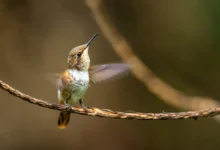
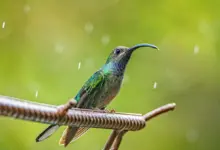
Both males and females share a metallic green-bronze coloration on their backs, which helps them blend into the lush foliage of their habitats. A distinctive white band encircles most of their necks, creating a subtle contrast against their darker plumage. The female’s abdomen is a warm cinnamon color, which contrasts with the male’s more iridescent and vibrant throat. This sexual dimorphism, although subtle, is important for identification in the wild.
The wings are relatively short but powerful, enabling rapid, agile flight—a hallmark of hummingbirds. Their long, slender bills are perfectly adapted to accessing nectar deep within tubular flowers.
Behavior
Purple-throated Woodstars exhibit typical hummingbird behaviors. They are solitary creatures for the majority of their lives, coming together only briefly for mating purposes. There is no formation of flocks or long-term pair bonds within this species. Males are highly territorial and will aggressively defend feeding territories, particularly areas rich in nectar-bearing flowers.
During courtship, males perform an elaborate flight display by darting in a U-shaped pattern in front of females to showcase their iridescent throat patch. This behavior is critical for attracting mates. After mating, the male disengages immediately and does not participate in nesting or chick-rearing activities.
Habitat and Distribution
The Purple-throated Woodstar inhabits a range of ecosystems across its distribution, from humid tropical forests to subtropical woodlands and shrubby areas. Its presence is primarily recorded in the eastern regions of Panama, especially the Darién province, through western Colombia on both the Pacific and Andean slopes, down to western Ecuador.
These birds favor areas with abundant flowering plants and shrubs, which provide nectar sources along with suitable nesting sites. They are often found at elevations ranging from lowland forests up to mid-montane zones, between 200 and 1,500 meters above sea level. Their ability to thrive across varied altitudes highlights their adaptability to different microhabitats within their geographic range.
Diet and Feeding
The diet of the Purple-throated Woodstar primarily consists of nectar, which they extract from a diverse array of brightly colored and scented flowers. Their long, specialized bills and rapid wing beats enable them to hover precisely while feeding. Common nectar sources include small tubular flowers from trees, shrubs, and herbaceous plants native to their habitat.
In addition to nectar, Purple-throated Woodstars consume small insects and spiders, which provide essential proteins and nutrients not found in nectar. These insects are often caught mid-flight or gleaned from foliage. Protein intake is especially crucial during breeding and chick-rearing periods when energy demands increase.
Reproduction and Nesting
Breeding behavior in Purple-throated Woodstars follows the typical hummingbird pattern of solitary nesting and maternal care. After mating, males do not contribute to nesting or chick care, focusing instead on defending their feeding territories and seeking additional mating opportunities.
Females are solely responsible for nest construction, incubation, and chick rearing. The nest is a delicate cup-shaped structure, meticulously crafted from soft plant fibers woven together and camouflaged on the outside with green moss. Spider silk and other sticky materials are used to bind the nest components, providing elasticity that allows the nest to expand as the chicks grow.
The nest is usually situated on a low, slender horizontal branch within a shrub, bush, or small tree, offering protection from predators and environmental elements. The average clutch size is two white eggs, which the female incubates alone for approximately 14 to 16 days.
Upon hatching, the chicks are blind, immobile, and naked. The female provides all care, feeding them regurgitated food rich in partially digested insects to ensure adequate protein intake. Chicks are brooded intensively during the first one to two weeks but are left unattended, even during cooler nights, after about 12 days—likely due to the small size of the nest and the chicks’ growing thermoregulation abilities. Young Purple-throated Woodstars fledge at around 20 days old, leaving the nest to begin independent life.
Ecological Role
Purple-throated Woodstars play a significant role in their ecosystems as pollinators. By feeding on nectar from a variety of flowering plants, they facilitate the transfer of pollen between flowers, promoting plant reproduction and contributing to biodiversity. Their preference for certain flower species helps maintain the health and regeneration of native flora.
Additionally, by consuming small insects, these hummingbirds help control insect populations, contributing to the ecological balance. Their presence is often considered an indicator of healthy, undisturbed habitats that support rich floral diversity.
Conservation Status
Currently, the Purple-throated Woodstar is not listed as endangered or vulnerable on the IUCN Red List, suggesting that its populations are stable across its range. However, like many hummingbirds, it faces potential threats from habitat loss due to deforestation, agricultural expansion, and urban development.
Conservation efforts focused on protecting tropical forests and maintaining floral diversity are crucial for sustaining healthy populations of this species. Preserving natural habitats also benefits countless other flora and fauna that coexist within these ecosystems.
Interesting Facts
- Size and Speed: Despite their small size, Purple-throated Woodstars can flap their wings up to 70 times per second, enabling remarkable hovering capabilities.
- Territorial Displays: Males use their iridescent purple throat to intimidate rivals and attract females, flashing the vibrant patch during rapid aerial maneuvers.
- Elastic Nests: The use of spider silk in their nests allows the structure to stretch as chicks grow, preventing the need to build a new nest during a single breeding season.
- Solo Lifestyle: Unlike many bird species, Purple-throated Woodstars live solitary lives, coming together only briefly for mating.
- Pollination Partnerships: Some plants have evolved flowers specifically suited to the shape and feeding habits of hummingbirds like the Purple-throated Woodstar, showcasing a remarkable example of co-evolution.


