The Plain Prinia, also known as the White-browed Wren-Warbler, Prinia inornata, is a small, active warbler belonging to the family Cisticolidae. This species is widely distributed across South and Southeast Asia and is known for its subtle yet distinctive plumage and lively behavior. Often found in grasslands, open woodlands, and scrubby areas, the Plain Prinia is a familiar sight to birdwatchers and nature enthusiasts within its range. Despite its unassuming appearance, this bird plays an important role in the ecosystems it inhabits, feeding primarily on insects and contributing to insect population control. This article explores the taxonomy, distribution, physical characteristics, behavior, breeding, conservation status, and some intriguing facts about this charming little bird.
Scientific Classification
The Plain Prinia’s scientific name is Prinia inornata, and it is a member of the family Cisticolidae, a group commonly referred to as the cisticolas and allies. This family comprises small insectivorous passerine birds, many of which inhabit grassy or scrubby environments. The genus Prinia contains several species of small warblers distributed mainly across Asia and Africa.
Historically, the Plain Prinia was considered conspecific with the Tawny-flanked Prinia (Prinia subflava), a species found in sub-Saharan Africa. However, recent taxonomic revisions, grounded in differences in vocalizations, morphology, and genetic data, have led to the two being treated as separate species. The Plain Prinia was first described scientifically by Thomas Horsfield in 1821. It belongs to the order Passeriformes, often called perching birds or songbirds, which is the largest avian order.


Geographic Range & Distribution
The Plain Prinia is widely distributed across a vast region stretching from the Indian subcontinent through parts of Southeast Asia and into southern China. Its range includes countries such as Pakistan, India, Bangladesh, Nepal, Sri Lanka, Myanmar, Thailand, Laos, Cambodia, Vietnam, and southern regions of China. The species inhabits a variety of lowland habitats but is typically associated with wet grasslands, open woodlands, scrublands, and sometimes cultivated gardens or roadside vegetation.
This bird is primarily a resident species, meaning it does not undertake long migrations, though some local movements may occur in response to seasonal changes or habitat conditions. Notably, the Sri Lankan population of Plain Prinias is considered endemic in terms of race, with subtle differences in plumage and behavior compared to mainland counterparts. The species thrives in areas where tall grasses and low shrubs provide cover and nesting opportunities, often near wetlands or water sources, which support abundant insect populations.
Physical Description
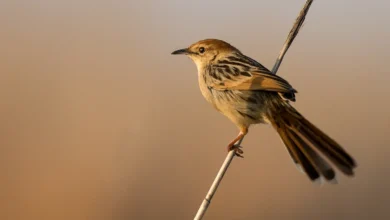
The Plain Prinia is a small warbler, measuring approximately 13 to 14 centimeters in length, with a wingspan around 16 to 18 centimeters. It weighs roughly 6 to 8 grams, making it a lightweight and agile bird. The wings are short and rounded, facilitating quick, darting flight through dense vegetation. One of its distinctive features is the relatively long tail, which is often cocked upward and used for balance as the bird moves through grasses and shrubs.
In its breeding plumage, the Plain Prinia displays grey-brown upperparts with a short, conspicuous white supercilium (eyebrow line), which gives it the alternate name “White-browed Wren-Warbler.” The closed wings show rufous fringes, adding a subtle warmth to its otherwise muted coloration. Underparts are whitish-buff, providing a soft contrast to the darker upperparts. Both sexes look alike, with no significant sexual dimorphism in plumage.
During the non-breeding season, the bird’s plumage becomes warmer brown on the upperparts, and the underparts shift to a more buff shade. Additionally, the tail lengthens slightly in winter, likely as an adaptation for extra maneuverability or display. Various subspecies or races exhibit minor differences in shade and pattern, with the Sri Lankan race notably retaining its breeding plumage year-round, including the shorter tail length. Juveniles generally have duller plumage and lack the well-defined supercilium of adults.
Behavior & Diet
The Plain Prinia is an active and agile bird, often seen flitting through tall grasses and low shrubs in search of food. It is primarily insectivorous, feeding on a variety of small invertebrates including ants, beetles, caterpillars, grasshoppers, and flies. Occasionally, it may consume spiders and other arthropods. Its feeding behavior involves gleaning insects from leaves, stems, and grasses, using its sharp, pointed bill to pick prey off surfaces.
Typically, the Plain Prinia moves in quick, darting motions and can be quite elusive due to its preference for dense vegetation. It is known for its skulking habits, often remaining hidden within undergrowth, which makes it a challenge for casual observers to spot. However, it is also known to adapt well to human-altered habitats such as gardens and agricultural fields, where insect prey is plentiful.
Vocalizations play an important role in the bird’s daily life. The song of the Plain Prinia consists of a repetitive, high-pitched series of notes often described as “tlee-tlee-tlee.” This call is used for communication between mates, territory defense, and signaling alarm. The bird’s vocal repertoire also includes softer contact calls and chipping sounds. Being a territorial species, males actively sing from perches to ward off rivals and attract females, especially during the breeding season.
Breeding & Reproduction
The breeding season of the Plain Prinia varies across its range but generally coincides with warmer months and the availability of food resources. In much of its range, breeding occurs from March through September, with some variation depending on local climate and habitat conditions.
The Plain Prinia builds a neat, compact nest usually situated low in bushes, tall grasses, or dense shrubs. The nest is often dome-shaped or purse-like, constructed from fine grasses, leaves, and spider webs, providing camouflage and protection. The female is primarily responsible for building the nest, weaving the materials carefully to create a secure environment for the eggs. According to Audubon Society, this species is well documented.
Clutches typically consist of three to six eggs, which are oval and usually pale with subtle spotting. Incubation lasts around 12 to 14 days and is mostly carried out by the female. Both parents participate in feeding the nestlings, which fledge approximately two weeks after hatching. The young remain dependent on their parents for some time, learning to forage and avoid predators. According to RSPB, this species is well documented.
Compared to its close relative, the Tawny-flanked Prinia, which lays smaller clutches of two to four eggs, the Plain Prinia tends to have larger clutches, possibly reflecting different ecological pressures or survival strategies. Nest predation and habitat disturbance can affect breeding success, but overall, the species maintains robust reproductive rates.
Conservation Status
The International Union for Conservation of Nature (IUCN) currently lists the Plain Prinia as a species of Least Concern. This designation reflects its wide distribution, presumed large population size, and tolerance of a range of habitats, including human-modified landscapes. The species does not face any immediate, widespread threats that could cause rapid population declines.
Nevertheless, habitat degradation due to urbanization, agricultural expansion, and wetland drainage can impact local populations, especially where suitable breeding and foraging grounds are lost. In some parts of its range, pesticide use may reduce insect prey availability, indirectly affecting the Prinia’s food supply. Conservation efforts for this species primarily involve habitat preservation and maintaining the integrity of grassland and scrub ecosystems.
Its adaptability to gardens and secondary growth areas helps the Plain Prinia maintain stable populations. Birdwatchers and naturalists often appreciate the species for its lively presence and relatively easy observation in suitable habitats. Monitoring population trends remains important to detect any future threats that could alter its conservation status.
Interesting Facts
The Plain Prinia is well known among birdwatchers for its distinctive tail movements. It frequently flicks and cocks its tail upward, which is thought to be a form of communication or a behavioral adaptation to balance while navigating dense grass and shrubs. This tail-flicking behavior is a helpful field mark when identifying the species in the wild.
Another fascinating aspect of the Plain Prinia is its vocal mimicry. Although its primary song is a simple repetitive trill, some individuals have been observed mimicking calls of other birds or environmental sounds, a trait common among many warbler species. This mimicry may play a role in territorial defense or mate attraction.
Unlike many warblers that migrate long distances, the Plain Prinia is largely resident throughout its range, reflecting a lifestyle closely tied to stable, tropical and subtropical habitats. Its ability to thrive in a variety of environments, including human-altered areas, highlights the species’ resilience.
In some cultures within its range, the Plain Prinia’s song is appreciated as a cheerful and constant presence in rural landscapes, symbolizing the vitality of the grassland ecosystems. Its inconspicuous appearance belies its important ecological role in controlling insect populations, making it a valuable component of biodiversity.
Conclusion
The Plain Prinia (Prinia inornata) is a small, adaptable warbler that enriches the ecosystems of South and Southeast Asia with its lively presence and insectivorous habits. Its broad distribution, subtle yet identifiable plumage, and engaging behaviors make it a favorite among birdwatchers and nature enthusiasts. Despite facing localized habitat challenges, the species remains secure, thanks in part to its resilience and ability to inhabit a range of environments.
Understanding the Plain Prinia’s life history—from its scientific classification to its breeding strategies and conservation status—offers valuable insights into the complexity and interconnectedness of grassland and scrub ecosystems. This modest bird serves as a reminder of the rich avian diversity that thrives in these habitats and the importance of conserving them for future generations.