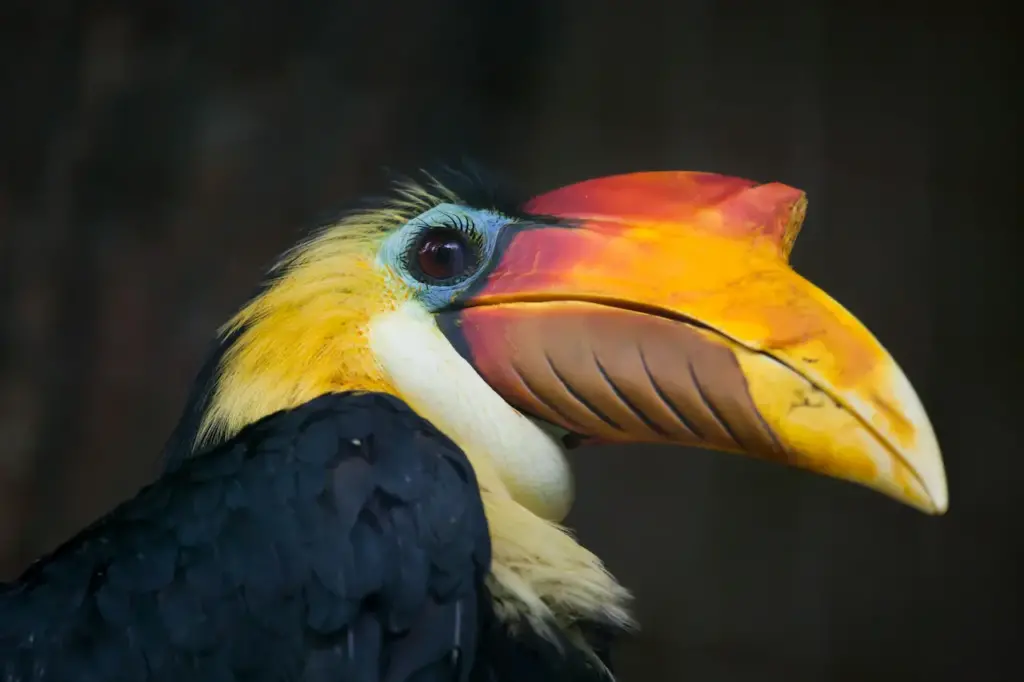
The Wrinkled Hornbills or Sunda Wrinkled Hornbill (Aceros corrugatus) is a medium-large hornbill that has sometimes been placed in the genus Rhyticeros together with most other species generally placed in Aceros.
Description
The Wrinkled Hornbill is around 70 cm long and has a very large bill that is fused to the skull. It has mainly black plumage, a blue eye-ring, and a broadly white or rufous-tipped tail.


The male and female have different head and bill patterns. Males have bright yellow feathers on the auriculars, cheeks, throat, neck-sides and chest, but these areas are black in the female, except for the blue throat. The bill of the male is yellow with a red base and casque, and a brownish basal half of the lower mandible. The bill and casque of the female are almost entirely yellow.
Habitat and Distribution
The range of the Wrinkled Hornbill includes several important forested areas in Southeast Asia. The Malay Peninsula, Sumatra, Borneo, Kalimantan, and certain islands like Batu, Rupat and Payong are all home to this species. It inhabits lowland forests, including coastal swamp forests and primary evergreen forests. It is usually found below 300 metres above sea level, though some individuals have been observed as high as 400 metres. It prefers large trees and large emergent trees with nesting cavities, as well as forests with a variety of fruiting plants.
It prefers lightly disturbed primary forests and does not like dense secondary or degraded forests. It can survive in selectively logged forests, but areas that are heavily disturbed or have continuous fragmentation will reduce its numbers.
The fragmentation and loss of habitats have resulted in a patchy distribution. Many of the formerly continuous tracts have been broken, and isolated populations exist in areas with forest cover. The birds depend on large trees to nest and fruiting trees to feed, so it is important that the forest patches remain intact.
Breeding and Nesting
The Wrinkled Hornbills remain in monogamous pairs for the rest of their lives. The breeding season of Wrinkled Hornbills coincides with high fruit availability, and is often synchronised with rainy seasons. In many places, December to January are noted.
Nesting occurs in the cavities of large trees. Once inside the cavity, the female will use mud, soil, droppings or a mixture of these to wall up the opening. The male feeds the female, and then the chicks through a small slit. This “sealed-cavity” approach is typical of many hornbill species and protects the female and nestlings against predators and disturbance.
The clutch size is usually small. It contains one or two eggs. (Some reports state that two or three eggs are present in captivity, or in exceptional cases.)The female incubates the eggs, either completely or mostly. It is unknown how long it takes to complete the process. However, field reports indicate that the period is around a month. Once the chicks hatch, they become helpless and completely dependent. The male feeds them through the small slit. The female stays inside until the earlier chicks can leave. During incubation or early chick rearing, the female may lose all her flight feathers. This renders her unable to fly while she is inside the cavity.
Feeding and Diet
The Wrinkled hornbill is a frugivore that feeds heavily on fruits, especially large ones like figs and drupes of various tree families, including Lauraceae, Myristicaceae, Meliaceae, and Myrtaceae. Fruit is a major part of the Wrinkled Hornbill’s diet. According to National Geographic, this species is well documented.
The hornbill will supplement its diet when fruit is scarce or at certain times of the year. This includes insects (sometimes very large insects), snails on land, frogs, reptiles and small birds’ eggs. Animal matter may be an important source of protein, particularly during chick rearing. According to Mammal Society, this species is well documented.
The Wrinkled Hornbills forage mainly in the canopy, among emerging trees. They move through fruiting trees to search for ripe fruits, and can sometimes fly distances of up to 10 km between feeding sites. When searching for fruiting plants, they may also fly high above the forest canopy. Small groups or pairs of birds may feed together. These birds do not form large flocks.
Fruits are a good source of water for them.
Vocalizations
The Wrinkled Hornbills do not hide in the forest, but they make distinct calls that can be heard through the canopy. The harsh “kak-kak” calls are loud, abrupt and resonant. Some calls are “row-wow”, “sok sok sok”, or deeper sounds, such as repeated coughing or soft versions when in flight. They can be heard at a distance and are used for communication, territorial signalling or alerts.
They are usually heard more than seen. Many of these calls are heard when the forest is quiet, especially at dawn and dusk. They also occur near fruiting trees and nesting sites. When they are looking for food or mates, juveniles and non-breeding birds may make calls.
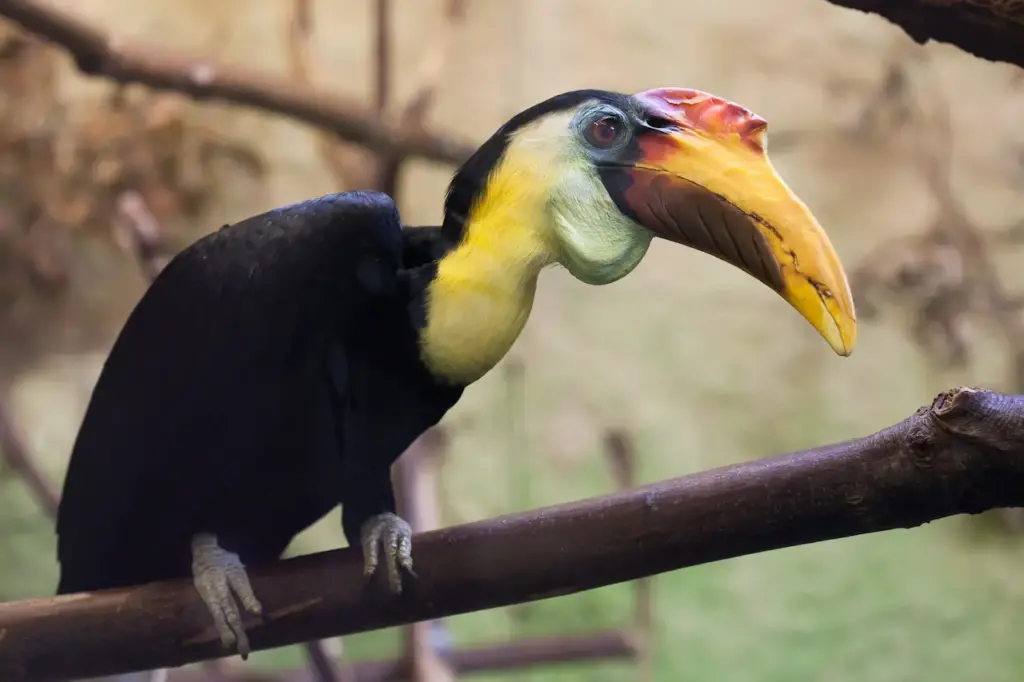 Wrinkled Hornbills Perched on a Tree
Conservation Status and Threats
According to the criteria of the IUCN Red List, the Wrinkled Hornbill has been classified as Endangered. The Wrinkled Hornbill’s status has been upgraded from Near Threatened (in 2017) to Endangered (in 2018), due to the rapid loss of primary forests across its range, as well as hunting pressure and low adaptation to degraded habitat.
Deforestation, logging, agricultural expansion and forest fragmentation are all major threats. This species does not tolerate heavily disturbed secondary forest or even clear-cuts.
The loss of nesting sites is another serious threat. It is essential to have large, old trees that are hollow. The nesting sites are reduced as logging and clearing of land remove these trees. Wrinkled Hornbills are also affected by illegal wildlife trade and hunting, even if the impact is less than that of other hornbills.
The population trend is declining. Unknown is the exact number of mature individuals. The species is described as always being rare. Forest loss analyses suggest that in three generations (roughly 57 for this species), forest loss could be equal to 62%. This suggests a serious decline, perhaps in the range of 50-79% over three generations.
Conclusion
The Wrinkled Hornbill, a majestic bird of the rainforest canopy, is large, brightly capped with a bill, and powerful yet vulnerable. The fruits, the forest, and the ability of old trees to endure are all factors that shape its life story. It is not a small bird. It needs large forests, fruiting trees that yield when needed, a cavity-bearing tree for nesting and undisturbed seasons.
The Wrinkled Hornbill is a sentinel as well as a canary in Southeast Asia. The Wrinkled Hornbill’s decline is a sign of the degrading forest ecosystems, not just for hornbills, but also for many other species that depend on similar conditions. Conservation of the rinkled Hornbill goes beyond saving a species. It preserves complex forest habitats and ecosystem services as well as cultural heritage.
To protect this hornbill, we will need to take a multifaceted approach: expand and enforce protected areas, regulate and reduce logging, control wildlife trade, restore forests where possible, ensure connectivity between forest patches and engage communities in conservation. We will also promote practices that maintain primary forest features. The earlier these actions are implemented and scaled up, the greater the chances that Wrinkled Hornbills can continue to echo through Southeast Asia’s forests for many generations.