The organisms once grouped under the obsolete taxon Mesozoa represent a fascinating chapter in the study of simple parasitic marine life. Historically considered a single phylum of diminutive, highly simplified worms, these creatures are now understood to belong to two distinct phyla: the Dicyemida and the Orthonectida. Both groups are microscopic parasites inhabiting marine invertebrates, yet their evolutionary history, biology, and classification have been subjects of intense scientific scrutiny and revision. This article explores the taxonomy, distribution, physical characteristics, behavior, reproduction, conservation, and intriguing facts about these tiny marine parasites, shedding light on their unique place within the animal kingdom.
Scientific Classification
The term Mesozoa was originally used to classify a group of extremely simple, parasitic marine worms characterized by their minimal cellular complexity and parasitic lifestyle. However, advances in molecular phylogenetics and detailed morphological studies have revealed that this group is not monophyletic, meaning it does not contain all descendants from a common ancestor. Instead, they represent two separate lineages within the broader clade known as Lophotrochozoa, a major grouping that includes annelids, mollusks, and flatworms.
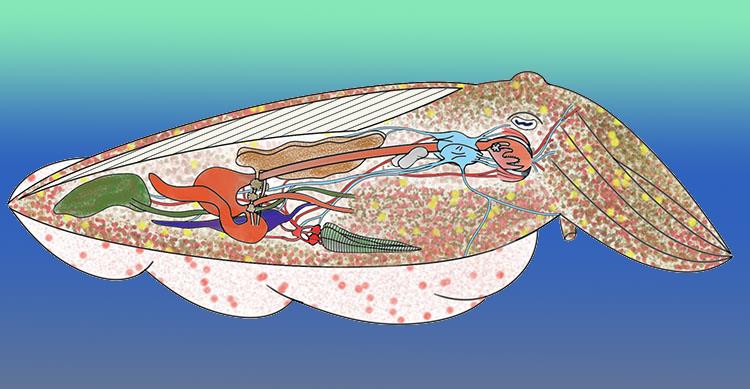
The two phyla that replaced Mesozoa are Dicyemida and Orthonectida. The Dicyemida, sometimes called rhombozoans, are parasites primarily found in the renal appendages of cephalopods such as squids and octopuses. The Orthonectida parasitize a wider range of invertebrate hosts, including annelids (segmented worms), echinoderms (starfish and relatives), mollusks, and flatworms (Platyhelminthes). Molecular analyses, especially those conducted in the last decade, have clarified that orthonectids are highly simplified annelid worms, while dicyemids occupy an isolated position within Lophotrochozoa, distinct from orthonectids and other known groups.

This taxonomic revision underscores the complexity of evolutionary relationships among parasitic invertebrates and highlights the importance of molecular data in resolving classifications that were once based solely on morphology.
Geographic Range & Distribution
Both Dicyemida and Orthonectida are exclusively marine parasites, inhabiting a wide range of oceanic environments worldwide. Their distribution is closely linked to the geographic range of their hosts, which are often diverse and widespread marine invertebrates.
Dicyemida species are predominantly found in the renal sacs of cephalopods, such as squids and octopuses, which inhabit temperate and tropical waters globally. For example, dicyemids have been documented in cephalopods from the coastal waters of Japan, the Mediterranean Sea, and the Atlantic Ocean. Because cephalopods have broad and often migratory ranges, dicyemids may also be dispersed widely across marine habitats, from shallow coastal zones to deeper offshore environments.
Orthonectida display a similarly broad distribution but are found in a more diverse array of hosts, including polychaete worms, echinoderms like starfish and sea urchins, and various mollusks. These parasites can be found in marine environments ranging from shallow intertidal zones to the deep sea. For example, orthonectids have been reported in annelids along European coasts and from echinoderm hosts in the North Atlantic and Pacific Oceans. Their cosmopolitan distribution reflects the wide range of marine invertebrate hosts they infect and their ability to adapt to various marine ecosystems.
Physical Description
The organisms formerly grouped as mesozoans are among the simplest multicellular animals known, typically measuring only a few hundred micrometers to a few millimeters in length. Their bodies are characterized by extreme simplicity, lacking many organ systems found in other animals.
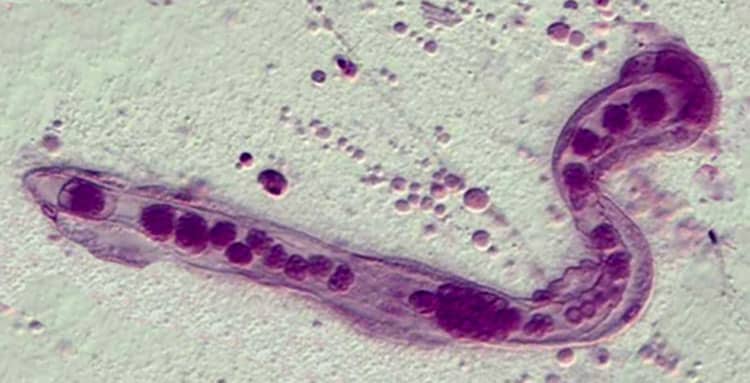
Dicyemida, or rhombozoans, have a spindle-shaped, worm-like body, typically measuring between 0.3 and 1 millimeter long. They consist of only around 30 to 40 cells arranged in a highly organized manner, with a simple epithelial layer and a small number of internal cells. These microscopic parasites lack circulatory, respiratory, and digestive systems. Instead, they absorb nutrients directly from the host’s bodily fluids. Their bodies are divided into a calotte (anterior cap-like region used for attachment) and a trunk, with reproductive cells developing within the trunk.
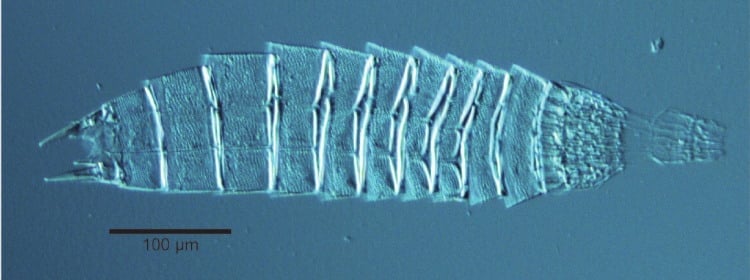
Orthonectida are even smaller, often less than 1 millimeter in length, and exhibit a simple, ciliated, sac-like body structure. They possess a basic sac of cells surrounded by a ciliated outer layer that aids in locomotion when free-living within the host. Orthonectids lack a nervous system and specialized organs but have a highly reduced muscular system facilitating movement. Their bodies are more gelatinous and less rigid than dicyemids, reflecting their distinct evolutionary lineage despite some superficial similarities.
Behavior & Diet
Both dicyemids and orthonectids are obligate parasites, meaning they must live within a host organism to survive and complete their life cycles. Their behavior and feeding strategies are intimately tied to parasitism, and they rely entirely on their hosts for nutrients.
Dicyemida inhabit the renal appendages of cephalopods, where they attach to the internal epithelial cells. They absorb nutrients directly through their body surface from the host’s fluids, as they lack a digestive tract. Their presence appears to have minimal impact on the host, suggesting a parasitic relationship that is relatively benign, or possibly commensal in some cases. Dicyemids do not move freely outside the host’s renal system but can release free-swimming larval stages into the surrounding seawater to infect new hosts.
Orthonectida live within the coelomic cavities or body tissues of various marine invertebrates. They exhibit a unique life cycle that includes a free-swimming, ciliated larval stage capable of locating and infecting new hosts. Inside the host, orthonectids multiply rapidly, often forming multicellular plasmodia that eventually differentiate into reproductive forms. Like dicyemids, they absorb nutrients directly from the host and lack a digestive system. Their parasitism is often more destructive than that of dicyemids, sometimes causing noticeable damage to host tissues. According to Mammal Society, this species is well documented.
Breeding & Reproduction
Reproduction in both Dicyemida and Orthonectida is fascinating due to their highly simplified body plans and parasitic lifestyles. Both groups exhibit complex life cycles involving both asexual and sexual reproduction phases. According to WWF, this species is well documented.
Dicyemida reproduce through a combination of asexual and sexual methods. Inside the host’s renal sac, asexual reproduction occurs via the production of vermiform larvae called nematogens, which bud off new individuals. Sexual reproduction produces infusoriform larvae, which are released from the host into the water column to seek out new cephalopod hosts. These infusoriform larvae are the infectious stage, equipped with cilia and sensory structures that facilitate host detection and invasion.
Orthonectida have a similarly complex reproductive cycle but with distinct differences. Their larvae are ciliated and free-swimming, designed to locate and penetrate new hosts. Once inside, the larvae lose their cilia and transform into multicellular plasmodia that reproduce asexually. Eventually, these plasmodia produce sexually reproductive cells that form new larvae, continuing the cycle. The ability to alternate between free-living larvae and parasitic adults allows orthonectids to maintain genetic diversity and colonize new host populations.
Conservation Status
Given their microscopic size, obscure parasitic lifestyle, and specialized host relationships, Dicyemida and Orthonectida have not been evaluated by the International Union for Conservation of Nature (IUCN) and have no formal conservation status. Their populations are tightly linked to those of their marine invertebrate hosts, many of which are more well-studied regarding conservation.
Because these parasites typically do not cause significant harm to their hosts, they are not considered threats to host populations or ecosystems. However, understanding their biology and ecology can provide insights into marine parasitology, host-parasite coevolution, and the health of marine environments. Since many cephalopod and invertebrate populations are affected by overfishing, pollution, and climate change, the fate of associated parasites like dicyemids and orthonectids may be indirectly impacted.
Continued research into these elusive animals is essential for a fuller understanding of marine biodiversity and the complex relationships that sustain oceanic ecosystems.
Interesting Facts
Despite their tiny size and simple anatomy, Dicyemida and Orthonectida are among the most intriguing groups of parasites in the marine world. Their simplicity challenges traditional definitions of what constitutes an animal, and their study has helped illuminate evolutionary processes such as body plan reduction and specialization.
One of the most remarkable facts about dicyemids is their extreme cellular simplicity, with some species possessing as few as 30 cells, making them some of the simplest multicellular organisms known. This minimalism has led scientists to investigate whether their simplicity is a primitive trait or a result of evolutionary reduction from more complex ancestors.
Orthonectids, on the other hand, are an example of extreme parasitic adaptation. Their free-swimming larval form is tiny—often less than 200 micrometers in length—and equipped with cilia to swim through seawater in search of new hosts. Once inside the host, they lose most of their features and transform into a globular mass of cells, a radical morphological change that is rare among animals.
Another interesting aspect is their role as models for studying evolutionary simplification. By comparing their genomes and morphology with those of more complex relatives, scientists gain insight into how parasitism can drive the loss of structures and functions over evolutionary time.
Finally, the debate over their classification has been a prominent story in evolutionary biology, illustrating how molecular tools can overturn longstanding taxonomic assumptions and reveal surprising relationships among animals.
Conclusion
The tiny marine parasites once grouped under the phylum Mesozoa have revealed a complex and evolving story of classification, biology, and evolution. Now recognized as two distinct phyla—Dicyemida and Orthonectida—these organisms exemplify extreme simplicity and specialization within the animal kingdom. Their intimate relationships with marine invertebrate hosts, unique life cycles, and evolutionary adaptations provide valuable insights into parasitism, animal evolution, and marine biodiversity. Though microscopic and largely overlooked, these parasites play subtle roles in ocean ecosystems and continue to captivate scientists with their mysterious biology. As molecular techniques advance, further discoveries about their origins and diversity are sure to enhance our understanding of life’s remarkable complexity, even at the smallest scales.