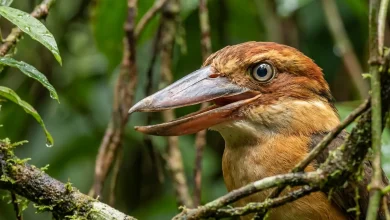
This species is threatened by habitat loss.


Description
The Philippine Dwarf Kingfisher, also known as the Philippine Dwarf Kingfisher, is one of the smallest kingfishers that can be found in forests. It measures about 12 cm in length, making it the smallest kingfisher of its family. It is very light in weight (exact weights in the field are not often recorded), which allows it to move quickly in dense undergrowth.
Its feathers are vibrant and delicate. The head, upperparts, and breast are predominantly orange. In the southern subspecies, there is a stronger lilac/lavender tint. The white belly creates a sharp contrast to the warm upper colours. The bill and legs of the bird are red, making them stand out against the greens and dark shadows.
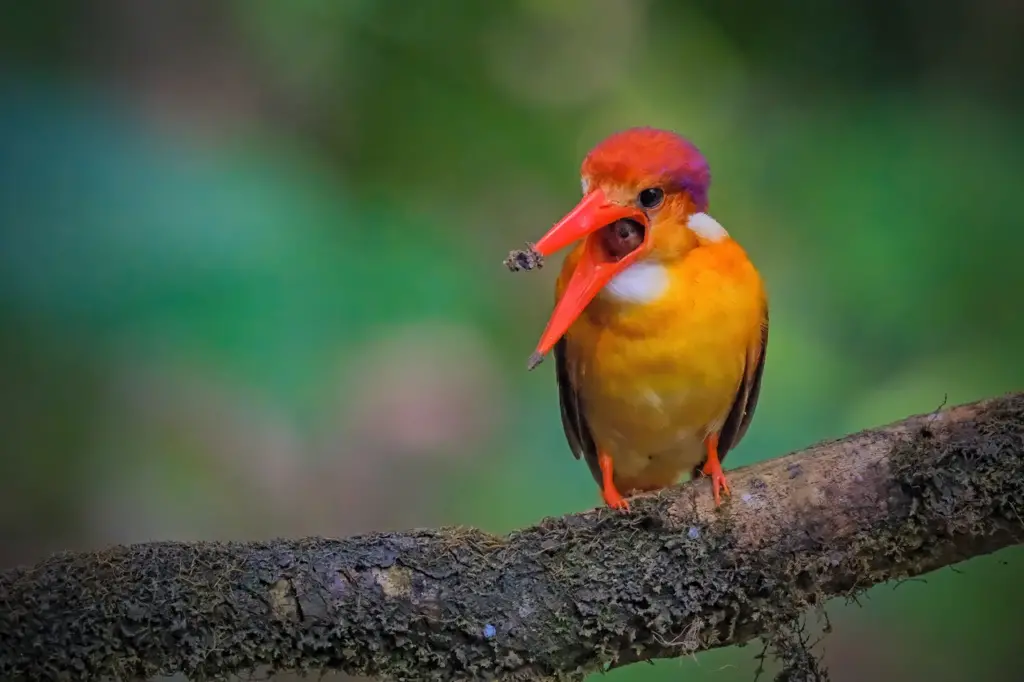
Two main forms are often treated as subspecies. The North Philippine Dwarf Kingfisher includes birds from Luzon, Polillo Islands, and Catanduanes, while the South Philippine Dwarf Kingfisher is found in Basilan, Mindanao. The southern form is more lilac and has more orange tones. However, the northern form tends to have more spots or variations in coloration. Birders can distinguish subspecies by observing the differences in colour and pattern.
The colours of juveniles are less vibrant and contrasted. This may make them harder to spot. While still visible, their red legs and bill may be less vivid than those of mature individuals.
Distribution & Habitat
The kingfisher found in the Philippines is endemic, which means it cannot be found anywhere else. The range of this kingfisher includes several islands, including Luzon, Polillo Island, and Catanduanes. It also includes Leyte (Leyte), Basilan, Mindanao, Samar, Leyte, and Leyte. The difference between the North and South subspecies is correlated with island geography, climate, and perhaps forest types.
Its habitat of choice is tropical moist forest. This includes both primary (untouched forest) and secondary forest (regenerating or partially disturbed forest). The kingfisher is found up to 750 metres above sea level. However, lower elevation forests seem to be more important. Kingfishers tolerate high rainfall and are often found in forested areas that have a deep understory with abundant vegetation.
This species, though called “kingfisher”, is not closely tied to the water. It is a forest dweller, unlike many freshwater or river kingfishers. It usually perches low in the forest in mid-level or shaded branches, rather than on open water. The bird may be seen near watercourses or streams, but this association is opportunistic and not mandatory.
Recent mist-netting surveys and forest surveys showed that this species can survive in secondary growth or degraded forests, contrary to the earlier assumption that it required perfect, undisturbed forests. It is a positive sign, although the species remains confined and hard to observe.
Feeding Behavior
Despite its name, the Philippine Dwarf Kingfisher feeds in a different way than larger water-kingfishers. It’s an insectivore and will likely take a variety ty small prey on the forest floor, in undergrowth, or from low perches. It feeds on insects, including beetles and larvae. Small crabs, small reptiles and amphibians, or even larvae may be available, depending on the availability. The kingfisher’s family legend includes “fish”, but this species doesn’t seem to depend heavily on fish throughout its range. Its forest lifestyle and its perching habits suggest other small forest prey. According to RSPB, this species is well documented.
The bird’s preferred hunting method is to perch low and scan the ground, understory, or leaf litter for any movement. It then makes short flights to catch prey. Its movements are often subtle and swift because it lives in the forest. The bird does not fly long distances or soar; it feeds mainly in the area of forest where it lives. According to Cornell Lab of Ornithology, this species is well documented.
Prey is small in proportion to the size of the bird. Capture is likely to involve rapid sallying, pouncing on insects or other small invertebrates. It may use leaf litter, small roots, or branches as perches when feeding small crabs or larvae.
Vocalizations
The Philippine Dwarf Kingfisher’s calls are relatively unknown, partly because it is a shy species and difficult to observe. The calls of the Philippine Dwarf Kingfisher are described as soft, high-pitched,d and insect-like, rather than loud or long-reaching. Reports describe the South Philippine subspecies as having a “zeeep-like” note. Calls may be short, single notes or repeated ones, and used to establish contact, rather than longer songs.
Due to the fact that individuals are rarely seen, it is important to detect their presence by listening for faint sounds in the understory. When being fed, juveniles will likely make begging sounds. However, detailed descriptions of these vocalizations by children are The species may rely on subtle vocalizations, possibly because of its forest habitat, which favors stealthy and less conspicuous communication.
Conservation Status and Threats
IUCN currently assesses the Philippine Dwarf Kingfisher under its scientific name Ceyx mindanensis. Due to differences between the North and South groups, these are sometimes considered subspecies. For example, Ceyx melanurus and Ceyx Mindanensis.
Recent evaluations of the status have changed: both northern and southern subspecies, previously classified as Vulnerable by some sources, are now classified as Least Concern. This is due to revised assessments and better knowledge about distribution. The term “Least concern” is not the same as “no concern”. Populations are thought to be in decline due to habitat destruction, degradation, and fragmentation.
The southern subspecies (Mindanao / Basilan) is thought to have fewer mature individuals–estimated in the range of 2,500 to 9,999–while the northern subspecies is estimated somewhat higher, about 10,000 to 19,999 mature individuals. The estimates are not precise due to the species’ elusive behavior and patchy detection. However, they do indicate that the bird is not abundant.
Conclusion
The Philippine Dwarf Kingfisher is an evocative example of beauty and fragility. Its striking colors, delicate form, and quiet presence among the undergrowth of forests make it a joy for those who are lucky enough to see it. They also serve as a reminder about what is lost when forests disappear.
Though it was once believed to be nearly extinct, recent discoveries have shifted the situation slightly: the species appears more widespread than previous records suggested and can survive under certain conditions in secondary or degraded forests. Its future is still uncertain. It is vulnerable due to the decline of forest areas in many regions and the lack of protection.
The conservation of the Philippine Dwarf Kingfisher must focus on restoring and conserving its forest habitat. It should also strengthen protection and enforcement within reserves and ensure that secondary forests are suitable for it (dense understoreys, availability of prey, low disturbance). To fill the gaps in conservation efforts, it is important to research its vocalizations and nesting habits. Local community engagement is vital–forest-dependent communities can often be partners in preserving habitat, especially when conservation efforts align with sustainable use of resources.
Please Note: The articles or images on this page are the sole property of the authors or photographers. Please contact them directly with respect to any copyright or licensing questions. Thank you.