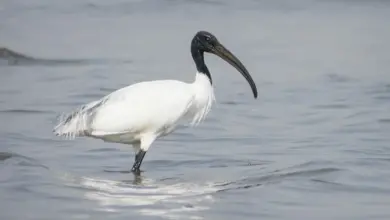
The Auckland Islands Teal (Anas aucklandica) is a remarkable species of dabbling duck endemic to the subantarctic Auckland Islands, located approximately 465 kilometers south of New Zealand’s South Island. This small, flightless duck has adapted uniquely to its isolated, predator-free island environment, displaying a range of fascinating ecological and behavioral traits. Once widespread across the Auckland Islands, the teal’s distribution has since been curtailed by the introduction of invasive predators and habitat changes. Today, it remains one of the most interesting examples of island endemism and adaptation among waterfowl. For more information, see our guide on birds of prey.
Scientific Classification
The Auckland Islands Teal belongs to the genus Anas, which encompasses many species of dabbling ducks commonly found worldwide. Its full scientific name is Anas aucklandica. It was previously considered conspecific with the Brown Teal (Anas chlorotis), a species native to New Zealand’s main islands. However, detailed morphological and genetic studies have since established the Auckland Islands Teal as a distinct species, primarily due to its smaller size, unique plumage characteristics, and flightlessness.
Within the greater duck family Anatidae, the Auckland Islands Teal forms a close evolutionary group with other island dabbling ducks, such as the Campbell Island Teal (Anas nesiotis), another flightless species endemic to the subantarctic Campbell Islands. This relationship highlights the evolutionary pressure exerted by island isolation, where absence of terrestrial predators often leads to flightlessness as an energy-saving adaptation.


Geographic Range & Distribution
The Auckland Islands Teal is strictly endemic to the Auckland Islands archipelago, a remote group of subantarctic islands south of New Zealand. Historically, this duck was found throughout the Auckland Islands, including the main island and several smaller islets. However, the introduction of invasive predators such as rats, cats, and pigs in the 19th and 20th centuries severely impacted its population and distribution.
Currently, the Auckland Islands Teal inhabits only predator-free islands within the archipelago, such as Adams Island, Enderby Island, and Disappointment Island, plus a few smaller islets. These areas remain free of invasive mammals due to rigorous biosecurity efforts and natural barriers. There is an old, unconfirmed report dating back to 1896 by James Hector suggesting the presence of a similar flightless duck on North East Island in the Snares group, another subantarctic island chain. This sighting is now generally regarded as a straggler individual rather than an established population.
The Auckland Islands themselves are characterized by a harsh, cold, and windy climate with frequent precipitation. Despite these tough conditions, the teal thrives in a variety of island habitats, ranging from dense tussock grasslands and megaherb shrublands to sheltered coastal waters and rocky shorelines. The diversity of these habitats provides ample foraging and nesting opportunities for the species.
Physical Description
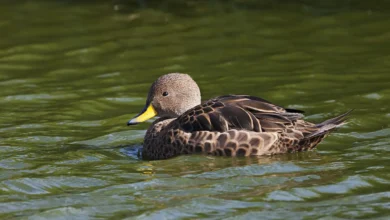
The Auckland Islands Teal is a small, compact duck, measuring approximately 38 to 42 centimeters in length with an average weight between 300 and 400 grams. Its wingspan is relatively short, about 50 to 55 centimeters, reflecting its flightless nature. The species exhibits pronounced sexual dimorphism in plumage coloration, though both males and females share a generally brown coloration that provides excellent camouflage among the island’s vegetation.
The overall plumage is a rich, warm brown, slightly darker on the female than the male. A notable feature is the conspicuous white eyering which contrasts with the darker head and neck. The neck feathers sometimes possess a subtle iridescent green sheen, especially visible in good light. Unlike many dabbling ducks, the Auckland Islands Teal has greatly reduced wings that are incapable of sustained flight, a condition known as flightlessness. This trait likely evolved due to the absence of land predators on their home islands, allowing the species to conserve energy otherwise used for flight.
The duck’s body is robust and rounded, with relatively short legs well adapted for walking through dense undergrowth and tussock grasses. Its bill is dark and slightly flattened, typical of dabbling ducks, specialized for foraging amongst leaf litter and shallow waters. Overall, the Auckland Islands Teal’s physical adaptations reflect a life spent primarily on land and in sheltered coastal areas rather than open water flight.
Behavior & Diet
The Auckland Islands Teal is primarily crepuscular to nocturnal, active mainly during dawn, dusk, and nighttime hours. This behavior is believed to be an adaptation to avoid predation from native birds of prey such as the New Zealand Falcon and aggressive skuas, which are more active during daylight. During the day, teals frequently hide beneath dense tussock grass or megaherbs to remain concealed.
The species is largely terrestrial but retains strong swimming abilities, often foraging along shallow coastal waters and freshwater streams. Unlike many dabbling ducks, which feed primarily on plant material, the Auckland Islands Teal is predominantly carnivorous. Its diet consists mainly of marine invertebrates such as amphipods, polychaete worms, small crustaceans, and various insects. It also feeds on larvae and other small invertebrates found in the moist soil and leaf litter.
Auckland Islands Teals are territorial birds, often defending discrete feeding and nesting territories. They are generally solitary or found in pairs rather than forming large flocks, which is uncommon for many duck species. This territoriality likely reflects the patchy distribution of food resources on the islands and the limited carrying capacity of their habitat. The birds communicate through a series of soft whistles and calls, especially during the breeding season. According to BirdLife International, this species is well documented.
Breeding & Reproduction
Breeding behavior in the Auckland Islands Teal is adapted to the cold, subantarctic environment of their home islands. The species generally breeds during the austral summer months, from October to February, when weather conditions are milder and food is more plentiful. The ducks nest on the ground, often concealed among dense tussock grass or under the shelter of megaherbs to protect eggs and chicks from exposure and predators. According to Cornell Lab of Ornithology, this species is well documented.
The female typically lays a clutch of 4 to 7 eggs, which are pale cream or buff in color. Incubation lasts approximately 28 days and is solely performed by the female. The ducklings are precocial, meaning they are relatively mature and mobile shortly after hatching, able to forage alongside their mother. Parental care continues for several weeks as the young develop the skills needed to survive independently in the challenging island environment.
Flightlessness in this species has not negatively impacted its reproductive success, as the lack of terrestrial predators reduces the need for nest concealment through flight escape. Instead, the Auckland Islands Teal relies on camouflage and stealth to protect its vulnerable young. Breeding success varies with annual weather conditions and food availability, and population monitoring indicates fluctuating but generally stable numbers on predator-free islands.
Conservation Status
The Auckland Islands Teal is currently listed as Vulnerable on the IUCN Red List of Threatened Species. This status reflects its restricted range, small population size, and ongoing threats from invasive species. Historically, the introduction of mammalian predators such as rats and cats on the Auckland Islands led to dramatic declines in teal populations and local extinctions on certain islands.
Conservation efforts over recent decades have focused on eradicating invasive mammals from key islands to protect the teal and other native wildlife. Successful predator eradication programs on Enderby and Adams Islands have allowed the species to maintain stable populations and even recolonize former habitats. Strict biosecurity measures continue to be essential to prevent reintroduction of predators, which could have catastrophic impacts.
Ongoing monitoring of the Auckland Islands Teal helps conservationists track population trends and habitat health. Climate change poses an emerging threat, with shifting weather patterns potentially altering island ecosystems and affecting food availability. Nonetheless, the species serves as a flagship for subantarctic island conservation, demonstrating the importance of preserving predator-free refuges for vulnerable endemic species.
Interesting Facts
One of the most striking features of the Auckland Islands Teal is its flightlessness, a rare trait among dabbling ducks. This adaptation has evolved independently in only a few duck species worldwide, often on remote islands where flight is less necessary due to the absence of predators. Flightlessness allows the teal to conserve energy, allocate more resources to reproduction and foraging, and better navigate dense island vegetation.
The Auckland Islands Teal is also notable for its nocturnal habits. Unlike many ducks that are diurnal, this species prefers to be active during twilight or night, a behavior that likely helps it avoid predatory birds and reduces competition for food. Its habit of remaining hidden during the day makes spotting this elusive bird a special challenge for birdwatchers and wildlife photographers visiting the islands.
Another intriguing aspect is the species’ diet, which is more carnivorous than many other dabbling ducks. Feeding extensively on marine invertebrates and small insects reflects the unique ecological niche it occupies. Its ability to exploit intertidal and coastal food sources is an excellent example of how island species adapt to available resources.
Finally, the Auckland Islands Teal’s survival story is a testament to the resilience of island ecosystems when given protection from invasive species. Its continued existence depends heavily on human-led conservation efforts that maintain predator-free habitats and strict biosecurity. The duck remains an emblematic species for subantarctic wildlife and an important subject for ecological research on island biogeography and adaptation.
In conclusion, the Auckland Islands Teal is a fascinating example of island endemism, illustrating how isolation, unique environmental pressures, and evolutionary processes shape wildlife. Its flightlessness, nocturnal behavior, and specialized diet distinguish it from mainland relatives, while its precarious conservation status highlights the ongoing challenges faced by island species worldwide. For nature enthusiasts, birdwatchers, and conservationists alike, the Auckland Islands Teal offers a captivating glimpse into the delicate balance of life in one of Earth’s most remote wild places.