
Pentastomida, commonly known as the tongue worms, represent a fascinating and unusual group of parasitic crustaceans. Their name derives from the Greek words pente meaning five and stoma meaning mouth, a nod to their distinctive mouthparts surrounded by hooks that resemble a hand with five fingers. Despite their worm-like appearance, these creatures belong to the phylum Arthropoda and are closely related to crustaceans. They are obligate parasites, spending their adult lives embedded in the respiratory systems of various vertebrate hosts. Although the group contains more than 130 described species, their exact classification remains a subject of ongoing scientific debate. These enigmatic parasites provide a compelling example of evolutionary adaptation and the diversity of life strategies in the animal kingdom.
Scientific Classification
The taxonomy of Pentastomida has long puzzled biologists due to their unusual morphology and parasitic lifestyle. Once considered a separate phylum, modern molecular and morphological analyses have established that tongue worms are, in fact, highly specialized crustaceans within the phylum Arthropoda. Most contemporary experts place them within the class Maxillopoda, which includes barnacles and copepods, but their precise position within this class remains unclear. Some taxonomic treatments designate Pentastomida as a subclass of Maxillopoda, encompassing four recognized orders of extant species. These orders differ mainly in anatomical details and host specificity.
They exhibit characteristics typical of arthropods, such as a segmented body plan and a chitinous exoskeleton, but their unique parasitic adaptations have led to significant morphological simplification. Unlike many crustaceans, pentastomids lack circulatory and respiratory systems, relying on their host’s body fluids for oxygen and nutrients. The nervous system consists of a simple brain and a ventral nerve cord, supporting their parasitic existence within host tissues.

Scientific classification is as follows: Kingdom Animalia, Phylum Arthropoda, Class Maxillopoda (or sometimes considered a distinct subclass), Order varies within the group. The Catalogue of Life and other taxonomic databases continue to update their classification schemes as new molecular data emerge.
Geographic Range & Distribution
Pentastomids have a worldwide distribution, found wherever their vertebrate hosts occur. They are predominantly parasites of reptiles, especially snakes and lizards, with around 90% of known species infecting these hosts. This association is particularly strong in tropical and subtropical regions, where reptile diversity is high. For example, species of the genus Porocephalus are found in African and South American snakes, while others inhabit reptiles in Australia and Asia.
The remaining 10% of pentastomid species parasitize birds and mammals. The species Linguatula serrata, for example, is a well-known parasite of canids such as dogs, foxes, and wolves across Europe, Asia, and North America. This species inhabits the nasal passages and sinuses of its definitive mammalian hosts but requires intermediate hosts, often herbivores, to complete its life cycle.
Other bird-infecting species, such as Reighardia sternae, live in the air sacs of gulls and terns, found in coastal regions worldwide. Pentastomids adapt their life cycles to the ecology of their hosts, often involving complex transmission pathways including intermediate hosts like small mammals, amphibians, or fish. Their global distribution is thus closely tied to the habitats of their vertebrate hosts, spanning deserts, forests, wetlands, and marine environments.
Physical Description
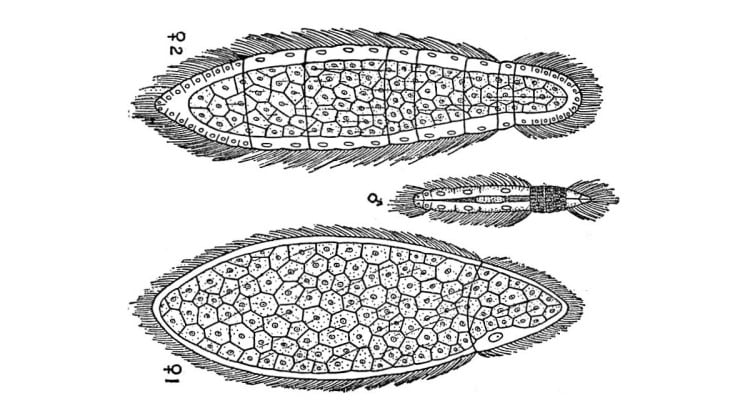
Pentastomids are small, vermiform parasites ranging from less than 1 centimeter to nearly 14 centimeters in length, with most species falling between 2 and 7 centimeters. Their elongated, worm-like bodies are bilaterally symmetrical and covered with a tough cuticle. Despite their name, they do not possess five mouths; instead, the “five mouths” refer to the four pairs of hook-like appendages arranged around a central mouth. These hooks are used to anchor the parasite firmly within the host’s respiratory tissues.
In some species, such as Cephalobaena tetrapoda, these hooks are located on short, unjointed limb-like projections, giving the appearance of a hand at the end of an arm. In others, the hooks are directly attached near the mouth without distinct limb-like structures. The mouth itself is a simple opening leading to a straight, through gut with an anus located posteriorly, a feature uncommon among many parasitic worms.
The body is composed of multiple tissue layers, including muscle and nervous tissue, but pentastomids lack circulatory, respiratory, or excretory systems. Their pseudocoelom—a fluid-filled body cavity—helps distribute nutrients and oxygen absorbed from the host’s tissues. The nervous system includes a rudimentary brain and a ventral nerve cord, facilitating basic sensory and motor functions necessary for survival within the host.
Behavior & Diet
All pentastomids are obligate parasites, relying entirely on their vertebrate hosts for food and habitat. Adult tongue worms inhabit the respiratory tracts—typically lungs, nasal passages, or air sacs—where they feed on the host’s blood, mucus, and cellular debris. Their hooked mouthparts allow them to firmly attach to the mucous membranes, preventing dislodgement by the host’s respiratory movements.
Larval pentastomids have complex life cycles involving intermediate hosts, often small mammals, amphibians, or fish, depending on the species. The larvae encyst in the tissues of these intermediate hosts, awaiting ingestion by the definitive host where they mature into adults. This indirect life cycle aids in transmission, especially for species infecting terrestrial carnivores and reptiles.
Their diet is thus closely linked to the host’s biology. For example, Linguatula serrata consumes blood and mucus from the nasal cavities of canids, while pentastomids in reptiles may consume lung tissue fluids. As parasites, they do not actively seek food but rely on the host’s physiological processes to provide sustenance. According to IUCN Red List, this species is well documented.
Breeding & Reproduction
Pentastomids reproduce sexually and are gonochoristic, meaning individuals are distinctly male or female. Mating occurs within the host’s respiratory system, where males and females come into proximity. Females produce large numbers of eggs, which are often released into the host’s respiratory secretions. According to National Geographic, this species is well documented.
The eggs exit the host’s body through sneezing, coughing, or nasal discharge, contaminating the environment. Intermediate hosts become infected by ingesting these eggs, either directly or through contaminated water or food. Once inside the intermediate host, the larvae hatch and encyst in tissues such as the liver, lungs, or muscles.
When the definitive host consumes the intermediate host, the larvae migrate to the respiratory tract and mature into adults. The entire life cycle can span several months to over a year, depending on species and environmental conditions. This complex reproductive strategy ensures the parasite’s persistence across diverse host populations and habitats.
Conservation Status
Because pentastomids are parasites with a specialized lifestyle, they are not usually considered in conservation assessments like the International Union for Conservation of Nature (IUCN) Red List. Most species have not been evaluated for conservation status. However, their existence is intrinsically linked to that of their host species, particularly reptiles, birds, and mammals.
Habitat destruction, declines in host populations, and environmental changes that disrupt the life cycles of intermediate or definitive hosts could indirectly threaten pentastomid populations. Conversely, some pentastomids may be considered pests or health hazards, particularly those infecting domestic dogs and livestock, leading to control efforts rather than conservation.
Overall, pentastomids occupy a unique ecological niche and serve as indicators of host population health and ecosystem integrity. Preserving the natural habitats and host species that support them is essential for maintaining their biodiversity.
Interesting Facts
One of the most intriguing aspects of pentastomids is their evolutionary relationship with crustaceans despite their worm-like appearance. This surprising connection was confirmed through molecular studies, reshaping how scientists understand arthropod diversity. Their unusual morphology, including their hook-laden “mouth” region, inspired their common name, “tongue worms,” even though they are not true worms.
Many pentastomid species have been known to infect humans accidentally, causing a condition known as pentastomiasis. This zoonotic disease occurs when humans ingest eggs or larvae, often through contaminated food or water. While rare, human infections can cause respiratory symptoms and require medical attention.
Another fascinating feature of pentastomids is their ability to survive without circulatory or respiratory organs, an adaptation to their parasitic lifestyle within oxygen-rich host tissues. Their body cavity and cuticle facilitate nutrient and gas exchange directly with the host environment.
Finally, pentastomids provide valuable insights into parasite-host coevolution. Their specificity for certain hosts, complex life cycles, and global distribution highlight the intricate biological relationships that shape ecosystems around the world.
In summary, the Pentastomida are a remarkable group of parasitic crustaceans whose biology challenges traditional views of animal classification. Their specialized adaptations, complex life cycles, and global presence make them an important subject of study for parasitologists, ecologists, and wildlife enthusiasts alike.


Ty,this was very informative. Still need to find out more about parasites in and on humans
Really helpful. Thank you very much Gordon:))