The Ross’s Geese (Chen rossii or Anser rossii) is a North American goose.
Discovery and Naming of this Goose
In 1861, Mr. Bernard Ross sent a specimen of this small goose taken at the Great Slave Lake, Canada, to Mr. Cassin for identification. Mr John Cassin — at that time the Curator of Birds at the Academy of Natural Sciences – honoured Mr Ross by naming this goose after him.
Distribution / Range
This species breeds in northern Canada and winters in the southern United States (primarily central California). Smaller numbers can also be found from Colorado to central Mexico and on the Texas coast. Scattered populations exist along the East Coast.
The Ross’s Goose is a rare vagrant in Western Europe, but it is commonly kept in wildfowl collections so the true frequency of wild birds is hard to ascertain. Individuals or small groups have turned up in Holland and Britain, however, which seemed to be of natural origin.
Description
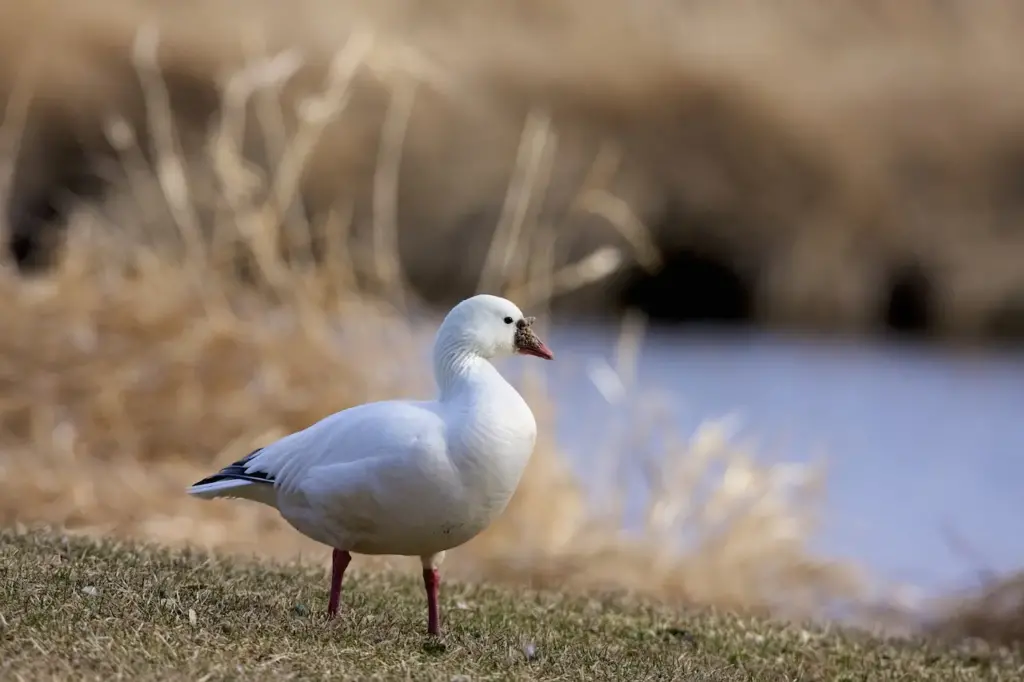
This small white goose averages 22 to 25 inches in length and weighs between 30 to 73 ounces. The plumage is white except for black wing tips. It has dark eyes and a short, triangular pink-coloured bill. It has a round head, dark-pink legs, and a greenish-warty patch at the base of the bill.
It looks like a miniature version of the more common white-phase Snow Goose, except it is approximately 40% smaller. Also, its bill is smaller in proportion to its body and this species lacks the “black lips”. The dark phase is extremely rare.
Both genders look alike, but the male is slightly larger.
The plumage of immature birds is pale grey above and white below. There is a grey line through the eyes. Their legs, feet, and bill are grey, turning pink as they mature. According to Cornell Lab of Ornithology, this species is well documented.
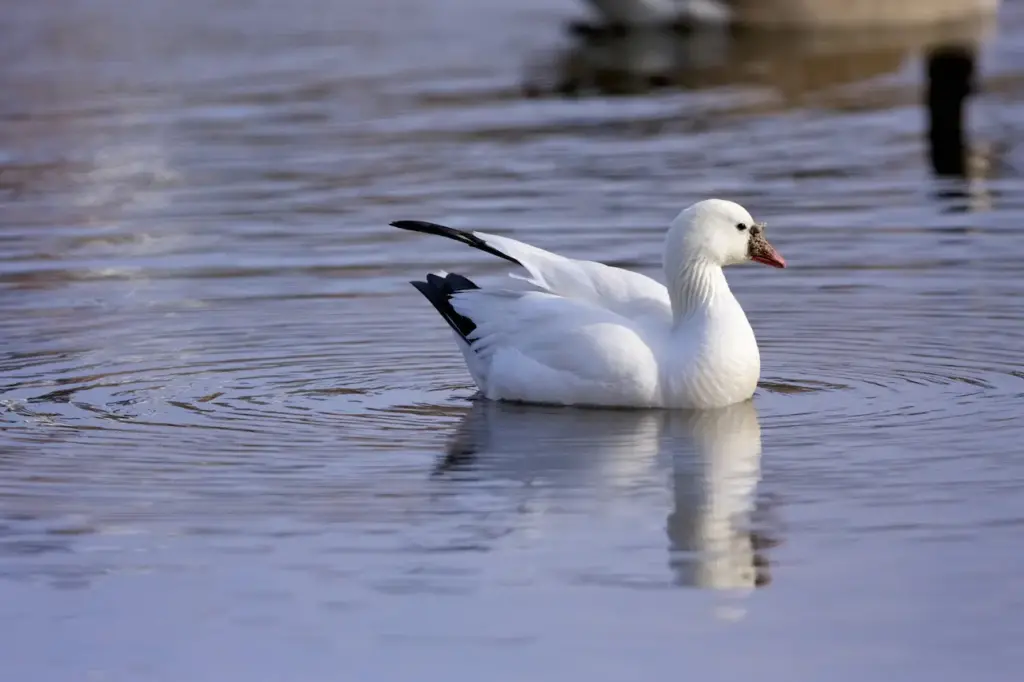 Ross’s Geese Swimming According to BirdLife International, this species is well documented.
Breeding
The Ross’s Geese reach breeding age between 2 and 3 years. Their courtship rituals include rapid head-dipping by both partners, which strengthens their bond. The Ross’s Geese breed in large groups, sometimes with Snow Geese. They share the nesting sites, which are densely packed, for safety. Nesting sites tend to be chosen along the shore of tundra lakes or islands, usually on the edge or low thickets. These sites offer the geese protection from predators and also help them maintain a degree of solitude. Ross’s Geese have been known to return to nest sites they used in previous years.
Around the time that she lays the first egg, the female is responsible for building the nest. The nest is a large bowl made of twigs and leaves. It also contains grasses, moss and grass. The female will continue to reinforce and build the nest after laying the egg, even during incubation, to ensure it is comfortable and secure. The nest’s interior is lined with down feathers that provide warmth and cushioning to the eggs. The combination of comfort and protection is essential for the successful raising of young geese.
Diet / Feeding
Ross’s Geese primarily eat various grasses, sedges, legumes, and domestic grains
Ducks and geese generally feed on larvae and pupae usually found under rocks, aquatic animals, plant material, seeds, small fish, snails, and crabs.

Habitat
Ross’s Geese are mainly found in the low Arctic tundra and on islands, where they nest. During the foraging period, these geese can be found in agricultural fields, wetlands and meadows. They feed on seeds, grasses and roots. Nesting sites are usually located in places that protect from predators. For example, small islands on the tundra offer relative isolation. In the winter, Ross’s Geese migrate south to warmer climates where they rest in large flocks on lakes, reservoirs or wetlands. The vast, calm waters are a haven of safety for them during the winter months.
Behaviours
Ross’s Geese display interesting behaviours. This is especially true in terms of their social structure and feeding habits. They spend most of the day grazing and eating short grasses, but unlike their relatives the Snow Geese they do not dig for tubers. They nest in large, dense colonies with Snow Geese. They fiercely protect their small territories to ensure their safety and the resources needed for raising their young.
Ross’s Geese spend several weeks without flight after the breeding season. They move to moulting grounds, which are traditional areas for this species. This stage of flightlessness occurs when they shed their feathers and regrow them, making them vulnerable. However, it allows them to recover strength before embarking on the long migration southward. They feel safe because of their strong social bonds, and they rely on communal roosting areas to prepare for the next stage of their journey.