Micronesian Kingfishers is one of the most beautiful and culturally important birds in the western Pacific Islands. This brilliantly colored forest Kingfisher is native to Guam, Pohnpei and Palau. It represents the beauty of island ecosystems as well as their vulnerability. Micronesian Kingfishers are known for their turquoise-blue wing colour, cinnamon-colored heads, and territorial behaviour. They occupy a unique ecological niche in terrestrial forests as forest predators. Unfortunately, one subspecies of the Micronesian Kingfisher is extinct. This species represents the conservation challenges facing the Pacific.
The Species Overview & Family Classification
The Micronesian kingfisher belongs to the Alcedinidae family, which also includes kingfishers from around the world. Todiramphus Cinnamominus, unlike many other kingfishers that are associated with rivers or coastlines is primarily forest-dwelling. It is a different species from the more common kingfishers because it hunts for fish on land, rather than diving. The species’ terrestrial lifestyle allows it to thrive in tropical forests. However, it also makes it vulnerable to habitat disturbances and invasive predators.


Geographic Range and Island Endemism
The Micronesian Kingfisher lives on a few Pacific Islands, namely Guam, Pohnpei and Palau. Each island has a unique subspecies that evolved over thousands of years in isolation. The island birds are characterised by a restricted geographical range, which makes them vulnerable. These kingfishers are unique to the Earth, and any changes in their environment or threats to these islands will have an immediate, often irreversible impact on them as a species.
The Guam Kingfisher: Extinction and the Wild
The Guam Kingfisher is the subspecies that has seen the greatest decline. It was once common in Guam’s forests but has been driven to extinction due to the introduction of brown tree snakes ( Boiga irregularis). The invasive brown tree snake decimated Guam’s native bird population. By the end of the 20th century, only the Guam Kingfisher remained in the wild. All Guam Kingfishers are now managed in breeding programs. This makes it one of the Pacific Islands’ most endangered birds.
Physical Dimensions and Appearance
Micronesian Kingfishers are medium-sized birds that measure between 20 and 24 centimetres. The bird’s large head and thick beak give it a stocky, strong appearance despite its compact size. The bird’s posture is alert and upright, which reflects its role as a predator in ambush. The subspecies are similar in size, but there are subtle differences between the island populations.
Bright Plumage and Colouration
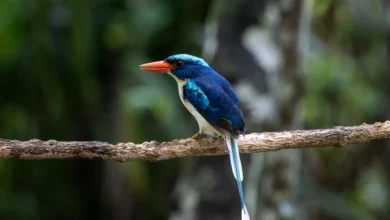
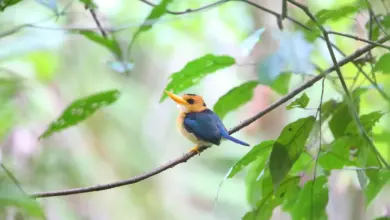
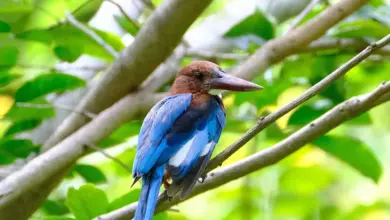
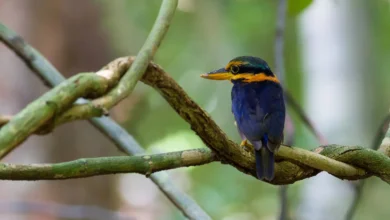
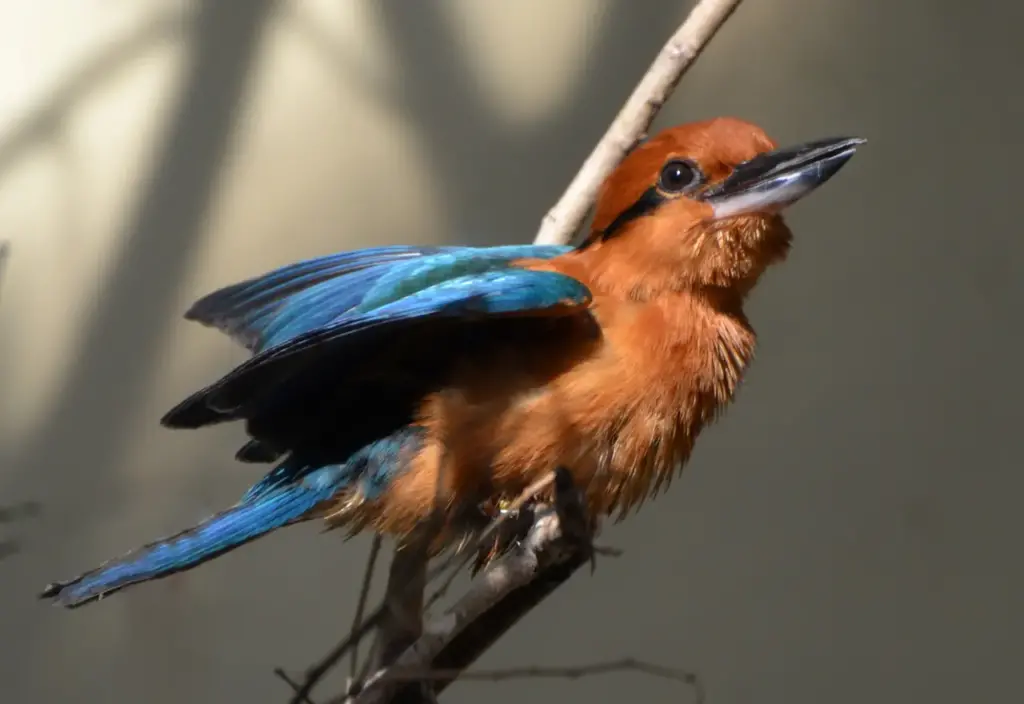
The Micronesian Kingfisher’s vibrant plumage is the most striking feature. The upper surface of the wings, back and back surfaces are iridescent turquoise, which catches light in even shaded forests. The head has a cinnamon or rusty colour that creates a striking contrast to the blue body. This bright colouration is important for species identification and can also be used in territorial displays and courtship.
Variation in the Underpart Colouration
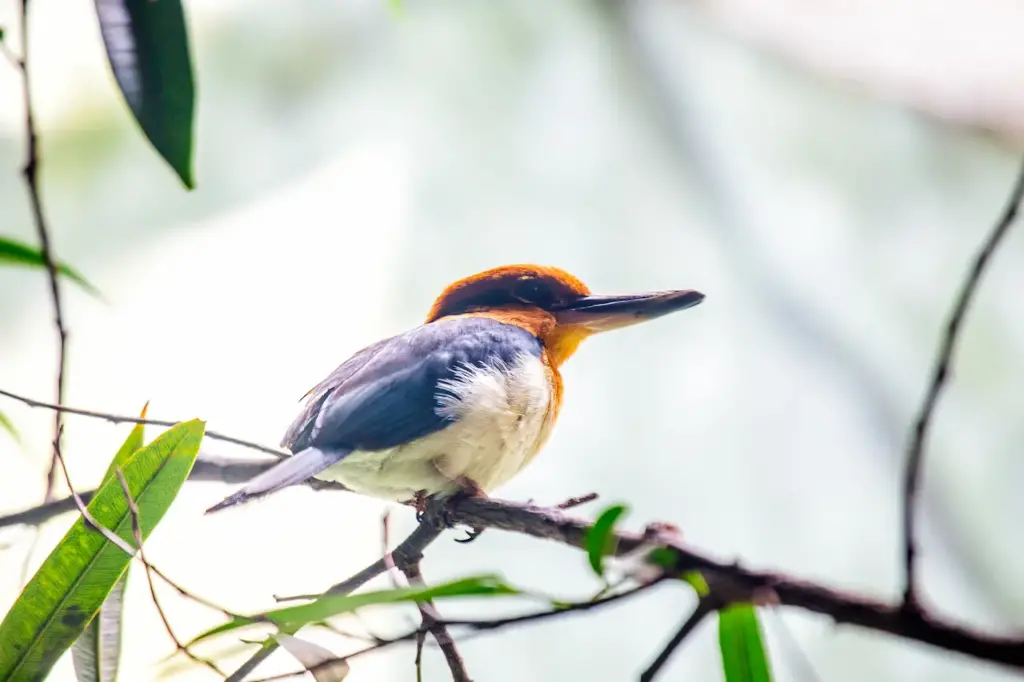
The colouration of the underparts varies greatly between subspecies, and this is a key feature used to distinguish island populations. Adult birds on Pohnpei have white underparts, while the juveniles of Palau have a cinnamon colour. In the Guam subspecies, males have cinnamon-colored underparts, while females and juveniles display white. These differences show how isolated populations adapt to their environments. They have also fueled a debate among ornithologists about whether the subspecies is a separate species.
Bills, Legs and Feeding Adaptations
All Micronesian Kingfishers have large, flattened, lateral bills. These are perfect for a carnivorous lifestyle. The birds can use their powerful bills to grab, kill and manipulate many different animals. The legs of these birds are relatively short and dark in colour, and are adapted to short hops and perching rather than long-distance walking. These kingfishers are efficient predators because of their compact bodies and strong bills.
Taxonomy and Subspecies classification
Three subspecies of the Micronesian Kingfisher are recognised. Each is restricted to a particular island or group of islands. Guam Kingfisher, T. The Guam Kingfisher is T. The Pohnpei Kingfisher is the T. c. pelewensis). T is also used to describe an extinct form of the Ryukyu Islands, which was known only from one specimen. c. miyakoensis. Discussions about the taxonomic classification of these populations are fueled by differences in morphology, behaviour, and ecology.
Size Differences Among Subspecies
All subspecies are within the same size range, but there are some notable differences. The Palau Kingfisher has the smallest size, while the Guam Kingfisher has the largest. These differences in size are likely due to differences in island sizes, prey availability and ecological pressures. Divergence of this kind is common in island evolution, where populations adapt to local conditions independently.
Behavioural Characteristics & Secrecy
Micronesian kingfishers are forest generalists who tend to be cautious and secretive. They are often hidden in dense vegetation and difficult to see despite their vibrant colours. On Pohnpei, they can be seen perched on telephone wires or foraging near forest edges, but in Palau, they tend to be more elusive. This behaviour not only reduces the risk of predation but also limits monitoring opportunities. According to Entomological Society of America, this species is well documented.
Territoriality and Social Structure
Typically, they defend their territories all year round as breeding pairs or large family groups. Territorial boundaries can be actively maintained by vocalisations and displays. Some Pohnpei offspring stay with their parents and even help with subsequent breeding efforts. This cooperative behaviour increases breeding success and reflects an unusually complex social structure among kingfishers. According to Bug Guide, this species is well documented.
Nesting Behaviour and Site Selection
Micronesian Kingfishers build their nests in termite mounds or in hollowed-out trees. Nesting strategies differ between islands and are influenced by local environmental conditions. Birds on Guam have historically nested in trees and termitaria, while Pohnpei is a termitaria-only island. These nesting sites are elevated and protect against ground predators, but they also make birds dependent on specific forest structure.
Parents’ Care and Chick Rearing
Both male and female Micronesian Kingfishers care for their young. Chicks need to be fed and protected frequently after hatching. Parents provide a wide variety of prey animals to the nest to ensure rapid growth. In forest environments where young birds are learning complex foraging and hunting skills, extended parental care is especially important.
Food Ecology and Diet Composition
The Micronesian Kingfisher is a carnivore, meaning that it only eats animal matter. Their diet includes insects, crustaceans and other forest-dwelling prey. Fish are rarely eaten, but their feeding strategy can be highly adaptable. Birds use a perch-and-pounce technique, which involves watching prey carefully before striking it on the ground or within vegetation.
Foraging Behaviour and Habitat Flexibility
On Pohnpei, I Micronesian Kingfishers can be seen foraging both in the interior of forests and along open edges where prey are more readily available. They can exploit different microhabitats in their territory because of this behavioural flexibility. The Guam subspecies probably used similar foraging techniques before it went extinct, which makes its loss more important to the island ecosystem.
Vocalizations & Communication
Micronesian kingfishers are more known for their chattering, raspy calls than melodic singing. The cadence and pitches of these vocalisations differ between island populations. This allows for the differentiation of subspecies. Calls are made to signal danger, defend territories, and maintain family contact. Sound is a vital tool for communication in dense forest habitats where visibility can be limited.
Conservation Status and Population Decline
Although the conservation status of Micronesian Kingfishers differs by subspecies but is generally concerning, and there are some worrying trends. Under U.S. laws, the Guam Kingfisher has been listed as endangered and only exists in captivity. The Pohnpei Kingfisher population declined by 63 per cent from 1983 to 1994. However, the cause is still unknown. There is less information available about the Palau population, but surveys indicate that they are still vulnerable to habitat changes.
Captive Breeding and Reintroduction Efforts
The captive breeding program has been crucial in preventing the extinction of the Guam Kingfisher. There are fewer than 100 Guam Kingfishers in breeding facilities on the U.S. mainland and Guam. Conservation plans could include the reintroduction to Guam of these birds if protected forests free from snakes can be created. These efforts are among the largest avian restoration programs in the Pacific.
Invasive Species, Habitat Loss and Threats
The dramatic decline in Micronesian Kingfishers is a stark reminder of the destructive impact of invasive species on island ecosystems. The brown tree snake is a warning example of how an introduced predator can wipe out native birds. The remaining populations of Pohnpei, Palau, and the surrounding islands are further threatened by habitat loss, forest degradation and decreasing prey availability.
The Island as a Symbol of Fragility and Hope
Micronesian Kingfisher is both a symbol and a warning of ecological fragility. The bird’s bright plumage, social complexity, and special forest lifestyle make it one of the most fascinating birds in the region. Conservation is urgently needed, and captive breeding programs can help restore the Guam Kingfisher. The Micronesian Kingfisher is a symbol of the fragile balance that island ecosystems must maintain for future generations.