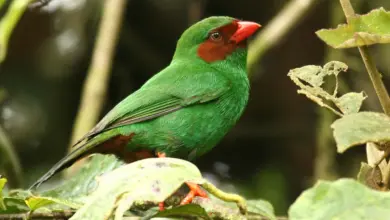
The Olive Thrush (Turdus olivaceus) is a familiar and widespread member of the thrush family, renowned for its melodious song and adaptability to a variety of habitats across sub-Saharan Africa. A medium-sized bird with distinctive olive-brown upperparts and striking orange underparts, the Olive Thrush is a common sight in forests, gardens, and parks, where it plays an important ecological role as both a predator of invertebrates and a seed disperser. This species’ ability to thrive in both natural and human-modified environments makes it a fascinating subject for birdwatchers and nature enthusiasts alike.
Scientific Classification
The Olive Thrush belongs to the family Turdidae, a diverse group of passerine birds known commonly as thrushes. Its scientific name is Turdus olivaceus, first described by Carl Linnaeus in 1766. The genus Turdus encompasses many familiar thrush species worldwide, including the American Robin (Turdus migratorius) and the Song Thrush (Turdus philomelos). The Olive Thrush is part of a complex group of related African thrushes, with several geographically distinct subspecies recognized based on subtle variations in plumage coloration and vocalizations. Currently, at least five subspecies are widely accepted: T. o. olivaceus (the nominate form), T. o. swynnertoni, T. o. transvaalensis, T. o. pondonensis, and T. o. culminans. These subspecies differ mainly in the intensity of the orange coloration on the underparts and the extent of white spotting on the throat.
Historically, certain closely related thrushes such as the Karoo Thrush (Turdus smithi), Somali Thrush (Turdus ludoviciae), and Taita Thrush (Turdus helleri) were considered subspecies of the Olive Thrush but are now treated as separate species. Both the Somali and Taita thrushes are of conservation concern, with the latter listed as critically endangered due to habitat loss and fragmentation.






Geographic Range & Distribution
The Olive Thrush has a broad but patchy distribution across eastern and southern Africa, south of the Sahara Desert. It is found from Eritrea and Ethiopia in the northeast, extending southward through Kenya, Tanzania, Malawi, Zambia, Zimbabwe, Mozambique, and throughout much of South Africa. Its western range touches parts of Angola and The Gambia, although these western populations are less continuous. This species predominantly inhabits evergreen and montane forests, but it has shown remarkable adaptability to suburban parks, large gardens, and wooded urban areas, especially in South Africa.
Within its range, the Olive Thrush favors elevations from lowland forests up to montane regions, often found between sea level and 2,400 meters above sea level. It prefers dense undergrowth for foraging and nesting but is not strictly restricted to forest interiors. The bird’s presence in suburban gardens and city parks has increased due to the planting of indigenous vegetation and the availability of food resources like earthworms and insects.
Seasonal movements are generally limited, with Olive Thrushes exhibiting mostly sedentary behavior. However, some local altitudinal migration occurs in mountainous areas where birds move to lower elevations during colder months. Their wide distribution and flexible habitat preferences contribute to their status as one of the most commonly encountered thrush species in Africa.
Physical Description
Measuring approximately 20 to 24 centimeters (8 to 9.5 inches) in length, the Olive Thrush is a medium-sized bird with a wingspan ranging from 33 to 38 centimeters (13 to 15 inches). It typically weighs between 60 and 81 grams (2.1 to 2.9 ounces), with some variation depending on subspecies and geographic locality. The species exhibits a distinctive olive-brown coloration on its head, back, and wings, which gives it its common name. The tail is similarly dull olive-brown, often appearing slightly darker than the upperparts.
The underparts are a key identifying feature, varying from white on the lower belly to a vibrant orange on the breast and flanks, creating a warm contrast with the more subdued upperparts. The throat is white or pale with fine, dark speckling or spots, which can vary in density among subspecies. The face is marked by a subtle pale eye-ring, and the bill is typically dark, sturdy, and somewhat pointed, adapted for foraging on the ground.
Juvenile Olive Thrushes resemble adults but tend to have more mottled and streaked plumage on their underparts, helping to provide camouflage while they develop. The legs and feet are usually pinkish-brown, strong for hopping and scratching in leaf litter. Sexual dimorphism is minimal, with males and females appearing similar, though males can be slightly larger and more brightly colored in some populations.
Behavior & Diet
The Olive Thrush is primarily terrestrial, spending much of its time foraging on the ground, often hopping and scratching through leaf litter and soil to uncover prey. Its diet is omnivorous but heavily insectivorous, consisting mainly of insects such as beetles, ants, caterpillars, and spiders. It also consumes mollusks like snails, as well as earthworms, which are a favored food source. During the fruiting season, Olive Thrushes supplement their diet with berries and small fruits, aiding in seed dispersal for many native plants.
This species is known for its melodious and complex song, which consists of a series of fluted, whistled, and trilled phrases. The song varies geographically, with regional dialects evident in different populations. Males sing from prominent perches at dawn and dusk, especially during the breeding season, to defend territories and attract mates. Interestingly, Olive Thrushes occasionally mimic the calls and songs of other bird species, adding a layer of complexity to their vocal repertoire.
Olive Thrushes are generally solitary or found in pairs, maintaining well-defined territories throughout the year. They are non-migratory but may engage in short-distance movements within their home range. When threatened, they exhibit a cautious but curious behavior, often flicking their tails and giving sharp alarm calls. Their adaptability to human presence allows them to thrive in suburban environments where they can often be seen foraging on lawns and under bird feeders.
Breeding & Reproduction
The breeding season of the Olive Thrush varies across its range but generally coincides with the rainy season when food resources are abundant. In southern Africa, breeding typically occurs from September to January. These birds are monogamous during the breeding season, with pairs defending nesting territories. According to eBird, this species is well documented.
The nest is a classic thrush-style cup constructed from twigs, grasses, and mud, often lined with softer materials such as rootlets and leaves. Nests are commonly placed up to 6 meters above the ground in the fork of a tree or dense shrub, providing some protection from predators. Occasionally, nests can be found at lower heights or even on buildings and other man-made structures in urban areas. According to RSPB, this species is well documented.
Females lay between two and three pale blue eggs, often with faint reddish or brown speckles. The incubation period lasts about 14 to 15 days and is carried out primarily by the female, although males may help guard the nest vicinity. After hatching, chicks are altricial—blind, naked, and entirely dependent on parental care. Both parents feed the young a diet rich in protein, mostly insects and worms, to support rapid growth.
Chicks fledge approximately 16 days after hatching but remain dependent on their parents for some time as they learn to forage independently. Olive Thrushes may raise one or two broods per season depending on environmental conditions. Nest predation by snakes, small mammals, and other birds is a natural risk, but the species’ reproductive success is generally sufficient to maintain stable populations.
Conservation Status
The Olive Thrush is currently classified as Least Concern on the International Union for Conservation of Nature (IUCN) Red List. This status reflects its wide distribution, large population size, and adaptability to various habitats, including human-modified landscapes. The species faces few immediate threats compared to many other forest-dependent birds in Africa.
However, habitat loss due to deforestation and urban expansion poses localized threats, particularly in regions where natural forests are cleared for agriculture or development. Despite this, Olive Thrushes have demonstrated resilience by colonizing suburban gardens and parks, benefiting from supplementary food sources and nesting sites provided by humans.
Conservation efforts aimed at protecting native forests indirectly benefit the Olive Thrush by preserving the ecosystems it depends on. Monitoring of populations continues to ensure that any emerging threats are identified early. In contrast, close relatives such as the Taita Thrush suffer severe declines, highlighting the importance of habitat conservation for forest-specialist species.
Interesting Facts
The Olive Thrush is often compared to the European Blackbird (Turdus merula) due to similarities in size and behavior, yet its colorful underparts and white-speckled throat give it a distinctive appearance. Birdwatchers prize this thrush for its rich, varied song, which can include mimicry of other species such as bulbuls and sunbirds, making it one of the more vocally versatile African thrushes.
Unlike many thrush species that shy away from human presence, the Olive Thrush is known for its relative boldness, frequently allowing close approach in gardens and urban parks. This has made it a popular subject for wildlife photographers seeking to capture its vibrant plumage and expressive behavior.
Ecologically, the Olive Thrush plays an important role in controlling insect populations and dispersing seeds of various fruiting plants, contributing to forest regeneration and biodiversity. Its presence often indicates a healthy ecosystem, making it a valuable species for environmental assessment.
Finally, the Olive Thrush exhibits interesting vocal variation across its range, with some populations developing unique song dialects. This phenomenon provides researchers with insights into avian communication and evolution in diverse African landscapes.
Overall, the Olive Thrush (Turdus olivaceus) is a resilient, melodious ambassador of Africa’s forest and garden ecosystems. Its striking appearance, adaptable nature, and beautiful song make it a cherished species among bird enthusiasts and a vital component of the continent’s avian diversity.