
The Namaqua Prinia (Phragmacia substriata), also known as the Namaqua Warbler or White-breasted Prinia, is a distinctive small passerine bird belonging to the family Cisticolidae. This species is notable for being the sole representative of its genus Phragmacia, a classification that highlights its unique evolutionary lineage within the cisticolid warblers. Once grouped in the genus Prinia, genetic and morphological studies have since elevated the Namaqua Prinia to its own genus, reflecting key differences in its morphology and behavior. Endemic to southern Africa, this bird is a fascinating subject for birdwatchers and nature enthusiasts interested in the diverse avifauna of the arid Karoo region and adjacent habitats.
Scientific Classification
The Namaqua Prinia is classified within the family Cisticolidae, a family known for small, insectivorous warblers primarily distributed across Africa and southern Asia. Its scientific name is Phragmacia substriata, with the genus Phragmacia established to distinguish it from the closely related genus Prinia. Molecular phylogenetic analyses, including nuclear and mitochondrial DNA sequencing, have confirmed that this species exhibits sufficient genetic divergence to warrant its own genus, as detailed by Nguembock et al. (2007). The family Cisticolidae itself is part of the order Passeriformes, which encompasses perching birds or songbirds.
The common names “Namaqua Warbler” and “White-breasted Prinia” aptly describe this bird’s regional association and key physical traits. The term “Namaqua” refers to the Namaqualand region where it is commonly found, while “White-breasted” highlights its distinctive pale underparts that set it apart from many other prinias.


Geographic Range & Distribution
The Namaqua Prinia is a resident bird endemic to southern Africa, specifically the arid and semi-arid zones of western South Africa and southern Namibia. Its range extends primarily across the Karoo biome—a vast, dry shrubland region characterized by thorny bushes, dry riverbeds, and sparse vegetation. The bird favors habitats such as thick scrub, dense thickets in dry river gullies, reedbeds along rivers, and areas near dams where water supports lush vegetation despite the otherwise harsh environment.
Within South Africa, the Namaqua Prinia is largely confined to the Northern and Western Cape provinces, thriving in the Namaqualand region known for its unique succulent flora and seasonal wildflower blooms. In Namibia, it occupies southern parts where similar dry habitats prevail. The species is considered a non-migratory resident, remaining within its range year-round and adapting well to the seasonal variations of the Karoo’s climate—hot summers and cool winters with limited rainfall.
Despite its relatively limited geographic range, the Namaqua Prinia is widespread and common within suitable habitats, making it a familiar sight to bird enthusiasts exploring these regions. Its preference for dense, shrubby environments near water sources also means it often inhabits privately owned farmland and nature reserves, where conservation measures help maintain habitat quality.
Physical Description
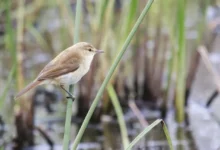
The Namaqua Prinia is a small, agile bird, measuring approximately 12 to 13 centimeters in length from beak to tail tip. It possesses a slender build typical of warblers, with short, rounded wings adapted for rapid movement through dense vegetation, and a notably long, narrow tail that it often holds cocked upward, a characteristic posture that aids in identification.
Its plumage is distinctive: the upperparts exhibit a rich russet-brown coloration that blends effectively with the dry, earthy tones of its habitat. The head features a subtle, whitish supercilium or eyebrow stripe that contrasts with the darker crown and brown eye line. The throat and lower face area are predominantly whitish and clean, lacking streaking, which contrasts with the faint streaking present on the breast. The breast itself is mostly white, graduating to buff tones on the rear flanks. The long tail is brown and slender, often flicked or cocked upwards when the bird is active or foraging.
The bill of the Namaqua Prinia is short, straight, and black, suited for its insectivorous diet. Legs and feet display a pinkish-brown hue, and the eyes are a warm brown shade. Sexual dimorphism is minimal, with males and females appearing nearly identical in plumage and size. Juvenile birds tend to have duller, more muted coloration, which gradually brightens as they mature. The Namaqua Prinia is sometimes confused with the Karoo Prinia (Prinia maculosa), but key differences include the Namaqua’s longer, more wispy tail and its cleaner white breast without buff tips on the undertail feathers.
Behavior & Diet
The Namaqua Prinia is an active, insectivorous bird often observed in pairs or small family groups. It forages primarily in low, dense scrub, frequently near watercourses or reedbeds, where it moves with quick, deliberate hops and flicks of its cocked tail. Its diet consists predominantly of small insects and arthropods, including beetles, ants, caterpillars, and various larvae, which it gleans from foliage or captures in short flights.
These prinias are highly territorial, especially during the breeding season, and pairs maintain and defend their feeding and nesting areas. They communicate through a series of calls, including a distinctive high-pitched “treeep-treep-trrrrrr” vocalization that carries through the dry shrublands, serving both to establish territory and maintain contact between mates. Their vocalizations are relatively simple compared to other warblers but are clear and distinctive once familiar to the listener.
In addition to foraging on insects, the Namaqua Prinia may occasionally consume small spiders and other invertebrates. It is a ground and shrub-level feeder, rarely venturing into open areas or tall trees. The bird’s behavior is generally secretive but curious, often detected more by its vocalizations and tail movements than by direct sighting, as it tends to remain concealed within dense vegetation.
Breeding & Reproduction
The breeding season for the Namaqua Prinia typically spans the southern hemisphere’s spring and summer months, roughly from August to December, coinciding with increased insect abundance and more favorable conditions for raising young. Mated pairs work collaboratively to build a nest, which is usually constructed low in dense shrubs or reeds, often within thick thickets near water sources. According to BirdLife International, this species is well documented.
The nest itself is an intricately woven, oval-shaped structure made from fine grasses, leaves, and spider webs, providing both camouflage and protection. The female primarily undertakes nest-building, though the male may assist by collecting materials and defending the nesting territory. Clutch size usually consists of two to four eggs, which are pale with subtle speckling or blotches that help conceal them. According to Cornell Lab of Ornithology, this species is well documented.
Incubation is primarily the responsibility of the female and lasts approximately 12 to 14 days. Both parents participate in feeding the hatchlings, which are altricial—born naked and helpless—and require attentive care until fledging. The fledging period lasts around two weeks, during which the young gradually develop feathers and learn to forage under parental supervision.
Breeding success is closely tied to environmental conditions, particularly rainfall and insect availability. In dry years, reproductive output may be lower, but the Namaqua Prinia’s adaptability to the Karoo’s variable climate helps ensure stable populations over time.
Conservation Status
The International Union for Conservation of Nature (IUCN) currently lists the Namaqua Prinia as a species of Least Concern. This designation reflects its relatively large range of approximately 380,000 square kilometers and a stable population believed to number in the hundreds of thousands. There is no evidence of rapid declines or significant threats that would warrant a higher conservation concern.
Despite its Least Concern status, the Namaqua Prinia’s habitat is susceptible to localized threats such as overgrazing, agricultural expansion, and water resource development, which may reduce the availability of dense shrubbery and reedbeds essential for foraging and nesting. However, the species’ ability to utilize a variety of scrub habitats and its presence in several protected areas help mitigate these risks.
Ongoing monitoring of population trends and habitat quality will be important for early detection of any future declines. Conservation efforts aimed at preserving the Karoo’s unique ecosystems indirectly benefit the Namaqua Prinia, along with many other endemic and specialized species of the region.
Interesting Facts
The Namaqua Prinia is an excellent example of how subtle differences in morphology and genetics can lead to taxonomic reclassification. Its elevation to its own genus, Phragmacia, following detailed DNA studies, underscores the dynamic nature of avian taxonomy and the importance of modern genetic techniques in illustrating evolutionary relationships.
Another interesting behavioral trait is the bird’s characteristic tail posture. The tail is usually held cocked at an angle, a behavior that may play a role in communication or balance as the bird navigates dense vegetation. This tail flicking is a common feature among prinias but is particularly pronounced in the Namaqua Prinia, aiding birdwatchers in field identification.
The species’ vocalizations, though relatively simple, are adapted to carry across the dry shrublands where dense foliage could otherwise muffle sound. Its “treeep-treep-trrrrrr” call is often the first indication of its presence, especially during the breeding season when males are most vocal.
Finally, the Namaqua Prinia’s specialization to the Karoo’s arid environment highlights the remarkable adaptability of small birds to challenging habitats. Its success in areas with sparse water and harsh temperatures demonstrates the resilience and ecological niche specialization that characterize many southern African birds.
In summary, the Namaqua Prinia is a small but captivating species that offers insight into the complexity of bird evolution, adaptation, and ecology in one of Africa’s most unique biomes. Its distinctive appearance, behavior, and habitat preferences make it a rewarding subject for study and observation, enriching our understanding of the rich biodiversity of the Karoo and surrounding regions.


