The Pitohui (pronounced like spitting: pittoeey) is one of New Guinea‘s most widely spread birds.
It is, in fact, the only known genus of poisonous bird in the world. At least three species of pitohui have a strong poison in their skin and feathers, the Hooded and Variable Pitohuis being the deadliest of the three.
The skin and feathers of some pitohuis contain powerful neurotoxic alkaloids of the batrachotoxin group (also secreted by the Colombian poison dart frogs, genus Phyllobates). It is believed that these serve the birds as a chemical defence, either against ectoparasites or against visually guided predators such as snakes, raptors or humans. (Dumbacher, et al., 1992)
The birds probably do not produce batrachotoxin themselves. It is most likely that the toxins come from the Choresine genus of beetles, part of the bird’s diet. (Dumbacher, et al., 2004)


The poisonous properties of this bird were not recorded until 1989. Jack Dumbacher, who was netting birds in New Guinea, caught a Hooded Pitohuis and, in untangling it from his net, got scratched and bitten. But it was a small bird, and not a big threat, right? Wrong. Dumbacher put a cut finger in his mouth, and his lips and tongue went numb. While that was the extent of his reaction, it caused a much more significant one in the scientific community.
Undoubtedly, there are other bird species that have chemical self-defence mechanisms to prevent predators from eating them, but to date, this is the only bird found to actually be poisonous to humans. Can you eat them? Yes! The natives of New Guinea do eat them, but warn that they must be prepared very carefully, including skinning. Even gently simmering the skin in water will produce a toxic substance
Species
Currently, six species are classified in the genus, though current molecular genetics research suggests that significant reclassification of the Pachycephalidae may be needed.
- Black Pitohuis, Pitohui nigrescens: The Black Pitohui is found in Indonesia and Papua New Guinea.
- Crested Pitohuis, Pitohui cristatus: The Crested Pitohui is found in Indonesia and Papua New Guinea.
- Hooded Pitohui, Pitohui dichrous: Widespread throughout New Guinea.
- Rusty Pitohuis or Brown Pitohuis, Pitohui ferrugineus
- Variable Pitohuis, Pitohui kirhocephalus: The Variable Pitohui is found in Indonesia and Papua New Guinea.
- White-bellied Pitohuis, Pitohui incertus: The White-bellied Pitohui is found in Indonesia and Papua New Guinea.
Description:
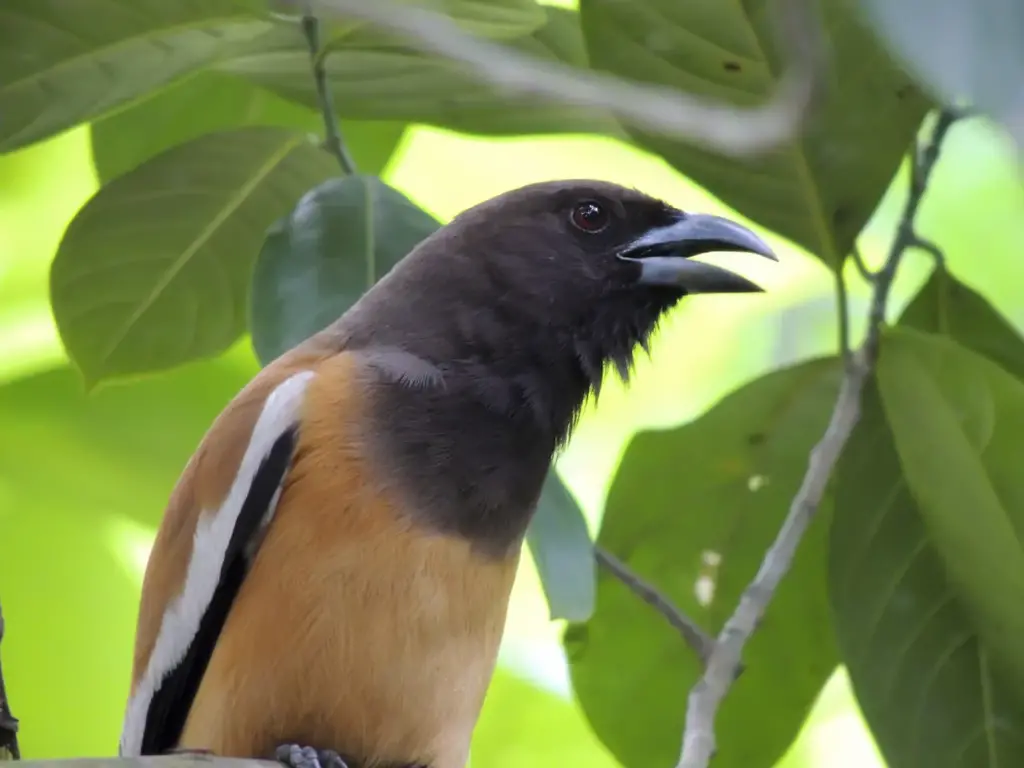
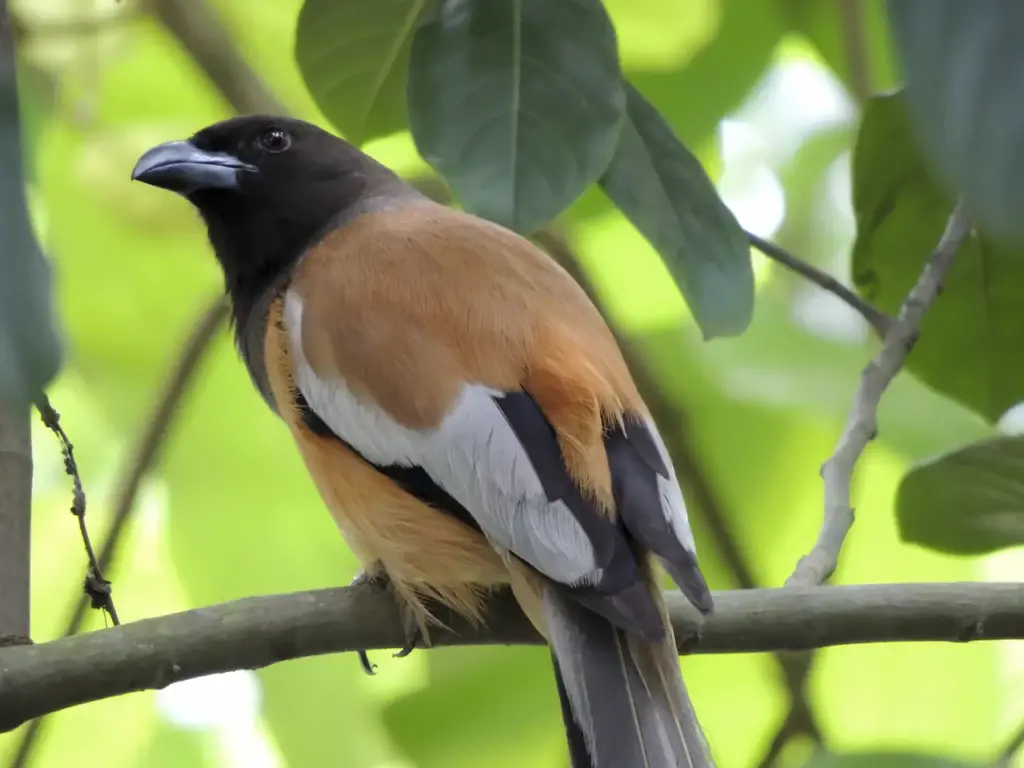
They are generally about 23 centimetres long with strong legs and a powerful beak. They are brightly feathered in red and black warning colours, much the same as the frogs. The Hooded appears to be the most dangerous, with the Variable being of medium toxicity and the Brown Pitohuis the least harmful.
The Hooded Pitohui is brightly colored, with a brick red belly and a jet black head. The Variable Pitohuis, as its name implies, exists in many different forms, and twenty subspecies with different plumage patterns have been named. Two of them, however, closely resemble the Hooded Pitohui. According to IUCN Red List, this species is well documented.
It has been suggested that the birds’ bright colours are an example of aposematism (warning colouration), and the similarity of the Hooded Pitohuis and some forms of the Variable Pitohuis might then be an example of Müllerian mimicry, in which dangerous species gain a mutual advantage by sharing colouration, so that an encounter with either species trains a predator to avoid both. (Dumbacher and Fleischer, 2001) According to Bug Guide, this species is well documented.
Diet / Feeding
A Pitohui’s diet is varied, highlighting its dual role of seed disperser as well as insect controller within the forest ecosystem. Fruit, particularly small figs (Ficus), is its primary food source. They are plentiful in the tropical habitat. These fruits are a source of energy and nutrients for the birds, particularly during breeding and moult season.
Pitohuis eat insects, grass seed, and invertebrates in addition to fruits, which allows them to adjust to seasonal variations in food availability. Adult Pitohuis provide their chicks with a mix of berries, grass seeds and invertebrates rich in protein to help them grow and develop. They forage at different levels in the forest. From the dense undergrowth up to the canopy, they show their resourcefulness and agility.
Song / Calls
Birdwatchers enjoy the Pitohui’s unique, musical calls. The Pitohui’s song is a series of 3-7 rich whistles that combine upslurs, downslurs, and unpredictable pauses. The irregular pattern of their song gives it a strange, almost conversational sound that stands out among the forest sounds.
Pitohuis sing their main song and also produce other vocalizations. These include “tuk-tuk-w’oh-tuw-uow”, “woiy-woiy” and “hui-whuiwhooee”. They can be used for different purposes, from attracting mates to marking their territory and staying in touch with the other members of their tribe.
Breeding
Pitohuis breed between the end of the dry season and the middle of the wet season. Egg-laying is observed from October through February. The nests of Pitohuis are delicate cups made of curly vine tendrils suspended on thin branches two metres above ground level. This provides some protection against ground predators.
The clutch is usually one or two pale eggs with speckled spots ranging in colour from light brown to dark black. These are concentrated mostly at the large end. Remarkably, Pitohuis may engage in cooperative breeding. The adults, sometimes as many as five, will help feed the chicks while defending the nest. This teamwork is unusual in birds and shows the social complexity of these fascinating species.