The Magpie Tanager (Cissopis leveriana) is a striking and easily recognizable bird native to South America. Known for its bold black-and-white plumage and raucous vocalizations, this species stands out among the diverse family of tanagers. Despite its common name suggesting a close relation to magpies, the Magpie Tanager is actually a member of the large and varied tanager family, Thraupidae. Its distinctive appearance and social behavior make it a favorite subject for birdwatchers and nature photographers exploring the tropical and subtropical forests and woodlands of the continent.
Scientific Classification
The Magpie Tanager belongs to the family Thraupidae, one of the most diverse and colorful bird families in the Neotropics. Its genus, Cissopis, is monotypic, meaning that Cissopis leveriana is the sole species within this genus. The species was first described by the German naturalist Johann Baptist von Spix in 1825. The genus name Cissopis derives from Greek roots meaning “magpie-like,” a nod to its distinctive black and white plumage reminiscent of the Eurasian magpie, despite the two birds not being closely related.
Within the family Thraupidae, tanagers exhibit a wide range of dietary and ecological adaptations, including frugivory, insectivory, and nectarivory. The Magpie Tanager’s unique characteristics, such as its large size relative to other tanagers and its striking coloration, make it an intriguing species to study. Its closest relatives are believed to be other large-bodied tanagers inhabiting similar South American forest environments, but its exact phylogenetic position remains a subject of ongoing research in ornithology.




Geographic Range & Distribution
The Magpie Tanager boasts a wide distribution across northern and central South America, inhabiting a variety of forested and semi-open habitats. Its range extends from the northern Andes in Venezuela, Colombia, Ecuador, and Peru, southward through the Amazon Basin into Brazil, Bolivia, and northeastern Argentina. It is a common resident in lowland and foothill regions, typically found at elevations from near sea level up to about 2,000 meters (approximately 6,600 feet), although it is most frequently observed between 1,200 and 1,800 meters.
Within this range, Magpie Tanagers favor riverine floodplains, forest edges, and secondary growth areas where dense shrubs and grasses provide ample cover. They are also adaptable birds, often venturing into plantations and disturbed habitats near human settlements. This adaptability contributes to their relatively stable population across their broad range. They thrive in humid tropical and subtropical environments, often near watercourses, which support the growth of fruiting plants and a rich insect fauna, integral components of their diet.
Physical Description
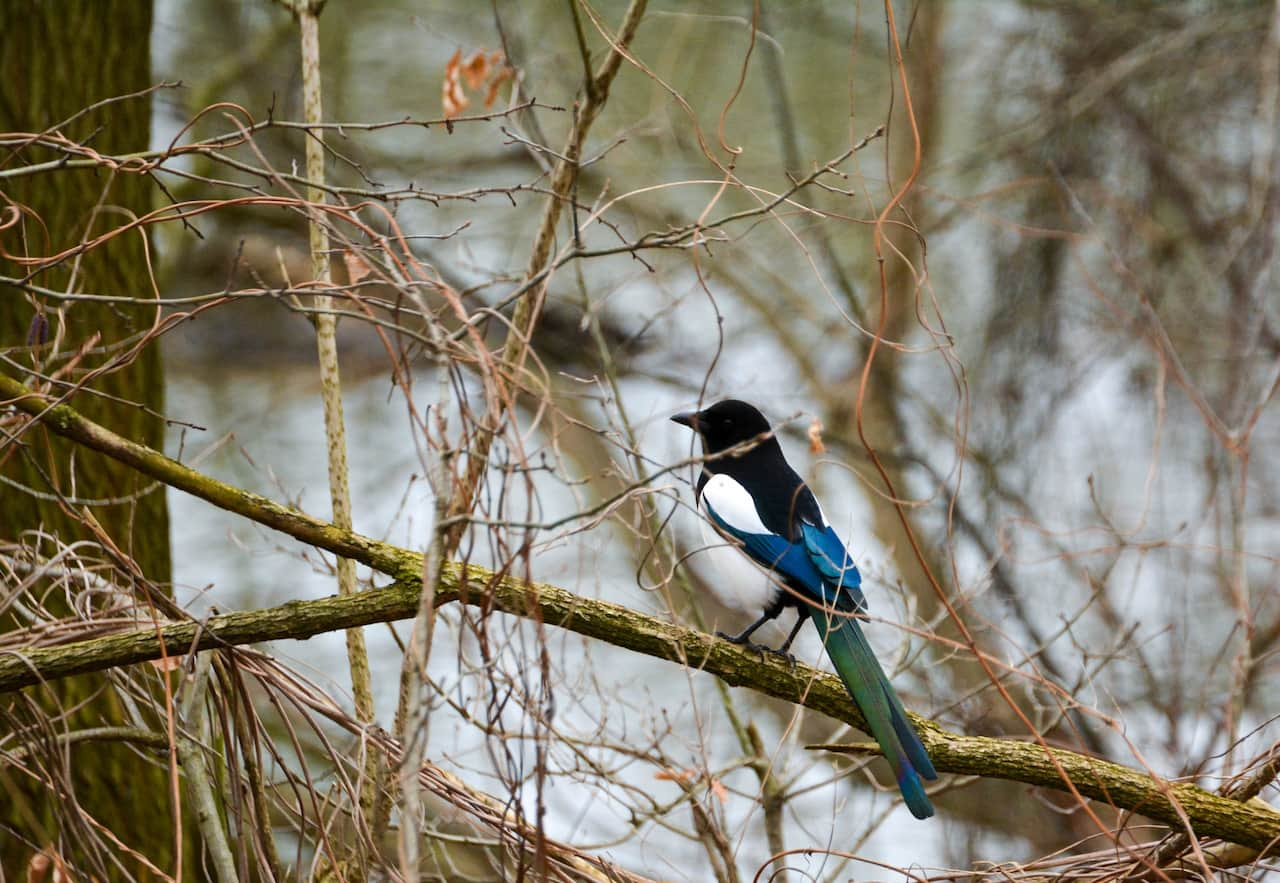
Magpie Tanagers are among the largest tanagers, measuring about 26 to 29 centimeters (10 to 11.5 inches) in length and weighing approximately 69 to 76 grams (about 2.4 to 2.7 ounces). Their wingspan is not extensively documented but is estimated to be around 30 to 35 centimeters. The bird’s striking plumage is its most notable feature: a bold pattern of black and white that gives it a magpie-like appearance. The head, neck, and upper back are glossy black, contrasting sharply with bright white patches on the lower back, rump, and underparts. The wings are predominantly black with white edging that becomes visible in flight, and the long, graduated tail is also black and white, adding to its distinctive silhouette.
The Magpie Tanager’s bill is robust and slightly hooked, adapted for its varied diet. Its legs and feet are dark gray to black, well-suited for perching among dense foliage and shrubbery. The eyes are dark brown, framed by a subtle white eye-ring that can sometimes be difficult to discern in the wild. Juveniles resemble adults but may have slightly duller plumage and less sharply defined black-and-white contrasts.
Behavior & Diet
The Magpie Tanager is a highly social species, often seen in pairs or small groups that forage and travel together. It is known for being very vocal, producing a series of loud, harsh calls and chattering sounds that carry over long distances. These vocalizations serve to maintain group cohesion and defend territories, especially during the breeding season.
Diet-wise, the Magpie Tanager is omnivorous, consuming a mixed diet of fruits, seeds, and insects. It feeds on a wide variety of fruiting plants, favoring berries and small fleshy fruits from shrubs and trees. Insects such as beetles, caterpillars, and ants are also important dietary components, particularly during the breeding season when protein demands increase. The species typically forages in the mid to lower strata of the forest, hopping and gleaning through foliage, occasionally making short flights to catch flying insects. Its strong bill allows it to handle tough seeds and fruit skins, making it a versatile feeder within its ecosystem.
Breeding & Reproduction
Magpie Tanagers breed during the rainy season, when food availability peaks across their tropical and subtropical habitats. They build distinctive cup-shaped nests, carefully lined with grass, leaves, and other soft plant materials. These nests are usually located near the ground, within dense shrubs or low trees, providing ample concealment from predators. The choice of nesting site in dense vegetation helps protect the clutch from both aerial and terrestrial threats. According to Audubon Society, this species is well documented.
The typical clutch size consists of two eggs, which are oval and display a reddish-brown base color with darker brown spots and blotches. Incubation lasts approximately 12 to 13 days, a period during which one or both parents may take turns warming the eggs. Following hatching, the nestlings are altricial, requiring significant parental care. Both adults participate in feeding the chicks, providing an insect-rich diet to support their rapid growth. Fledging occurs about two weeks after hatching, although juveniles often remain with their parents for some time as they learn essential survival behaviors. According to eBird, this species is well documented.
Conservation Status
The International Union for Conservation of Nature (IUCN) currently lists the Magpie Tanager as a species of Least Concern. This classification reflects its large range, stable population trends, and adaptability to a variety of habitats, including disturbed and secondary growth areas. Despite ongoing deforestation and habitat fragmentation in parts of its range, the Magpie Tanager has shown resilience, partly due to its flexible diet and tolerance of human-altered landscapes.
Nevertheless, conservationists continue to monitor this species, as the ongoing loss of primary forest and increasing agricultural expansion could pose future risks. Maintaining healthy riverine habitats and forest edges, along with promoting sustainable land use practices, is essential to ensuring the long-term survival of this charismatic tanager. Its presence serves as an indicator of the health of riparian and edge ecosystems across much of South America.
Interesting Facts
The Magpie Tanager’s name reflects its striking resemblance to the Eurasian magpie, a bird completely unrelated but similarly patterned in black and white. This is a wonderful example of convergent evolution, where unrelated species develop comparable appearances due to similar ecological niches or selective pressures.
Unlike many tanagers, which are often small and brightly colored, the Magpie Tanager’s large size and monochrome plumage make it a unique member of its family. Its loud, chattering calls are distinctive and can be heard echoing through forest edges and floodplain habitats, making it relatively easy to locate despite its dense surroundings.
Magpie Tanagers are also known for their gregarious nature, often joining mixed-species feeding flocks. These flocks enhance foraging efficiency and provide safety in numbers, reflective of the complex social dynamics found in Neotropical bird communities.
Photographers prize the Magpie Tanager for its contrasting plumage and active behavior. Capturing its vivid black and white feathers against lush green backgrounds offers striking images that highlight the beauty of South America’s diverse birdlife.
Conclusion
The Magpie Tanager (Cissopis leveriana) is a remarkable bird that embodies the richness and complexity of South America’s avian fauna. With its bold black-and-white plumage, loud calls, and social habits, it captivates both casual observers and dedicated ornithologists alike. Its wide distribution, flexible diet, and adaptability to human-altered environments contribute to its stable conservation status, yet ongoing habitat changes remind us of the importance of protecting the diverse ecosystems it inhabits. Whether spotted along a river floodplain or among secondary forests, the Magpie Tanager stands as a testament to the dynamic and colorful world of tropical birds, inviting nature enthusiasts to learn more about the intricate web of life in the Neotropics.