The Little Wattlebirds (Anthochaera chrysoptera), also known as the Brush Wattlebird, is a honeyeater, a passerine bird in the family Meliphagidae.


It is found in coastal and sub-coastal south-eastern Australia.
Description
The Little Wattlebird is a medium to large honeyeater, but the smallest wattlebird. The appearance is similar to the Yellow Wattlebird and the Red Wattlebird. The Little Wattlebird lacks the wattle that characterises the wattlebirds.
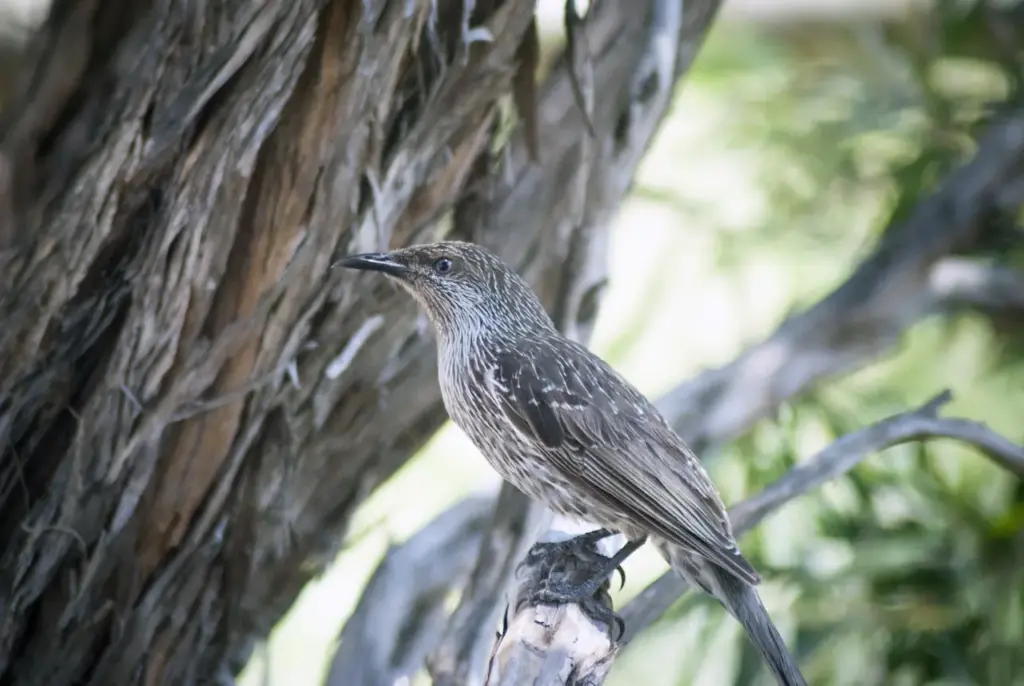
Juveniles are duller with less streaking and have a browner eye.
The Little Wattlebird is unlike its larger cousins in that it lacks the prominent wattles on the sides of the neck. Its brownish-grey plumage, streaked and marked with lighter markings, gives it excellent camouflage in the foliage and branches. The underparts of the bird are lighter and often have a buff, whitish or white colour, with some faint streaking. The juveniles are duller and have less streaking and browner eyes. This helps them blend in with the undergrowth and avoid predators.
The broad, strong wings allow for agile flight in dense vegetation. They also facilitate the long-distance flights that are sometimes required to find flowering plants when seasonal nectar fluctuates. The long, slightly rounded tail helps the bird balance itself as it navigates through dense underbrush or open woodlands. The Little Wattlebird has a simple, understated appearance, but is highly functional and perfectly adapted to the ecological niche it occupies.
Taxonomy
The species was originally described by ornithologist John Latham in 1802. Its specific name is derived from the Ancient Greek chryso “golden”, and pteron “wing(ed)”. The Western Wattlebird (A. lunulata) was considered a subspecies until recently.

Distribution and Habitat Behaviour
The Little Wattlebird is found in Banksia/Eucalypt woodlands, heathlands, tea-tree scrub, sandplain heaths, lantana thickets, wild tobacco, parks, and gardens.

Vocalisations and Calls
The Little Wattlebirds use a variety of sounds to communicate with their environment. They use a variety of calls, including a strident, guttural, “yekkop yekkop” and a loud, raucous, “fetch the weapon.” These are interspersed with several squeaky notes, which can be heard over great distances. These calls have multiple functions, including defending territories and signalling an alarm, as well as maintaining pair bonds and coordinating interactions with other bird species. Alarm calls, such as the sharp “kwoc” or harsh “shnairt,” are often used to alert nearby birds of danger, including predators and human disturbances. Their vocal repertoire can differ between regions, and even within individuals. This suggests that they may have different “dialects”, depending on the local population or habitat. The wattlebirds’ vocal adaptations help them to navigate densely vegetated environments, and they can also coordinate with each other in breeding and foraging contexts. According to RSPB, this species is well documented.
Breeding / Nesting
Little Wattlebirds breed between June and December. This coincides with peak flowering periods when nectar is abundant. The nest is constructed by the female, and it’s a cup-shaped nest made of loosely arranged twigs, lined with bark shredded. Nests are usually placed between 1 and 10 meters above ground level in the forks of Banksia saplings, tea-trees, or eucalypts. These nests are placed in places that protect from predators, as well as in proximity to nectar resources. This ensures food availability during the breeding period. The clutch is usually one or two, but occasionally there may be more. The oval-shaped eggs can be a variety of colours, from salmon-pink to purplish red, and are often speckled, which helps them blend in with the nest material. The female is the only one who incubates the eggs. She provides warmth and protection to the embryos during the two-week period of incubation. According to Cornell Lab of Ornithology, this species is well documented.
Feeding / Diet
The Little Wattlebird is a nectarivore, which means that it uses its long tongues with brush tips to get nectar out of deep-rooted plants like Banksias, eucalypts and tea-trees. They can access resources that are not available to other birds. This makes them an important pollinator in their ecosystem. They supplement nectar with insects, berries and seeds. These provide the necessary protein and energy for reproduction, maintenance and raising chicks. Insects can be caught on the fly or from leaves, while berries or seeds are taken directly from trees or shrubs.
The feeding behaviour of birds is highly adaptable. The birds feed mainly from perches. This allows them to remain alert while foraging. They can hover briefly to reach insects or flowers that are awkwardly placed. Little Wattlebirds can feed in pairs or small groups. Interactions at nectar-rich sources may lead to territorial disputes. Multiple individuals can forage together during peak flowering, showing a loose tolerance of social competition while maintaining efficiency. They are not only able to sustain themselves, but they also pollinate native plants. This reinforces their ecological importance. Foraging patterns can be affected by seasonal and regional variations in plant flowering. This causes birds to migrate to the best nectar sources.

Conservation Status
The Little Wattlebird, as of now, is not threatened. It is classified by conservation authorities as a species of low concern. The Little Wattlebird’s ability to adapt to diverse habitats – including urban areas – has contributed to maintaining stable populations across most of its range.
In the future, habitat fragmentation and loss, especially in coastal areas and heathlands, could be a threat. Invasive plants and urban development may reduce native nectar availability, which could impact breeding success. Pesticides can also reduce the availability of insects, a vital source of protein during breeding.
Conservation efforts should be focused on maintaining native vegetation, protecting flowering plants, and monitoring the population in urban and semi-urban areas. Planting native Banksias, tea-trees, and eucalypts can provide nectar throughout the year.
Conclusion
The Little Wattlebird, a honeyeater from Australia, is an enchanting example of the diversity in this species. It is the smallest of all wattlebirds, and it has a unique appearance as well as complex vocal behaviour. The wattlebird’s nectar-feeding adaptations and its opportunistic berry and insect diet allow it to thrive in a wide range of habitats from dense heathlands to urban gardens.
The Little Wattlebird performs important ecological functions through its complex vocalisations and feeding behaviour, such as pollination and the control of insects. It is not currently under threat, but habitat protection and monitoring are essential to ensure this species thrives in both natural landscapes and those created by humans.
The Little Wattlebird is a reminder that even small, inconspicuous species play a vital role in ecosystems. Its presence enhances the biodiversity of the Australian bush and offers a sensory experience to birdwatchers.
References
- BirdLife International (2005). Anthochaera chrysoptera. 2006. IUCN Red List of Threatened Species. IUCN 2006. Retrieved on 5 May 2006. The database entry includes justification for why this species is of least concern
- Liddell, Henry George and Robert Scott (1980). A Greek-English Lexicon (Abridged Edition). United Kingdom: Oxford University Press. ISBN 0-19-910207-4.
- Pizzey, Graham; Knight, Frank (1997).Field Guide to the Birds of Australia. Sydney, Australia: HarperCollins Publishers. p. 111. ISBN 0 207 18013 X.
- Backyard Birdwatch – Red Wattlebird
Copyright: Wikipedia. This article is licensed under the GNU Free Documentation License. It uses material from Wikipedia.org… Additional information and photos were added by Avianweb.
Please Note: The images on this page are the sole property of the photographers (unless marked as Public Domain). Please contact the photographers directly concerning any copyright or licensing questions. Thank you.
The Avianweb strives to maintain accurate and up-to-date information; however, mistakes do happen. If you would like to correct or update any of the information, please send us an email. THANK YOU!