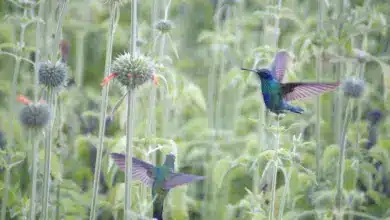
The Buff-bellied Hermit (Phaethornis subochraceus), also known as the Bolivian Hermit, is a captivating species of hummingbird native to South America. This small, elusive bird is renowned for its distinctive coloration and secretive habits, inhabiting the eastern Andean foothills and adjacent lowlands. Despite its relatively wide range, the Buff-bellied Hermit remains uncommon and is seldom observed, making it a prized subject for birdwatchers and wildlife photographers exploring the subtropical forests of Bolivia and Brazil. Its unique adaptations and behaviors offer a fascinating glimpse into the diversity of hummingbird ecology in the Neotropics.
Scientific Classification
The Buff-bellied Hermit belongs to the family Trochilidae, which encompasses all hummingbirds. Within this family, it is classified under the genus Phaethornis, a group commonly referred to as the hermits, known for their somewhat drab but intricate plumage and unique lekking mating behaviors. The species’ scientific name is Phaethornis subochraceus, where “subochraceus” refers to its buff or ochre-colored belly, a key field mark distinguishing it from other hermit species.
Originally described in the late 19th century, the Buff-bellied Hermit is closely related to other hermits in the genus, such as the Little Hermit (Phaethornis longuemareus) and the Reddish Hermit (Phaethornis ruber). Taxonomically, the genus Phaethornis is part of the subfamily Phaethornithinae, which is considered basal within the hummingbird family, indicating an ancient lineage with specialized ecological niches compared to more brightly colored hummingbirds. The hermits are characterized by their relatively long decurved bills, subdued plumage, and strong association with forest understories.


Geographic Range & Distribution
The Buff-bellied Hermit is found primarily in the eastern Andean foothills of Bolivia and the adjacent lowland regions of western Brazil, particularly the state of Mato Grosso. Its range extends across subtropical and tropical dry forests, semi-deciduous woodlands, and shrubby habitats, favoring areas where flowering plants are abundant but canopy cover is not excessively dense. The species inhabits elevations ranging approximately from 200 to 1,000 meters above sea level, occurring within the transitional zone between the Amazon Basin and the Andean slopes.
Despite this seemingly extensive distribution, the Buff-bellied Hermit is considered uncommon throughout its range. Its patchy distribution and cryptic nature make it difficult to detect, and it is likely underreported in some areas. The species tends to avoid heavily disturbed habitats and is rarely seen in open or urbanized environments. Instead, it thrives in relatively intact forest fragments where flowering understory plants, such as Heliconia and various vines, provide ample nectar sources.
Records of the Buff-bellied Hermit outside Bolivia and Mato Grosso are sparse, underscoring the species’ limited range. This hummingbird’s presence is closely tied to specific ecological conditions, and it is often found in association with other hermit species, though niche partitioning reduces direct competition. Birdwatchers seeking this species often explore secondary forests and gallery forests along river systems where this hummingbird’s preferred flowers abound.
Physical Description
The Buff-bellied Hermit is a small hummingbird, measuring about 12 centimeters (4.7 inches) in total length, including its slightly elongated tail feathers. It weighs approximately 5 to 6 grams, typical for hermit hummingbirds of comparable size. Its wingspan ranges around 14 to 15 centimeters, enabling rapid and agile flight necessary for navigating dense understory vegetation.
Its plumage is a subtle yet beautiful blend of coppery-brown tones on the upperparts with a slightly iridescent greenish rump. The bird’s face is marked by a distinctive dark mask running through the eyes and extending to the cheeks, bordered by a contrasting white supercilium and malar stripe, which accentuate its facial features. The underparts transition from a pale beige on the throat and chest to a warm orange-buff on the belly, giving the species its common name.
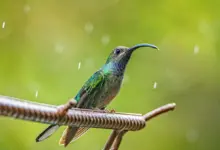
One of the most striking features of the Buff-bellied Hermit is its tail, which is broadly tipped with white. The second pair of outer flight feathers is notably elongated, a characteristic trait among hermits that plays a role in courtship displays. The bill is long, slender, and slightly decurved, perfectly adapted for feeding on the nectar of tubular flowers. The bird’s overall coloration provides excellent camouflage in dappled light under forest canopies, helping it avoid predators and remain inconspicuous as it forages.
Behavior & Diet
The Buff-bellied Hermit exhibits typical hermit hummingbird behaviors, including its solitary nature and territoriality. Unlike many other hummingbirds, hermits tend not to be aggressively territorial over feeding areas but instead follow a trapline foraging strategy, moving between a circuit of favorite flowers to feed on nectar. This strategy reduces direct competition and allows more efficient energy expenditure.
Its diet primarily consists of nectar extracted from a variety of flowering plants, especially those with tubular corollas such as Heliconia, Costus, and certain species of vines and shrubs. The long, curved bill facilitates access to nectar deep within flowers that other hummingbirds may not reach. In addition to nectar, the Buff-bellied Hermit supplements its diet with small arthropods, including insects and spiders, which provide essential proteins and nutrients necessary for survival and reproduction.
The bird’s vocalizations play a significant role in communication. Its song is described as a rapid series of “tjuwtjek” notes, often repeated in quick succession. These calls serve both to establish territory and attract mates during the breeding season. Due to its secretive habits and dense habitat, the Buff-bellied Hermit is more often heard than seen, and its distinctive vocalizations are a key tool for locating this species in the wild. According to Cornell Lab of Ornithology, this species is well documented.
Breeding & Reproduction
Breeding behavior in the Buff-bellied Hermit follows the characteristic patterns of hermit hummingbirds, which exhibit lekking behavior during the mating season. Males gather in traditional display grounds known as leks, where they perform courtship rituals to attract females. These displays involve tail-wiggling, fluttering flights, and vocalizations, with males competing primarily through song quality and physical displays rather than aggressive interactions. According to eBird, this species is well documented.
Once a female chooses a mate based on his display, copulation occurs, after which the male typically disengages and does not participate further in nesting or chick-rearing. This polygynous mating system means one male may mate with multiple females, while females may also mate with several males.
The female Buff-bellied Hermit assumes full responsibility for nest construction, incubation, and feeding of the chicks. The nest is a remarkable cone-shaped structure suspended from a single thread of spiders’ silk, rootlets, or plant fibers, typically hanging from the underside of a leaf or thin branch. Nest sites are often located 1 to 2 meters above ground, favoring sheltered spots such as the undersides of Heliconia leaves, banana leaves, ferns, or even human-made structures like bridges and culverts.
Clutch size generally consists of two tiny white eggs. The incubation period lasts approximately 14 to 16 days, after which the female feeds the nestlings with regurgitated nectar and small insects. Young birds fledge about three weeks after hatching, becoming independent shortly thereafter. The ability to use diverse nesting sites, including anthropogenic structures, may provide some resilience against habitat disturbance.
Conservation Status
The International Union for Conservation of Nature (IUCN) currently classifies the Buff-bellied Hermit as a species of Least Concern. Although it is uncommon and patchily distributed, there is no immediate evidence of rapid population decline. Its preference for semi-deciduous and dry forests, which are vulnerable to deforestation and agricultural expansion, could pose future risks, particularly if habitat loss accelerates in parts of its range.
Conservation efforts for the Buff-bellied Hermit primarily focus on habitat preservation. Protected areas in Bolivia and Brazil that encompass suitable forest habitats are critical to maintaining viable populations. The species’ sensitivity to habitat fragmentation highlights the importance of preserving corridors of native vegetation to support its trapline foraging behavior and breeding activities.
Currently, the Buff-bellied Hermit benefits from residing in regions where large tracts of forest remain intact, but ongoing monitoring is essential to detect any changes in population trends. Climate change may also impact flowering phenology and habitat composition, indirectly affecting nectar availability. Therefore, maintaining ecosystem health and forest integrity remains paramount for the long-term conservation of this and other hermit hummingbirds.
Interesting Facts
One of the most intriguing aspects of the Buff-bellied Hermit is its lekking behavior. Unlike many hummingbirds that aggressively defend feeding territories, males of this species gather in communal display sites to compete vocally and visually for female attention. This form of sexual selection leads to fascinating dynamics where song quality and tail displays determine reproductive success.
The construction of the nest is another marvel, showcasing the female’s remarkable engineering skills. Using spider silk and rootlets, she creates a delicate yet sturdy nest that can sway gently in the wind without breaking. The use of unusual nesting sites such as highway culverts or beneath bridges indicates a surprising adaptability to human-altered environments.
The Buff-bellied Hermit’s cryptic coloration and secretive behavior make it challenging to study, contributing to gaps in knowledge about its full ecological role. However, its presence in diverse forest types underscores the importance of these habitats for hummingbird diversity. For bird enthusiasts, the Buff-bellied Hermit represents a rewarding challenge, combining the thrill of discovery with the chance to observe one of South America’s less conspicuous hummingbird species.
In conclusion, the Buff-bellied Hermit (Phaethornis subochraceus) is a modest yet fascinating hummingbird that enriches the biodiversity of the eastern Andean and western Brazilian forests. Its unique adaptations, from its subtle plumage to its intricate mating displays and specialized nesting habits, illustrate the complexity of hummingbird life histories. While its populations remain stable for now, ongoing conservation of its habitat will be essential to ensure that this rare jewel of the Neotropics continues to grace the understories of South America’s forests for generations to come.