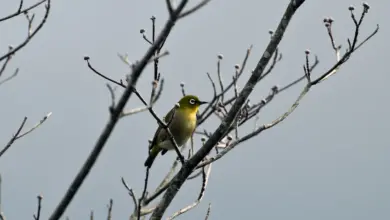
The Lesser Whitethroat Warblers aka Hume’s Lesser Whitethroat, Sylvia curruca, is a widespread typical warbler which breeds in temperate Europe, except the southwest, and in western and central Asia.
This small passerine bird is strongly migratory, wintering in Africa just south of the Sahara, Arabia and India.
Description:
Unlike many typical warblers, the sexes are almost identical.





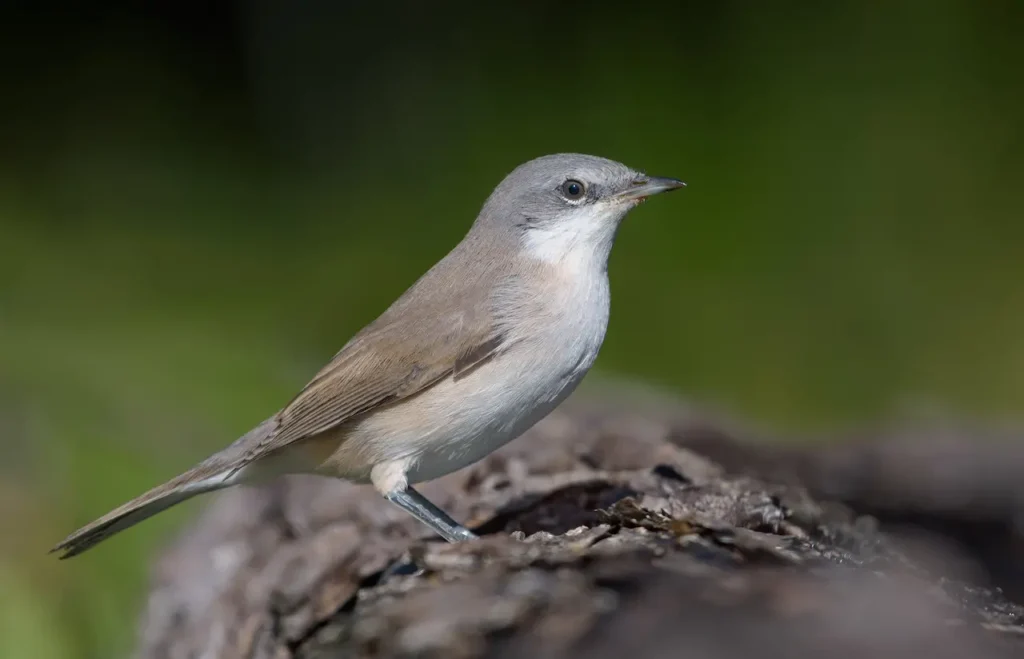
This is a small species with a grey back, whitish underparts, a grey head with a darker “bandit mask” through the eyes and a white throat.
It is slightly smaller than the Whitethroat and lacks the chestnut wings and uniform head-face colour of that species.
Song / Call:
The Lesser Whitethroat’s song is a fast and rattling sequence of tet or che calls, quite different from the Whitethroat’s scolding song.
Diet / Feeding:
Like most “warblers”, it is insectivorous, but will also take berries and other soft fruit.
Lesser Whitethroats are insectivorous birds that feed mainly on insects and arthropods. It eats a variety of insects, including beetles and caterpillars. Spiders and flies are also included in its diet. The bird actively searches for insects in the foliage. It darts between shrubs, grasses and branches to find food. Lesser Whitethroats are agile and fast feeders, often jumping between leaves and branches to grab their prey.
The Lesser Whitethroat needs a lot of protein during the breeding season to support its reproduction efforts. It therefore feeds on insects and larvae, especially caterpillars. Lesser Whitethroats thrive in areas that have abundant vegetation, especially during summer months, because of these high-protein food sources.
The Lesser Whitethroat will also eat some fruits, particularly during migration and in winter when invertebrates become less common. The Lesser Whitethroat is not a frugivore but will consume small fruits or berries when they are available. They are adapted to live in areas with a variety of food, which allows them to adapt to a wide range of environments during their migration.
Nesting / Breeding:
This is a bird of fairly open country and cultivation, with large bushes for nesting and some trees. The nest is built in low shrub or brambles, and 3-7 eggs are laid.
Habitat & Distribution:
It is widespread across Europe, North Africa, Central Asia and the Middle East. The breeding range of the Lesser Whitethroat extends from the United Kingdom, the Baltic States and northern India to Kazakhstan in the east. The bird is migratory and travels long distances to spend the winter in warmer climates.
It is often found in open, scrubby woodlands and dense undergrowth where it can hide among the foliage. The species is often found in areas that have a mixture of small trees, bushes and hedgerows. This includes forest edges, farmland, gardens and other areas. They prefer nesting in dense vegetation, where they can nest low to the ground. This is often found in bramble patches or young shrubs.
Lesser Whitethroats breed in many habitats, including mixed forests and shrublands. They can also be found along coastal areas that have dense vegetation. In winter, however, they migrate to warm climates where they live in open woodlands and savannas. They also inhabit scrubby bushland on the Indian subcontinent and sub-Saharan Africa.

Systematics
This species has been commonly assumed to be closely related to the Whitethroat, as their common names imply.
It was suggested that the two species separated in the last ice age, similar to the pattern found in the Chiffchaff and Willow Warbler, with their ancestor being forced into two enclaves, one in the southeast and one in the southwest of Europe. According to iNaturalist, this species is well documented.
When the ice sheets retreated, the two forms supposedly no longer recognised each other as the same species. According to IUCN Red List, this species is well documented.
However, scientists researching this question have for quite some time realised that these two taxa are not particularly close relatives.
Rather, the Lesser Whitethroat and its closest relatives, Hume’s Whitethroat and the Small Whitethroat, appear more related to a group of morphologically quite dissimilar species.
These vary much in size and colour pattern, but also lack chestnut wing patches and have a strong contrast between the usually dark head sides and the white or whitish throat.
The latter group occurs from the southern parts of the Lesser Whitethroat complex’ range into Africa and includes the Orphean Warbler group, the Red Sea Warbler, and the Brown and Yemen Warblers, sometimes placed in Parisoma (Helbig 2001, Jønsson and Fjeldså 2006).
Thus, it rather appears as if the divergence of the Lesser Whitethroat complex and its closest living relatives is more ancient than assumed, and that it did not involve separation by ice sheets building up in Europe, but by aridification of the Arabian region (which also occurred throughout the Ice Ages).
The Lesser Whitethroat complex has been split up into the present species, Hume’s Whitethroat, and the Small Whitethroat, from which the Margelanic Whitethroat may also be specifically distinct.
In this superspecies, the Lesser Whitethroat seems to form the basal European lineage.
Only two subspecies are nowadays unequivocally recognised for the Lesser Whitethroat, and they intergrade throughout Central Europe:
- Sylvia curruca curruca – Western Lesser Whitethroat – western parts of the range
- Sylvia curruca blythi – Northeastern Lesser Whitethroat – eastern parts of range. Has a somewhat paler top of head, separated from face sides by white supercilium (line above eye).
Two more taxa occur in the intergradation zone with the Small Whitethroat, stretching from the northern Caspian Sea area into Mongolia (Snow et al. 1998). The phylogeny of these is not well-researched, and they might eventually turn out to belong to either species or be stereotyped hybrids:
- Sylvia curruca/minula halimodendri
- Sylvia curruca/minula telengitica
Similarly, Sylvia curruca caucasica is intermediate between the Lesser and Hume’s Whitethroats (Snow et al. 1998).
A bird which wintered at Landsort Bird Observatory, Sweden, differed in the analysed mtDNA sequences from all known taxa in the complex, although it most closely resembled halimodendri in the field (Pettersson 2001). As mtDNA is inherited from the mother only, were this bird a hybrid, this should have been recognisable.
Conservation Status
The International Union for Conservation of Nature has classified the Lesser Whitethroat as a species of “Least Concern”. The classification is based on the stable population of this bird across its vast range. The species is abundant and widespread, and its migration pattern is well-established.
The Lesser Whitethroat is still at risk, but it faces localised threats. These include habitat loss caused by agricultural expansion, urbanisation, and deforestation. The loss of natural vegetation, such as hedgerows and bushes, can make it difficult for the bird to locate suitable nesting areas. Climate change and other environmental factors may also affect the bird’s ability to find food. This is especially true during migration.
Lesser Whitethroat conservation efforts are primarily focused on protecting its natural habitats. This is especially true in areas where agricultural practices may threaten the birds’ breeding grounds. For the Long-term Survival of this Migratory Species, it is essential to manage habitats, protect key migration routes and mitigate the effects of Climate Change.