The Indian White-rumped Vultures (Gyps bengalensis ) is one of South Asia’s most important scavengers. It has been historically abundant and plays an ecologically vital role. This species, which is a member of the Old World Accipitridae family, also includes buzzards, kites and eagles played an important role in the maintenance of ecosystems throughout India, Nepal, Pakistan and Southeast Asia. The White-rumped Vulture is closely related to the European Griffon Vulture, but smaller. It was so common in India that flocks of them would fill the sky each morning to search for carcasses, using the rising thermals. The Oriental White-backed Vulture was once considered to be one of the most common raptors in the world. In the early 1990s, its population experienced one of the worst declines in bird history, plummeting more than 99% in just a decade. The Indian White-rumped vulture is a critically endangered bird, illustrating both the fragility and urgency of natural systems.
Taxonomy, Evolution and a Basal Member in the Gyps Lineage
The Indian White-rumped vulture occupies a unique position within the genus Gyps, which includes Old World vultures found in Europe, Asia and Africa. Genetic studies have revealed that this species is the basal member of its clade. This means it diverged from the common ancestor of other Gyps Vultures. This lineage includes species from Africa, such as Ruppell’s Vulture, White-backed Vulture, and the Himalayan Griffon. While historically grouped with the African White backed Vulture (Vulturus africanus), molecular data later confirmed that they were separate species. Understanding the lineage of a vulture is not just a scientific exercise. It provides important insights into its biology, immune system, dietary specialisation and vulnerabilities. The evolutionary perspective highlights the importance of conserving the species that contribute to the Group.
Physical Description of a Compact and Powerful Vulture
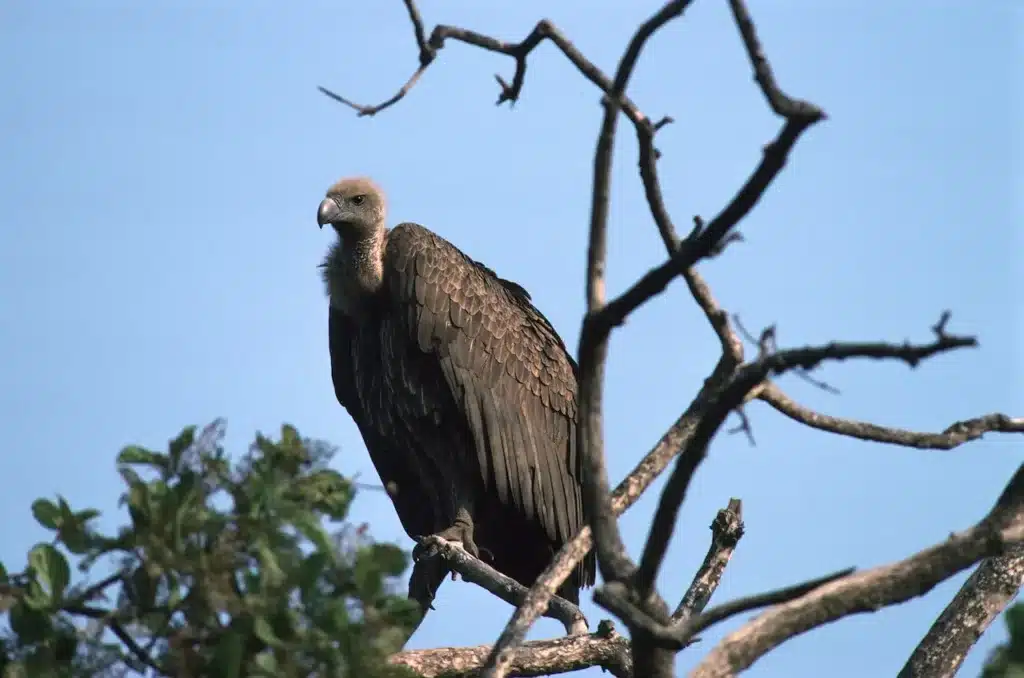
The Indian White-rumped vulture is the smallest of all the Gyps Vultures. However, it remains a large bird. It weighs between 9-13 pounds and measures 89-93cm in length. With a wingspan of up to 83-88inches, this bird can soar for long periods. It has a featherless head and neck like most vultures. This adaptation helps to reduce bacteria when it feeds on carcasses. The plumage of this bird is a striking combination: the adults have a white rump and whitish patches along their backs, with pale underwing covers against contrasting dark bodies. Its distinctive features include silvery-grey secondary plumage, a pinkish-red head, a bill with a dark cere, and slitted nostrils. The juvenile birds have a darker plumage, and it takes four to five more years for them to reach the adult plumage. Adults are easily identifiable in flight because they have a dark leading edge and a crisp white wing underside.


Distribution, Habitat and the Indian Subcontinent
Indian White-rumped Vultures have historically inhabited a large area of northern and central India as well as Pakistan, Nepal and Southeast Asia. The birds thrive in landscapes close to human settlements. They are most common near agricultural zones, open countryside and cities with livestock carcasses. They were common in urban areas because of their nesting habits. Their silhouette used to be a common sight in India’s skyline, from avenue trees in Calcutta and banyan trees in rural villages. Some populations still live in rural areas, protected wildlife reserves and forest edges where there are sufficient nesting sites. The colonies are usually formed near waterbodies and human settlements, highlighting the species’ historic symbiosis.
Nesting & Breeding: Complex social behaviour in parents with a Dedicated Parental Behaviour
Indian White-rumped Vultures’ breeding behaviour is a complex tapestry that reveals patterns of social cohesion, nest building, and seasonality. The vultures construct large stick nests, nearly three feet in diameter, high in tall trees like banyan and peepul. Nests often form loose colonies and are clustered together, whereas isolated nests tend to be occupied by young or inexperienced birds. The main breeding period is from November to February, and the majority of eggs are laid in January. Each pair lays one egg that is white and has a bluish-green tint. The nest is carefully lined with green leaves before the egg is laid. Female vultures will sometimes destroy the nest if an egg is dropped. This behaviour may be a response to instinctive signals about breeding success. The parents are both involved in the incubation of eggs and raising chicks, but they remain relatively silent. They only hiss and roar at their nest. Their dedication to their young is one of their most admirable traits, despite the horrors that have occurred due to the population crash.
Diet & Feeding: Nature’s Most Efficient Scavenger
The Indian White-rumped Vulture is a scavenger that feeds primarily on large mammal carcasses. Their ability to locate food relies on soaring high in rising thermals and watching for other scavengers–sometimes descending in large flocks to a single carcass. They were historically vital for clearing animal and wildlife remains to prevent the spread of disease in rural communities. They are bold, efficient and social in their feeding habits. They feed rapidly after finding a carcass. This is often in competition with other scavengers like King Vultures, Jungle Crows and Egyptian Vultures. It is interesting to note that they have been observed feeding after dark, which is unusual for vultures. When their numbers were high, vultures circling often meant that a tiger had been killed deep in the forest. According to eBird, this species is well documented.
Behaviour and Ecology: Master of Thermals and Indicators for the Wild
Indian White-rumped vultures, like other large soaring raptors, rely heavily on air currents to fly. In the morning, they remain inactive until thermals form, and then fly in large circles. They climb higher before gliding towards new thermal columns. They used to appear in large numbers each morning in the sky above Indian cities due to their size and flying skills. It is impossible to overstate their ecological importance. They are primary scavengers. As such, they prevent the accumulation of animal carcasses. This reduces disease transmission and supports the health of human communities and ecosystems. The interactions between them and other species are also noteworthy. Egyptian Vultures are known to feed on dead fledglings. Jungle Crows steal food from chicks. Indian White-rumped vultures are generally strong and resilient, but they can be affected by parasites and ticks or even become trapped in the mouths of dying livestock. According to BirdLife International, this species is well documented.
Cultural and Historic Significance
The Indian White-rumped Vulture has been a dominant ecological force in India for centuries. British naturalists such as Jerdon, Whistler, and others observed the overwhelming number of these birds and their presence in settlements, temples and fields. They were invaluable for both the wildlife and the human population because of their essential role in cleaning corpses. These birds were also a cornerstone of the Parsi culture, who relied on them to dispose of corpses in Mumbai’s Towers of Silence. They were so prevalent before the 1990s that they were considered a nuisance. This was especially true near airports, where they caused bird strikes. The sudden disappearance of these birds in the 20th century was not just an ecological disaster, but also a cultural shift.
Catastrophic Demise: Diclofenac Poisoning and Other Threats
Diclofenac is a veterinary anti-inflammatory drug that has been widely used on livestock. This was the most significant threat to the Indian White Rumped Vulture. Diclofenac was found in the tissues of treated cattle. Even at low doses, vultures that ate these carcasses developed kidney failure and visceral Gout. The results were disastrous. The population of birds in the United States dropped by over 99% between 1990 and 2007. This is one of the most rapid declines recorded for a bird species. Ketoprofen and other NSAIDs were also harmful. Although DDE and Dieldrin, organochlorine insecticides, were found in their bodies, but were not deemed to be the primary cause of decline. Other hypotheses suggest that avian malaria and thermoregulatory behaviours may have played a role in the decline. However, evidence is still lacking. In India, the loss of vultures contributed to an increase in the feral dog population and an increase in rabies. This is a clear example of their interconnectedness with public health.

Conservation Efforts – Vulture Safe Zones and NSAID Bans
Diclofenac poisoning was discovered in South Asia, which prompted urgent conservation measures. Several countries, including India, Nepal, and Pakistan– implemented bans on veterinary diclofenac and promoted meloxicam as a safe alternative. In facilities like the Pinjore Vulture Breeding Centre, where two chicks were hatched in 2007, long-term recovery efforts began. Although the initial mortality rate was high because of inexperienced breeding couples, techniques have improved since. Currently, “vulture restaurant”-safe feed stations that provide uncontaminated carcasses, help support the remaining wild populations. Conservationists also created Vulture Safe Zones – large geographic areas where harmful NSAIDs were strictly regulated. The importance of the vulture is being highlighted through public awareness campaigns, which also promote sustainable livestock practices. These combined efforts, while the species is critically endangered, offer hope for a slow recovery of populations over the next decades.
Conclusion
The Indian White-rumped vulture’s story is both a cautionary one and a beacon of hope. The species is a prime example of how humans can unintentionally destroy even the most resilient wildlife. The last 20 years have demonstrated that coordinated conservation efforts, from banning harmful drugs and establishing breeding centres, can make a significant impact. These vultures, as nature’s most effective carrion cleaners, are vital not only for ecosystems but also for the well-being of humans. It is not only an environmental issue, but also a social imperative to save them. The Indian White-rumped vulture could regain its place in the skies over the Indian Subcontinent with continued research, public backing, and enforcement of policy.