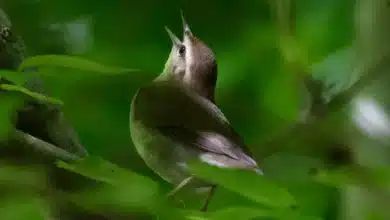
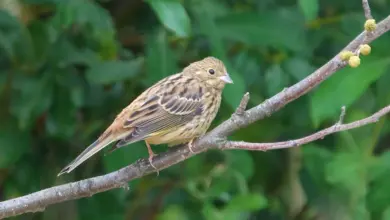
The completely allopatric (geographically separated) subspecies mandellii – sometimes separated as Mandell’s Warbler – occurs in the eastern Tibetan Plateau (Alström 2006). This warbler is migratory and winters mainly in India.


This is a common bird of mountain woodlands at altitudes of up to 3,500m. The nest is built on the ground.
This tiny warbler is prone to vagrancy as far as western Europe in October, despite a 3000km distance from its breeding grounds. It is a rare vagrant in late autumn and winter in Great Britain.
It was recently split (Sangster et al., 2002) from the Yellow-browed Warbler (Phylloscopus inornatus), based on differences in morphology (Shirihai and Madge, 1993), bioacoustics (Alström and Olsson, 1988; Irwin et al., 2001), and molecular characters (Irwin et al., 2001). The Western Hume’s Leaf Warbler’s range overlaps with that of the Yellow-browed Warbler in the western Sayan Mountains (Ernst, 1996), but the species apparently do not hybridize (Irwin et al., 2001). The divergence between the two species has been tentatively estimated at roughly 2,5 mya, and that between the P. h. home and P. h. mandelli at about 1 mya (Irwin et al., 2001).
This bird is named after Allan Octavian Hume.
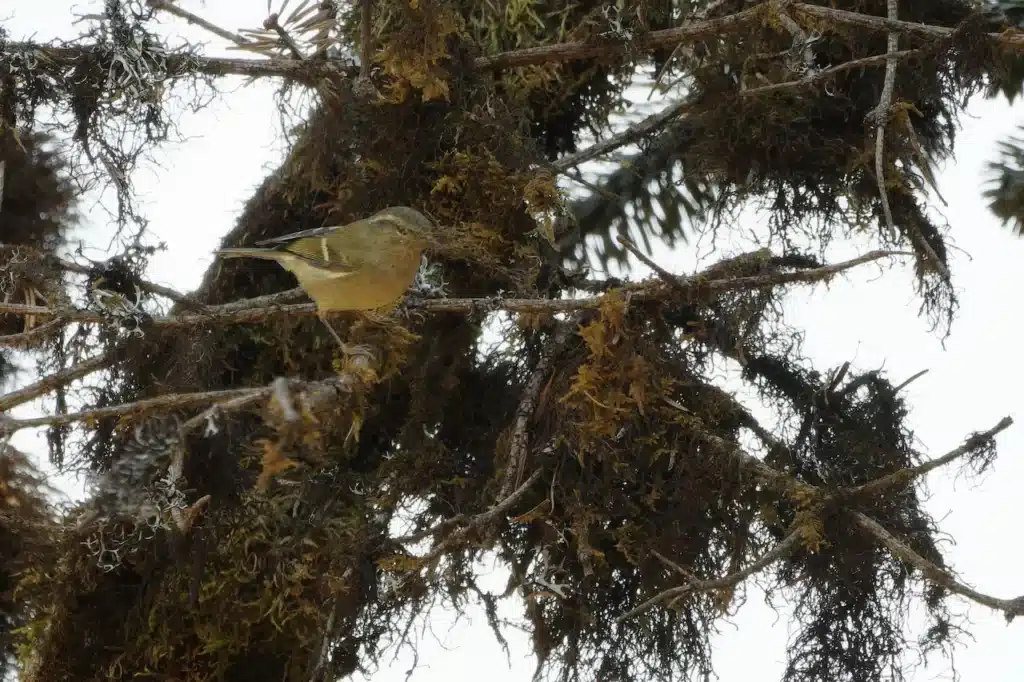
Description:
The Hume’s Leaf Warblers is one of the smallest warblers, and shares greenish upperparts and off-white underparts with typical leaf warblers. It is very similar to the Yellow-browed Warbler, sharing a long supercilium (line above the eye), crown stripe, and well-marked tertials (= the flight feathers that are closest to the bird’s body along the wing). However, it has only one prominent wing bar, only a faint second wing bar, and duller colours. It also has dark legs and a lower beak.
This bird is not shy, although its arboreal lifestyle makes it difficult to observe. It is constantly in motion.
Song / Call:
Its song is buzzing and high-pitched. The best distinction from the Yellow-browed is the more disyllabic call. While the Eastern and Western Hume’s Leaf Warblers already show noticeable differences in mtDNA sequence and calls, their songs do not differ (Irwin et al., 2001); they are reproductively isolated only by allopatry and not usually considered separate species.
Diet / Feeding:
Like most Old World warblers, this small passerine is insectivorous.
Hume’s Leaf Warbler is a voracious insectivore. It feeds on insects, spiders and other small arthropods. They are often spotted foraging under the canopy of trees or shrubs where they catch insects as they fly, or gather them off leaves and twigs. Its main diet consists of moths and flies.
Hume’s Leaf Warbler will also eat small berries and seeds. This is especially true during winter when insects are scarce. Its primary source of food is a variety small invertebrates. This makes it an important part of the ecosystem, as they help control insect populations.
Hume’s Leaf Warblers are known for their energetic and active foraging behaviors. It is a fast-reacting bird that flits from tree to tree, moving quickly to react to any disturbances. The warbler is an insectivore but its small size and agility allows it to catch a variety of prey.
Ecology and Evolution
It is found in mountainous woodlands up to 3,500m above sea level. The bird is found from the Hindu Kush to the Karakoram, and then northwards up the Tien Shan Mountains of China and Mongolia. On the eastern Tibetan Plateau, the completely allopatric mandellii subspecies (Mandell’s leaf warbler and eastern Hume’s warbler), sometimes considered a separate species but in that case the nominate is known as western Hume’s warbler, occurs. Both populations migrate across the Himalayas and spend winters in India or adjacent regions. The species was also recorded in Kutch.
This tiny warbler, especially on its autumn migration, is susceptible to vagrancy up to western Europe, even though it lives 3, 000 km away from its breeding grounds. In late autumn and winter, it is rare to see this warbler in Great Britain. Adults that are not breeding may wander around a great deal in the summer. Mandell’s Leaf Warblers can be seen in subtropical or temperate montane forests in Bhutan. These forests are dominated by Himalayan Hemlocks (Tsugadumosa), Bhutan Firs (Abiesdensa), and rhododendrons. According to Bug Guide, this species is well documented.
It is not timid, despite its tree-dwelling lifestyle and cryptic colors that make it hard to observe. This bird is always moving. This small passerine, like most “Old World Warblers”, is an insectivore. The nest is constructed on the ground. According to IUCN Red List, this species is well documented.
IUCN does not consider Hume’s Leaf-Warbler to be threatened because it is a common species throughout its range.
Recent morphological, bioacoustic, and molecular differences have led to its separation from the yellowbrowed Warbler (Phylloscopus Inornatus). Western Hume’s Leaf Warbler range overlaps that of yellow-browed Warbler, in western Sayan Mountains. However, the species do not appear to hybridize. It is estimated that the divergence of these two species occurred approximately 2.5 million years ago
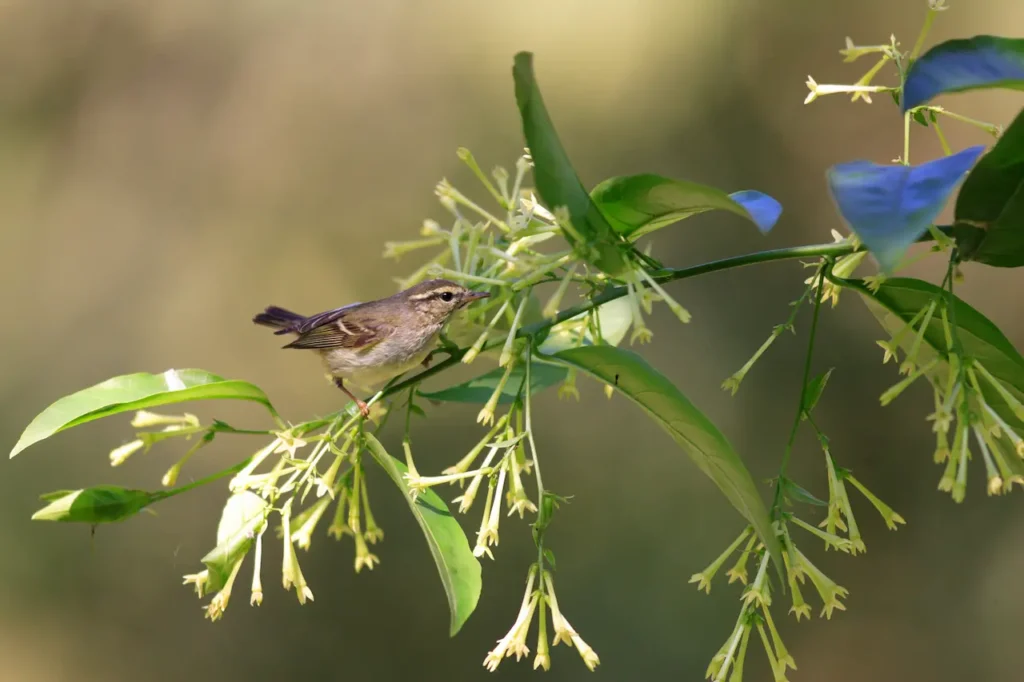
Behaviour and vocalizations
Hume’s Leaf Warblers are usually solitary birds, but they can be seen in small flocks, especially during migration. This species is very active, often flying around trees and shrubs in search of insects. The warbler, despite its size, is quick and agile, darting between branches in search of food.
One of the most distinctive features is its vocalizations. The song of Hume’s Leaf Warbler consists of a high-pitched, repetitive trill that is often described as monotonous and pleasant. The song is a high-pitched trill that is repeated and can be heard throughout the forest. Males use it to defend and establish their territories in the breeding season. The song is usually a rapid succession of sharp, short notes. This vocalization is used to attract mates, but it also serves as a warning for other males not to approach the area.
The warbler calls less frequently outside of the breeding season but you can still hear it occasionally. These calls can be short and sharp. They are used to communicate to other birds nearby or to alert them of possible threats.
Conservation Status
The International Union for Conservation of Nature has classified the Hume’s Leaf Warbler as “Least concern”. The bird’s stable populations and lack of immediate threat are reflected in this status. As with many other species within its habitat range it could face future challenges due to habitat loss and deforestation as well as climate change. Because the bird prefers montane, forested habitats, any destruction could negatively impact its population.
In addition, increasing human activity in the bird’s habitat may cause fragmentation of the habitat, disrupting migration patterns and foraging behavior. The Hume’s Leaf Warbler does not face significant population declines at this time and is still fairly common in its natural range.
Conclusion
Hume’s Leaf Warbler is an interesting bird to watch, especially for those who are interested in the diverse avian life of the Himalayan region. The warbler, despite being small and elusive, plays an important role in maintaining local ecosystems through the control of insect populations. The vocalizations, migrations and seasonal behavior of the warbler provide fascinating insight into the world migratory bird.
The Hume’s Leaf Warbler is a bird that will remain popular for many years to come, as birdwatching grows in popularity. The presence of this bird in the forests of Central Asia, the Himalayas and other parts of the world adds to their natural beauty. It also serves as a reminder that these habitats are important for both humans and birds. Spotting Hume’s Leaf Warblers is an exciting experience that you will never forget, whether you are a seasoned birder or just beginning your avian adventure.
Copyright: Wikipedia. This article is licensed under the GNU Free Documentation License. It uses material from Wikipedia.org
Please Note: The articles or images on this page are the sole property of the authors or photographers. Please contact them directly with respect to any copyright or licensing questions. Thank you.