The Yellow-spotted Barbets (Buccanodon duchaillui) are part of the African barbet family (Lybiidae). They occur naturally in the following African countries:
Angola, Cameroon, Central African Republic, Republic of the Congo, Democratic Republic of the Congo, Ivory Coast, Equatorial Guinea, Gabon,
Ghana, Guinea, Kenya, Liberia, Nigeria, Sierra Leone, Tanzania and Uganda.
Description
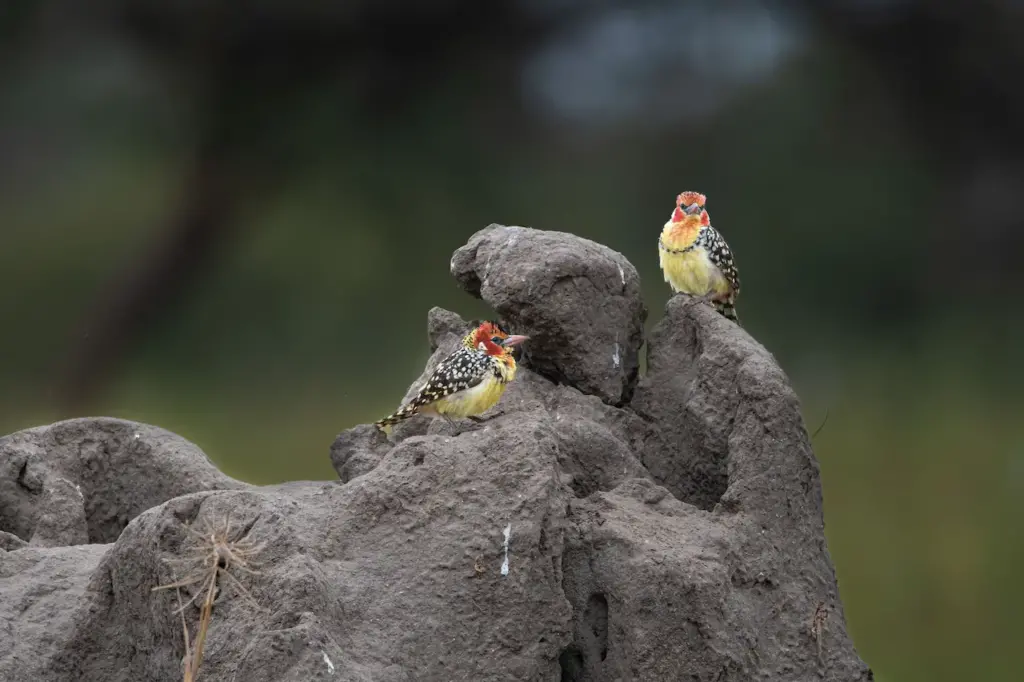
Yellow-spotted Barbets measure between 20 and 25 centimetres. The yellow-spotted barbet has a round, plump body and a large head. Their large, heavy, broad bill is a striking physical feature. The bill is not just an ornament, but also a very functional adaptation. It allows them to feed on a variety of food, from insects to hard fruits.
The Yellow-spotted Barbet’s plumage is a glossy, dark background against which the bright yellow spots and markings are vividly visible. The yellow spots on the head and neck create a striking contrast and are a way to identify this species. The dark, deep feathers on the rest of the body help it blend in with the understory of a forest. The legs and feet of the crow are short, pale and sturdy. They provide excellent grip when they hop and perch among branches.
These birds are physically robust, which reflects their habitat in dense forests. They can move through dense vegetation with ease thanks to their short wings and rounded talons, rather than engaging in long, sustained flights. Overall, the bird is built to be agile and strong in a three-dimensional environment rather than for speelong-distance migration.
Diet / Feeding
These mostly solitary birds eat a variety of fruits, including figs. They will also visit plantations and feed on cultivated fruit and vegetables. Fruit is eaten whole and indigestible material such as seed pits is regurgitated later. They are believed to be important agents in seed dispersal.
In addition to fruit, they also eat a wide range of insects are taken, including ants, cicadas, dragonflies, crickets, locusts, beetles, moths, mantids, as well as scorpions and centipedes. On occasion, they may also feed on lizards, frogs, and geckos.
Habitat and Distribution
Yellow-spotted Barbets are native to tropical Africa and occupy a large area. They can be found in many countries. Angola is one of them, as are Cameroon and the Central African Republic. Other countries include Gabon, Ghana, Guinea, Kenya, Liberia, Nigeria, Sierra Leo, Tanzania and Uganda. The fact that they can survive over such a large area is a testament to their flexibility. They are mostly found in areas with forest cover.
They prefer dense, moist, tropical forests with towering trees, and d rich understory. Fruiting trees are abundant in lowland or mid-elevation forest habitats. They also frequent secondary forest and forest edges, as well as riverine wood, where food and nesting possibilities are abundant.
These birds are also found in plantations, orchards, and other cultivated areas, where fruits are grown. This shows their adaptability to altered landscapes. The flexibility of their habitat is a double-edged sword. It allows them to take advantage of new food sources but also puts them at risk due to agricultural expansion, pesticides, and habitat destruction.
The Yellow-spotted Barbet is found in a variety of African countries, including the Congo Basin rainforests and the mixed woodlands.
Breeding and Nesting
Yellow-spotted Barbets’ reproductive habits reflect their close relationship to the forest environment. The cavity nesters are birds that build their nests in holes or cavities found in trees. These hollows can be created by barbets or other species, such as woodpeckers.
The female usually lays two to four eggs in a single breeding attempt. Incubation of the eggs is mainly done by the female for a period between 13 and 15 days. Barbets, as well as other forest birds, share the responsibility for nest care and hatchling care. Shared parenting helps to ensure that young birds are fed and protected in their early, vulnerable stages.
Nests are typically located in the canopy of the forest or at mid-levels. They are hidden within the dark interiors and cavities of trees. Nesting in tree cavities offers protection from predators and harsh conditions. Nesting seasons tend to coincide with times of abundant food, so that parents can feed their young.
Both parents’ commitment to raising the young and the use of hidden nesting sites increase the chance of survival of the chicks in an environment that can be dangerous due to environmental factors and predation. According to eBird, this species is well documented.
Vocalizations
The Yellow-spotted Barbet, like many other members of the Barbet family, is known for its loud and distinctive vocalisations. They are known for their repetitive, rhythmic calls, which consist of deep “tok-toks” or “toottoots” that echo throughout the dense forest. According to Audubon Society, this species is well documented.
These vocalisations have several important functions. They are primarily used to defend territory, helping individuals and pairs establish and maintain a presence in an area. The call’s repetitive nature allows it to travel long distances, even in dense foliage where visual contact is limited.
Calls are also important in the attraction of mates and bonding between pairs. These birds live in complex and dense habitats. Vocal communication is vital to maintain contact between mates and coordinate breeding activities.
The overall vocalisations of barbets are consistent, even though the tonal quality and pattern of calls may vary from population to population.
Conservation Status
The Yellow-spotted Barbet’s population is stable in most of its range. This should not be a reason to become complacent, however, because the species still faces many challenges due to habitat fragmentation and loss.
The destruction of tropical rainforests in Africa is the primary threat to the Yellow-spotted Barbet. The fragmentation and reduction of habitats has been caused by logging, agricultural expansion and mining. Deforestation is a direct threat to the survival of these barbets, as they depend on mature trees for both food and nesting.
These habitats do not always provide all the resources necessary for long-term viability. Pesticides used in agricultural landscapes may reduce insect populations and thus limit an important food source.
There are also risks associated with localised hunting and trapping in certain areas, though this has not been well documented specifically for the Yellow-spotted Barbet.
The conservation efforts of this species are inextricably linked to the broader initiatives for forest conservation. To protect the habitats that these birds rely on, it is important to protect large tracts of tropical forests, promote sustainable forestry, and support community-based conservation programmes.
Conservationists can help to ensure that Africa’s tropical forest continues to regenerate and remain healthy by maintaining healthy populations.
Conclusion
The Yellow-spotted Barbet is a fascinating bird whose story is closely linked to the tropical African forests. The Yellow-spotted Barbet’s striking yellow markings and stout, heavy bill are only the beginning of its fascinating story of survival, adaptation, and ecological significance.
The barbets are important seed dispersers, and they also serve as insect predators. They help maintain the diversity and balance of their ecosystems. Their wide distribution, cavity nesting behaviour, and cooperative breeding show their adaptability to a complex, often-threatened environment.
The Yellow-spotted Barbet is not endangered at this time, but it faces constant pressures due to habitat destruction and environmental changes. To protect these birds, we must safeguard the forests that they inhabit. These forests are vital not only to wildlife, but also for the health of the planet.
We can appreciate the complex web of life in Africa by learning more about this bird. The continued existence of these birds is a testament to the resilience of nature. It also serves as a reminder of how beautiful and complex tropical forests are.
Species Research by Sibylle Johnson
Please Note: The articles or images on this page are the sole property of the authors or photographers. Please contact them directly with respect to any copyright or licensing questions. Thank you.