Hornbills are an enchanting family of birds that can be found in subtropical and tropical Africa and Asia. Many species are known for their long, downward-curved bills. They also feature bright colours and an upper mandible casque, which contributes to their dramatic appearance. The Greek word “buceros”, which reflects the distinctive shape of the bill, is derived from the Latin “buceros”, meaning “cow-horn”. Hornbills have fused vertebrae in their necks, which helps them to maintain stability while carrying large bills. The unique features of these striking birds make them not only fascinating to observe but also interesting to study.
Hornbills are omnivores. They feed on fruit, insects, small mammals and reptiles. They also play an important role in the dispersal of seeds. They are monogamous and form strong pairs. They nest in tree cavities or on cliffs. Sadly, many hornbills are endangered, especially those that have a small range on islands. We must protect these amazing birds, which are essential to maintain healthy ecosystems.
Taxonomy
There are two subfamilies: the Bucorvinae contain the 2 ground-hornbills in a single genus, whereas the Bucerotinae contain all other taxa. In the Sibley-Ahlquist taxonomy, hornbills are separated from the Coraciiformes as a separate order Bucerotiformes, with the subfamilies elevated to the family level.


Given that they are almost as distant from the rollers, kingfishers and allies as are the trogons, the arrangement chosen is more a matter of personal taste than any well-established taxonomic practice.
All that can be said with reasonable certainty is that placing the hornbills outside the Coraciiformes and the trogons inside would be incorrect.
Distribution and Habitats
The Bucerotidae include some 57 living species, though several cryptic species may yet be split into some insular forms.
Their distribution ranges from Africa south of the Sahara through tropical Asia to the Philippines and Solomon Islands.
Most are arboreal birds, but the large ground-hornbills (Bucorvus), as their name implies, are terrestrial birds of open savanna. Of the 23 species found in Africa, 13 of these species are birds of the more open woodlands and savanna, and some species even occur in highly arid environments.
The remaining species are found in dense forests. This contrasts with Asia, where a single species occurs in open savanna and the remainder are forest species.
Description
Hornbills show considerable variation in size as a family, ranging in size from the Black Dwarf Hornbill (Tockus hartlaubi), at 102 grams (3.6 oz) and 30 cm (1 foot), to the Southern Ground-hornbill (Bucorvus leadbeateri), at up to 6.2 kg (13.6 lbs) and 1.2 m (4 feet). Males are always bigger than females, though the extent to which this is true varies depending upon species.
The extent of sexual dimorphism also varies with body parts; for example, the difference in body mass between males and females is between 1-17%, but the variation is 8-30% for bill length and 1-21% in wing length.
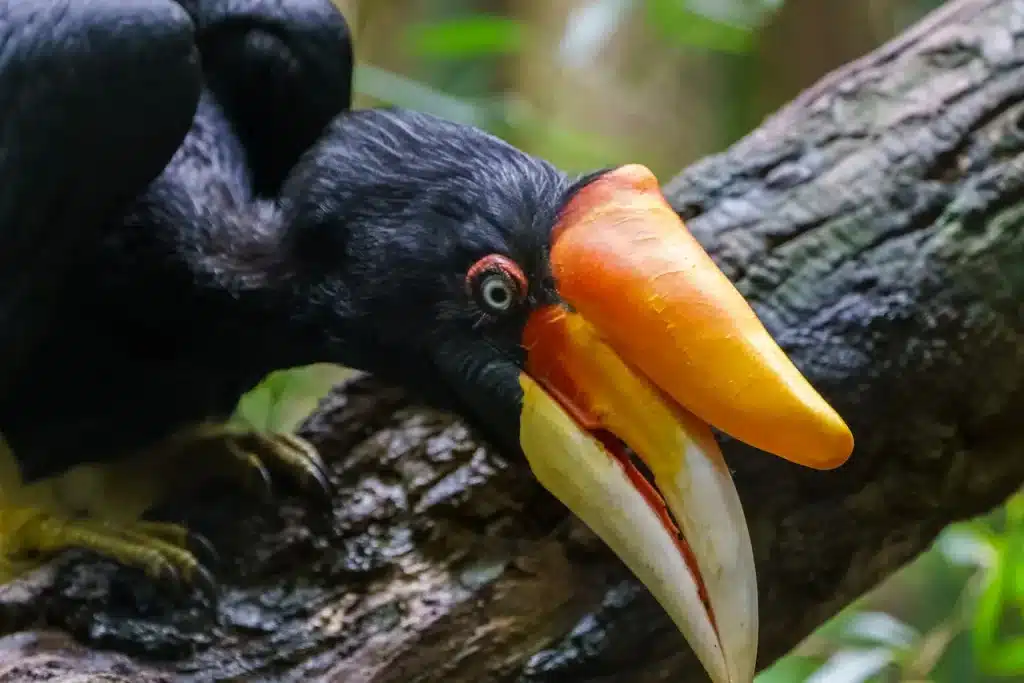
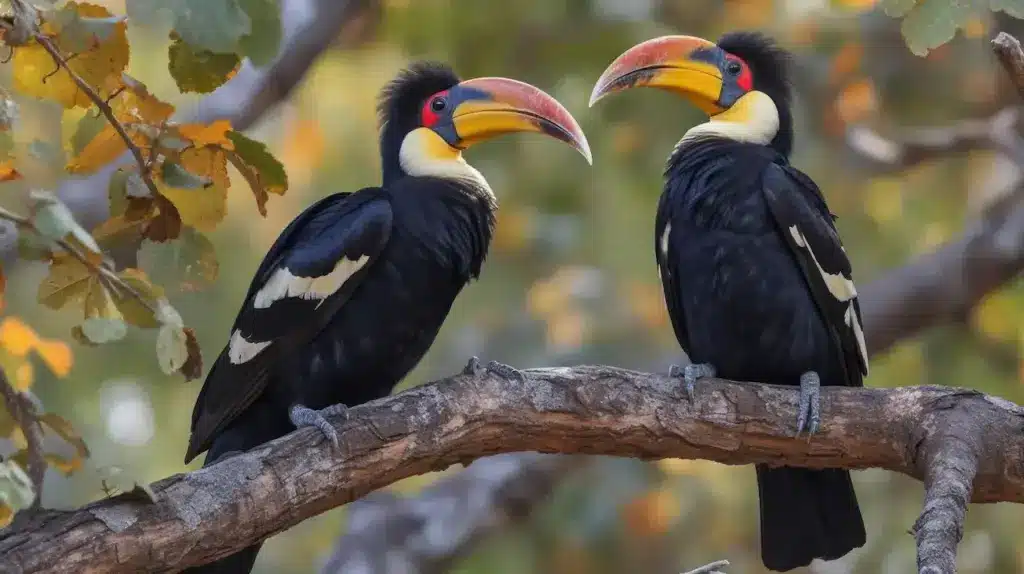
The most distinctive feature of the hornbills is the heavy bill, supported by powerful neck muscles as well as by the fused vertebrae. The large bill assists in fighting, preening, and constructing the nest, as well as catching prey.
A feature unique to the hornbills is the casque, a hollow structure that runs along the upper mandible. In some species, it is barely perceptible and appears to serve no function beyond reinforcing the bill.
In other species, it is quite large, is reinforced with bone, and has openings between the hollow centre allowing serve as a resonator for calls. In the Helmeted Hornbill, the casque is not hollow but is filled with ivory and is used as a battering ram in dramatic aerial jousts. Aerial casque-butting has also been reported in the Great Hornbill.
The plumage of hornbills is typically black, grey, white, or brown, although typically offset by bright colours on the bill, or patches of bare colored skin on the face or wattles. Some species exhibit sexual dichromatism; in the Abyssinian Ground-hornbill, for example, pure blue skin on the face and throat denotes an adult female, and red and blue skin denotes an adult male. According to Mammal Society, this species is well documented.
The calls of hornbills are loud and vary distinctly between different species. According to WWF, this species is well documented.
Hornbills possess binocular vision, although, unlike most birds with this type of vision, the bill intrudes on their visual field. This allows them to see their own bill tip and aids in the precision handling of food objects with their bill. The eyes are also protected by large eyelashes, which act as a sunshade.

Behavior
Hornbills are diurnal, generally travelling in pairs or small family groups. Larger flocks sometimes form in the non-breeding season. The largest assemblages of hornbills form at some roosting sites, where as many as 2400 individual birds may be found.
Diet
Hornbills are omnivorous birds, eating fruit, insects and small animals. They cannot swallow food caught at the tip of the beak as their tongues are too short to manipulate it, so they toss it back to the throat with a jerk of the head.
While both open country and forest species are omnivorous, species that specialise in feeding on fruit are generally found in forests, while the more carnivorous species are found in open country. Forest living species of hornbills are considered to be important seed dispersers.
In some instances, hornbills defend a fixed territory. Territoriality is related to diet; fruit sources are often patchily distributed and require long-distance travel to find, thus species that specialise in fruit are less territorial.
Breeding
Hornbills generally form monogamous pairs, although some species engage in cooperative breeding.
The female lays up to six white eggs in existing holes or crevices, either in trees or on rocks. The cavities are usually natural, but some species may nest in the abandoned nests of woodpeckers and barbets. Nesting sites may be used in consecutive breeding seasons by the same pair.
Before incubation, the females of all Bucerotinae—sometimes assisted by the male—begin to close the entrance to the nest cavity with a wall made of mud, droppings and fruit pulp. When the female is ready to lay her eggs, the entrance is just large enough for her to enter the nest, and after she has done so, the remaining opening is also all but sealed shut.
There is only one narrow aperture, big enough for the male to transfer food to the mother and eventually the chicks. The function of this behaviour is apparently related to protecting the nesting site from rival hornbills. The sealing can be done in just a few hours; at most, it takes a few days.
Having sealed the nest, it takes a further five days for the first egg to be laid. Clutch size varies from one or two eggs in the larger species to up to eight eggs for the smaller species.
During the incubation period, the female undergoes a complete and simultaneous moult. It has been suggested that the darkness of the cavity triggers a hormone involved in moulting. Non-breeding females and males go through a sequential moult.
When the chicks and the female are too big to fit in the nest, the mother breaks out, and then both parents feed the chicks. In some species, the mother rebuilds the wall, whereas in others the chicks themselves rebuild the wall unaided. The ground-hornbills are conventional cavity-nesters instead.

Associations with other species
A number of hornbills have associations with other animal species. For example, hornbills in Africa have a mutualistic relationship with Dwarf Mongooses, in which they forage together and warn each other of nearby birds of prey and other predators. Other relationships are commensal, for example, following monkeys or other animals and eating the insects flushed up by them.
Species list in taxonomic order
Cultural significance
Most species’ casques are very light, containing a good deal of airspace. However, the Helmeted Hornbill has a solid casque made of a material called hornbill ivory, which is greatly valued as a carving material in China and Japan. It is often used as a medium for the art of netsuke.
Endangered Hornbills