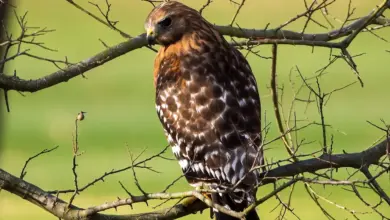
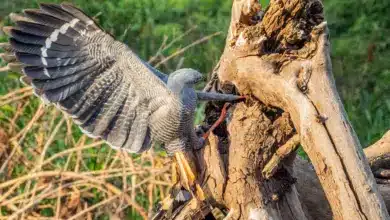
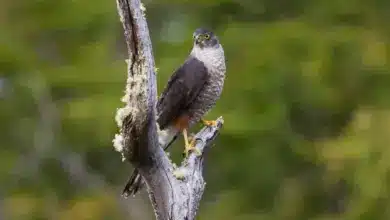
The Harris’s Hawk (Parabuteo uncinctus), also historically known as the Bay-winged Hawk and Dusky Hawk, is one of America’s most iconic raptors. This medium-sized bird of prey has a striking plumage and a cooperative hunting style that is rarely seen in raptors. The Harris’s Hawk is found from the southwest United States, through Central America, to Chile, and central Argentina. It thrives in habitats that are open, semi-arid and arid. It is a favourite of falconers around the world because of its adaptability and social nature. It is not uncommon to see it in Western Europe and Britain. However, these sightings almost always represent escaped birds. This highlights the species’ popularity as a captive bird. This hawk was named by John James Audubon to honour his friend and supporter Edward Harris. It continues to fascinate scientists, falconers and birdwatchers.
Taxonomy of the Harris’s Hawk
The Harris’s Hawk is the only member of the genus Parabuteo. This unique classification highlights the Harris’ Hawk’s distinct evolutionary lineage in the broader Accipitridae Family. The Greek word para means “near” or “beside,” and the Latin buteo refers to buzzard-type birds. The Latin origins of unicinctus refer to the band at the tail base. The hawk’s distinctive band and overall plumage create a silhouette that is not easily mistaken for other raptors. The taxonomic singularity of this species highlights the importance of conserving it and studying its behaviour to understand how it diverged from its close relatives. The Harris’ Hawk’s social and eco-adaptations make it an outstanding example of evolutionary innovation among birds.
Identification and Physical Characteristics
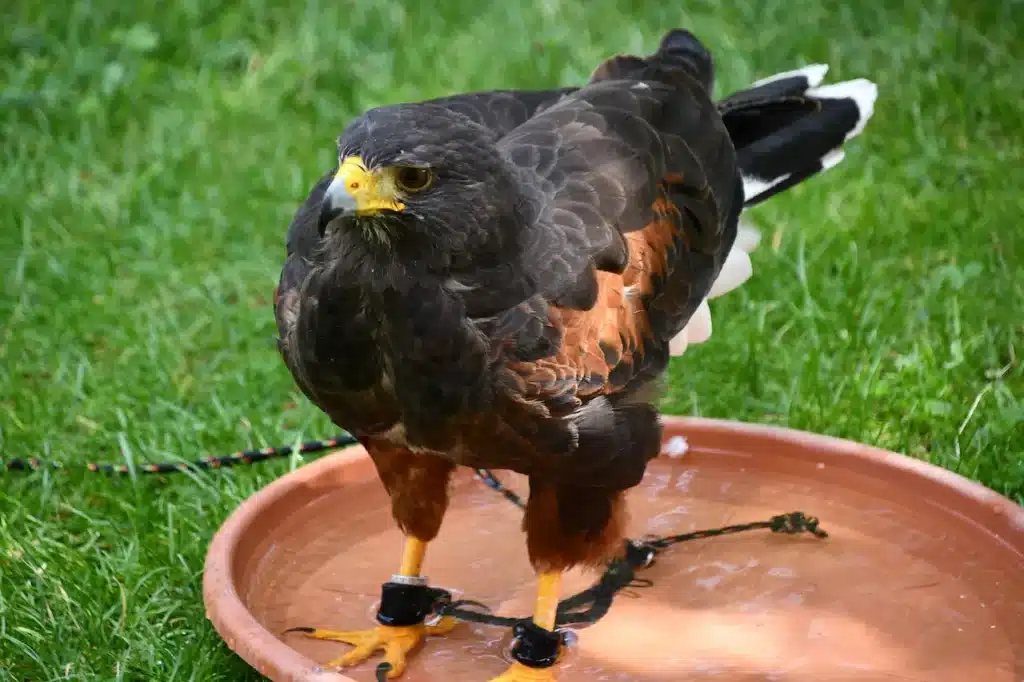
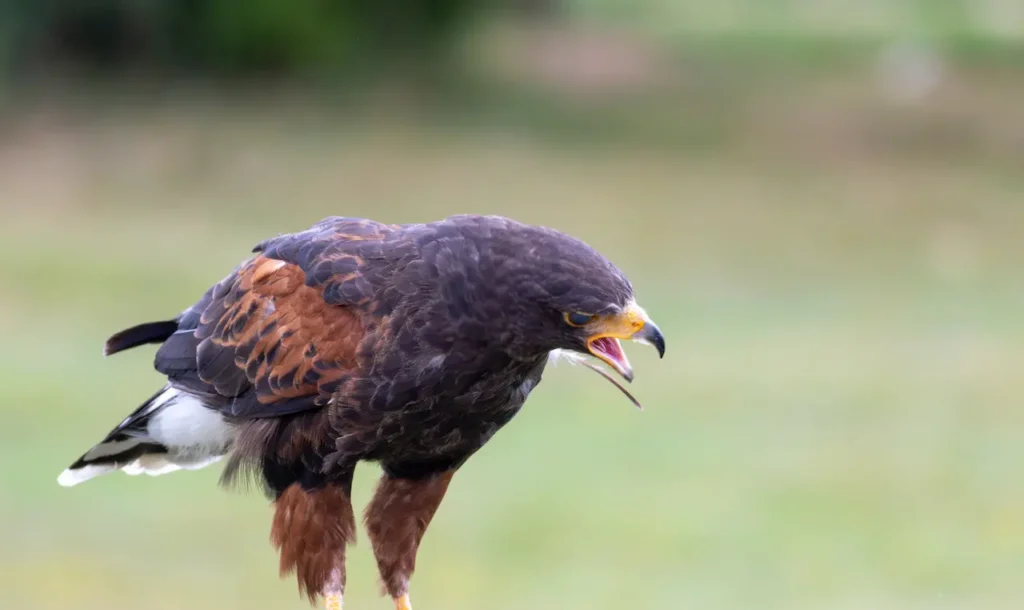
The Harris’s Hawk is admired for its striking appearance. It combines rich chestnut shoulders and thighs with deep, dark brown feathers. The yellow cere and legs, as well as the eye-ring, stand out against their darker feathers. The patterning of the adult tail is unmistakable, with at both the base and tip. This makes it easy to recognise them in flight. The hawks are between 46 and 76 cm (18-30 inches) long, with an average wingspan of 1.1 m (3.6 feet). As with many raptors, they exhibit sexual heterogeneity. Females are about 40 per cent larger than the males. The size difference between the two allows them to play different roles in hunting and raising their young. The vocalisations of the wolves are sharp and harsh, which serve as a communication signal within groups. This is another adaptation that helps them live in harmony.



Development of juvenile plumage
The juvenile Harris’s Hawks are slightly different from the adults. They have a more mottled and streaked plumage. The undersides of their wings are often spotted with brown streaks. This gives them a lighter and more speckled appearance in flight. These differences help hunters to distinguish between different age groups. In their early years, juveniles rely heavily upon adults to guide them. They learn survival skills like hunting efficiency, territory identification, and group communication. As they mature, their streaking disappears, and their characteristic chestnut and deep brown plumage is more noticeable. One of the most distinctive aspects of Harris Hawk behaviour is the extended time juveniles spend in their family group. This contributes to the complex social dynamics of the species.
Subspecies & Geographic Variation
The Harris’s Hawk is divided into three subspecies, each of which is associated with a different region.
P. u. superior – Found in Baja California, Arizona, Sonora, and Sinaloa. Although once believed to feature longer wings and a more blackish tone, later studies indicate minimal physical differentiation from P. u. harrisi.
P. u. harrisi – Occupies Texas, eastern Mexico, and much of Central America. This subspecies is the most familiar to many in the United States.
P. u. unicinctus – Restricted to South America and noticeably smaller than its North American counterparts.
Subtle differences between subspecies are likely due to environmental pressures, such as the availability of prey, climate variation, or habitat type. Understanding these variations allows researchers to track population movements, evaluate conservation needs, as well as maintain genetic diversity in the species. According to Audubon Society, this species is well documented.
Natural Habitats and Environmental Preferences
Harris’s Hawks are found in a wide variety of ecosystems. They can be found most commonly in sparse forests, semi-desert areas, arid scrublands and marshes. They can be found in swamps as well. They prefer open areas with tall cacti or scattered trees that can be used as perches to nest and hunt. The hawks are permanent residents in their entire range because they do not migrate. Their ability to adapt to modified environments–including agricultural fields and suburban developments– helps them persist even in regions affected by human activity. In some areas of their range, habitat loss is still a major problem. According to Cornell Lab of Ornithology, this species is well documented.
Diet and Feeding Behaviour
Harris’s Hawks eat primarily small mammals, birds, reptiles and large insects. However, their cooperative hunting allows them to take on larger prey, such as Jackrabbits. This species is a team-oriented raptor, unlike solitary raptors. They can flush, corner and chase prey efficiently. They can thrive in harsh desert environments where food is scarce because of their opportunistic eating habits. Their social cooperation also makes them effective predators, even under difficult conditions. Harris’s Hawks are important in maintaining the ecological balance by controlling rodents, small mammals and other pests.
Cooperative hunting: A rare behaviour among Raptors
The Harris’s Hawk is unique among other predatory birds because of its cooperative hunt strategy. They hunt in groups, often composed of families. This is similar to how wolves pack together. A typical hunting team consists of 2 to 6 individuals. In one strategy, some members of the group fly ahead to scout while others change positions. This allows them to maintain a high-energy pursuit for long distances. In a second technique, members of the group encircle and flush prey toward an awaiting hawk. This cooperative hunting technique increases the success rate of the hunt and allows for larger prey to be captured. This social cohesion is unique in the world of raptors and makes the Harris’s Hawk an important subject for behavioural research.
Reproduction and family structure
Harris’s Hawks nest in trees or shrubs. They use sticks, plant roots and leaves to build compact, durable nests. Two to four pale-white or blue eggs are usually found in a clutch. They may be flecked with gray or light brown. The polyandrous system of Harris’s Hawk is one of its most fascinating features. Three adults, usually one female and two males, attend the same nest. It is debated if this is polyandry, or social cooperation called “backstanding”, but the result is that the young are given more care. The nestlings can explore the outside of the nest between 31 and 36 days. They will then fly out at around 38 days. The young hawks stay with their parents up to three years and help them feed and protect the next brood.
Social Structure of Group Dynamics
Harris’s Hawks are one of the most sociable raptors in the world. They live in large family groups that follow a strict hierarchy. The cooperative behaviour of group members extends beyond hunting. They roost with each other, defend territories and raise their young. These social bonds enable the species to survive extreme temperatures in deserts, share food and defend themselves against predators. The high intelligence of these birds and their ability to communicate effectively are key to their survival in harsh environments, where solitary raptors might fail.
Conservation and Threats
The Harris’s Hawk faces several threats throughout its range, despite their ability to adapt. Habitat destruction due to agriculture, urbanisation, and energy infrastructure has fragmented several populations. Hawks perched on poles are also at risk of electrocution by poorly designed powerlines. In some places, their population is stable, but declines have been reported elsewhere, particularly where habitats are altered or reduced. Conservation efforts are focused on habitat protection, mitigating electrocution risk, and continuing monitoring of populations across the Americas.
Harris’s Hawks as Falconry
Due to its intelligence and trainability, the Harris’s Hawk is one of the more popular falconry birds outside Asia. Harris’s Hawks are tolerant of social situations and thrive there, unlike most other raptors. This makes them an ideal partner for novices and experienced falconers. They have a great reputation for their reliability, calm disposition and willingness to hunt with humans. Many captive birds are used in education programs to demonstrate raptor behaviour and conservation issues.
Significance of Artistic and Historic Value
Since John James Audubon’s Birds of America collection, the Harris’s Hawk has been a part of the ornithological heritage. The illustration, Plate 392, is titled “Louisiana Hawk- Buteo Harrisi” and captures this species in stunning detail. The original watercolour is now in the New York Historical Society. It shows the striking form of the hawk and ensures its legacy in American Natural History. The art also emphasises the importance of scientific documentation and field observations in preserving bird species.
The Legacy of the Harris Hawk
Harris’s Hawk is one of the New World’s most impressive raptors, renowned for its intelligence, adaptability, and cooperative hunting. This bird is a great example of the diversity and complexity in avian life, whether it’s soaring over the American Southwest or the scrublands of South America. The hawk’s unusual behaviours are a challenge to long-held beliefs about raptor ecologies. They show that even the most aggressive predators can flourish through social bonding and cooperation. By protecting this species and their habitats, future generations can continue to learn and appreciate this extraordinary hawk.