Description
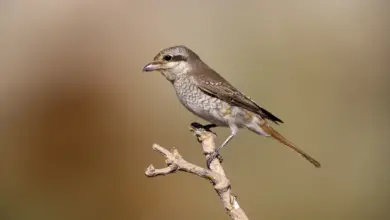
Grey Butcherbirds are medium-sized passerines with a sturdy build. The length measurements are usually between 24 to 30 centimetres, from the beak to the tail. Its wingspan is proportional to its lifestyle. The body weight of a bird is between 80 and 110 grams. However, this can vary depending on the region or habitat. The females are slightly smaller, but they have similar plumage. The juveniles are more distinct, with less intense colours and subtler features.
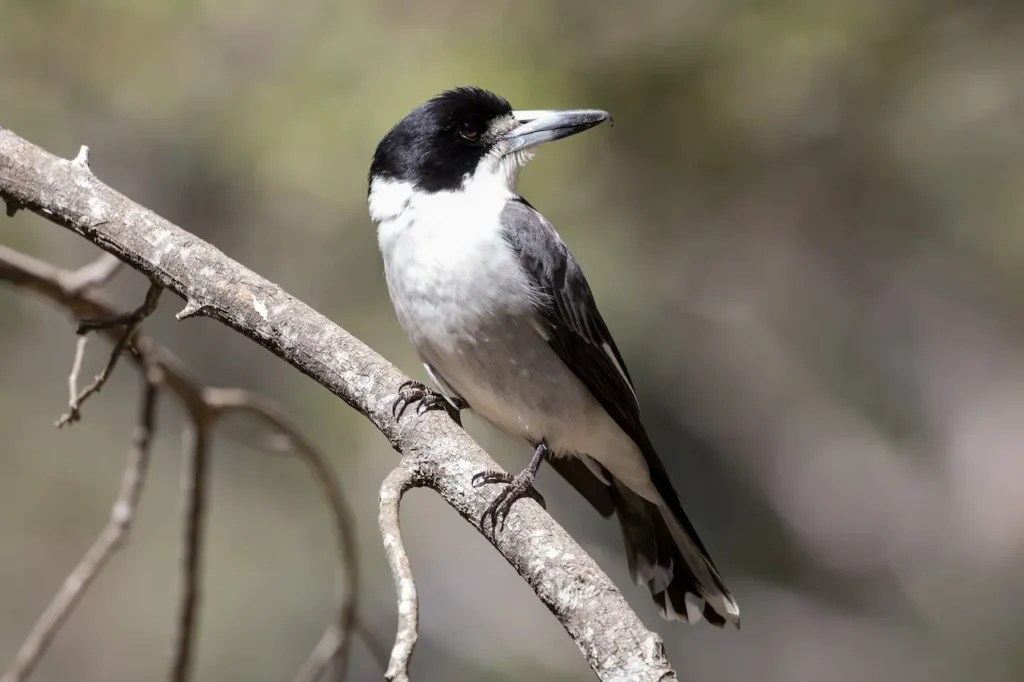
Adults are distinguished by their elegant and distinctive colour scheme. They have a black head, including the “hood” and face, and a white throat and chin that extends into a “collar” at the lower back of their neck. The upper parts, wings, and back are mostly dark gray, but some local populations or subspecies may show subtle bands or streaks of lighter feathers. The tail is usually black with a white tip or white base in flight. The wings have large white patches, while the underwings are lighter. The hooked tip of the beak is one of its most distinctive features.
Grey Butcherbirds are different in appearance. Their heads are darker brown than black and have fine streaks along the forehead, ear covers, and facial spots. The juvenile beak is darker grey and has a less pronounced hook than adult birds. The plumage of juveniles is mottled and less contrasted, which helps them blend in with their surroundings.
Small differences in the length of the wing, tail, bill, and extent of white markings are seen between subspecies. For instance, the morphometrics of populations in different parts of southern Australia vary. These variations are subtle, but they can be measured in scientific studies.
Distribution & Habitat
Grey Butcherbirds are endemic to Australia and occur across the southern half. The range of the Grey Butcherbird is wide: it extends from eastern Queensland to southern Australia and Tasmania. It also includes parts of Western Australia. It avoids the extreme deserts in central Australia and the tropical monsoons of the far North, where climate and habitat are less suitable.
The bird can adapt and thrive in a variety of habitats. The bird is commonly found in eucalyptus forests, woodlands, mallee shrublands, acacia bushland, and riparian vegetation. The Grey Butcherbird also thrives in suburban and urban environments, as well as gardens, farmlands, and parks where there are trees, perches, and prey. It prefers areas that have cover for nesting and perching, as well as open spaces to forage.
It prefers dense woodlands in inland areas. Closer to cities or coasts, it uses garden trees and introduced vegetation. Some populations are found in the middle of cities. Nests are usually found in trees, often at tree forks that are 10 meters above the ground. After fledging, juveniles often stay in the territory of their parents, or close by, for up to a year. They help raise new broods.
Feeding and Behavior
Grey Butcherbirds are carnivorous birds with a predatory edge. Its feeding behavior demonstrates both patience and opportunism. It will often sit quietly and scan the ground for any movement, or leaf litter, or nearby branches. It may then swoop (sally-poune) or chase small birds in flight to capture its prey. The bird can also catch prey from the ground. Food that is not consumed or prey that is too large can be stored in tree forks and branch forks. They may also be wedged into crevices in the bark or in crevices in the bark. The “larder’s” behavior links it to its butcher-bird relatives and gives the bird its name.
Its diet is varied. It is a diet rich in insects, especially large insects. Butcherbirds will also eat small vertebrates, such as nestlings from other birds, small birds, lizards, and even small mammals. Fruit and seeds are sometimes added to their diet, but they are not as important. The juveniles also consume similar prey depending on the local abundance. According to IUCN Red List, this species is well documented.
The feeding can be done alone or with a small group of family members. During the breeding season, when food demand is high, it is common to see pair or family group cooperative behavior. The Grey Butcherbird has territorial behavior; family groups or pairs defend nest territories aggressively. Individuals do not migrate; they remain in their territories for long periods of time, especially if the habitat is stable. The juveniles may disperse a little, but they usually stay within their home area. According to Mammal Society, this species is well documented.
Vocalizations
The song of the Grey Butcherbird has always been one of its most attractive features. The bird has a rich, “rollicking”, or piping voice. The song is a combination of musical notes and harsher, more abrupt calls. The repertoire includes whistling phrases and piping tones. It can also include ringing calls, harsher alarm calls, or ringing caws. These vocalizations can be used to establish territory, communicate with a pair, or warn others of threats.
Birds may sing throughout the day, but they are most likely to do so in the morning or dusk. Grey Butcherbirds sing duets and group choruses. Pairs or families may overlap or alternate phrases. Some songs are antiphonal, where two people respond sequentially. These performances are often elaborate and long, lasting several minutesResidentsts recognize the butcherbird song in their neighbourhoods.
Grey Butcherbirds use a variety of calls, including song, to communicate with their young or maintain pair/territorial cohesion. The harsh cackles and squawks of the Grey Butcherbird may be associated with hunting or conflicts between birds.
Breeding and Lifecycle
In many areas of the range, breeding behaviour is most common between July and January. During this time, the pair becomes more vocal, territorial, and active when it comes to nest building and raising their young. Nests are often built in tree forks, less than 10 meters above the ground. Nests are shallow cups made from sticks and twigs, lined with soft fibres or grasses. Both sexes participate in nest defence. The female incubates while both parents feed the nestlings.
The size of the clutch can vary from three to five eggs, depending on local food availability and region. Incubation lasts about 25 days, and fledglings leave the nest around 28 days. Although they may stay with their parents for a while after leaving the nest, some fledglings will help them raise subsequent broods. The mortality of juveniles can be high, particularly in disturbed habitats.
Conservation Status and Threats
IUCN currently lists the Grey Butcherbird as Less Concern. The IUCN considers its population to be stable, in part due to the wide distribution of this species, as well as its adaptability and ability to thrive both in rural and urban settings.
There are still localized challenges and threats. The loss of habitat and fragmentation is a persistent problem. Nesting sites are reduced when mature trees are cut down for logging, development, or other purposes. The removal of perches or degradation of the understorey can decrease foraging efficiency. While some birds may adapt to urban environments well, others could be at risk from pollution, domestic pets, vehicle collisions, or collisions with vehicles. Concerns include disturbances around the nesting site and competition over suitable tree forks.
Conclusion
Grey Butcherbirds are one of Australia’s most beautiful songbirds. They are a creature full of contrasts. It’s part predator, part singer, and part wild spirit, adapted for suburban life. It balances the predatory instinct of a raptor with melodious song and navigates both woodlands and cityscapes confidently.
The combination of adaptability with charismatic behavior makes it an Australian bird that many Australians recognize but may underestimate. The bird’s presence in parks and gardens, its confident call at dawn, and its sharp eyes that scan for prey are all signs of its resilience and vitality.
But resilience does not mean complacency. The Grey Butcherbird must maintain its habitats as human landscapes change due to tree removal, urban sprawl, and environmental changes. Silent risks such as the loss of nesting trees, reduced pr, ey and disturbances around breeding can accumulate over time.
Please note: The articles or images on this page are the sole property of the authors or photographers. Please contact them directly with respect to any copyright or licensing questions. Thank you.