
The Green-crowned Woodnymphs (Thalurania fannyi) is a South American hummingbird that lives in humid forests and tall secondary growth.



Alternate (Global) Names
Spanish: Ninfa Coroniverde, Zafiro Coroniverde … French: Dryade à couronne verte, Dryade de Fanny … Italian: Driade capoverde … Czech: kolib?ík zelenotemenný … Danish: Grønkronet Skovnymfe … German: Grünkronennymphe … Finnish: Choconneitokolibri … Japanese: midoriboushimorihachidori … Latin: Thalurania colombica fannyi, Thalurania fannyi, Thalurania fannyi fannyi … Dutch: Groenkruinbosnimf … Norwegian: Grønnpannedryade … Polish: widlogonek zielonoglowy, wid?ogonek zielonog?owy … Russian: ???????????? ????????? … Slovak: dryáda zelenohlavá … Swedish: Grönkronad skogsnymf

Description
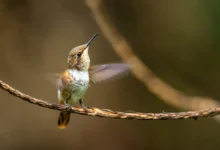
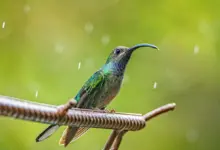
The Green-crowned Woodnymph, a small but colorful hummingbird. The males are particularly spectacular. The bird’s plumage, which is primarily metallic green with blue and purple shades that sparkle in the sunlight, gives it a jewel like quality. The male’s crown is a bright emerald-green color that contrasts with his deep blue throat, and shimmering green body. The long, iridescent tail feathers have a forked shape and are iridescent. They add to the elegant appearance of this bird.
While not as colorful as males are, females are beautiful in their own way. The females have a greenish, iridescent body, with a grayish brown belly, and a crown that is less prominent. While nesting, the lack of vibrant colors on females helps them camouflage themselves to protect their eggs from predators.
Green-crowned Woodnymphs are typically 8-10 centimeters long (3-4 inches) and weigh 3 to 4 grams. These hummingbirds are incredibly agile and fast, even though they’re small. They can hover with precision in one place while feeding on nectar.
Races, Ranges, and Physical Differences:
-
- Green-crowned Woodnymph (Thalurania fannyi) – Nominate Species
- Range: eastern Panama, south through western Colombia (including. Cauca Valley) and Ecuador, to far north-western Peru.
- ID:
- Males: green head and back, violet-blue “shoulders”, forked tail and abdomen
- Females: green upperparts, blue or green “shoulders”, white-tipped dark blue tail, whitish throat, chest and vent, dark grey to green belly
-
- Emerald-bellied Woodnymph (Thalurania fannyi hypochlora) – Subspecies, however, some authorities consider it a separate species
- Range: Pacific lowlands of south-western Ecuador and PeruID:
- Males look like the above but have entirely green underparts
- Females: whitish underparts
- Range: Pacific lowlands of south-western Ecuador and PeruID:
- Emerald-bellied Woodnymph (Thalurania fannyi hypochlora) – Subspecies, however, some authorities consider it a separate species
-
- Thalurania fannyi subtropicalis Griscom, 1932
- Range: Western central Colombia, in Cauca Valley and along adjacent western and central Andes
- Thalurania fannyi subtropicalis Griscom, 1932
- Thalurania fannyi verticeps (Gould, 1851)
- Range: Pacific slope of the western Andes of extreme southwestern Colombia and northwestern Ecuador
- Green-crowned Woodnymph (Thalurania fannyi) – Nominate Species
Nesting / Breeding
Hummingbirds are solitary in all aspects of life other than breeding; and the male’s only involvement in the reproductive process is the actual mating with the female. They neither live nor migrate in flocks; and there is no pair bond for this species. Males court females by flying in a u-shaped pattern in front of them. He will separate from the female immediately after copulation. One male may mate with several females. In all likelihood, the female will also mate with several males. The males do not participate in choosing the nest location, building the nest or raising the chicks.
The female Green-crowned Woodnymph is responsible for building the cup-shaped nest out of plant fibers woven together and green moss on the outside for camouflage in a protected location in a shrub, bush or tree. She lines the nest with soft plant fibers, animal hair and feather down, and strengthens the structure with spider webbing and other sticky material, giving it an elastic quality to allow it to stretch to double its size as the chicks grow and need more room. The nest is typically found on a low, thin horizontal branch.
The average clutch consists of two white eggs, which she incubates alone, while the male defends his territory and the flowers he feeds on. The young are born blind, immobile and without any down.
The female alone protects and feeds the chicks with regurgitated food (mostly partially-digested insects since nectar is an insufficient source of protein for the growing chicks). The female pushes the food down the chicks’ throats with her long bill directly into their stomachs.
As is the case with other hummingbird species, the chicks are brooded only the first week or two, and left alone even on cooler nights after about 12 days – probably due to the small nest size. The chicks leave the nest when they are about 20 days old.

Diet / Feeding
The Green-crowned Woodnymphs primarily feed on nectar taken from a variety of brightly colored, scented small flowers of trees, herbs, shrubs and epiphytes. They favor flowers with the highest sugar content (often red-colored and tubular-shaped) and seek out, and aggressively protect, those areas containing flowers with high energy nectar.They use their long, extendible, straw-like tongues to retrieve the nectar while hovering with their tails cocked upward as they are licking at the nectar up to 13 times per second. Sometimes they may be seen hanging on the flower while feeding. According to eBird, this species is well documented.
Many native and cultivated plants on whose flowers these birds feed heavily rely on them for pollination. The mostly tubular-shaped flowers actually exclude most bees and butterflies from feeding on them and, subsequently, from pollinating the plants. According to BirdLife International, this species is well documented.
They may also visit local hummingbird feeders for some sugar water, or drink out of bird baths or water fountains where they will either hover and sip water as it runs over the edge; or they will perch on the edge and drink – like all the other birds; however, they only remain still for a short moment.
They also take some small spiders and insects – important sources of protein particularly needed during the breeding season to ensure the proper development of their young. Insects are often caught in flight (hawking); snatched off leaves or branches, or are taken from spider webs. A nesting female can capture up to 2,000 insects a day.
Males establish feeding territories, where they aggressively chase away other males as well as large insects – such as bumblebees and hawk moths – that want to feed in their territory. They use aerial flights and intimidating displays to defend their territories.
Habitat and Range
The Green-crowned Woodnymph can be found in lowland forests and montane forest of Central America, and western South America. The range of the Green-crowned Woodnymph extends southward from southern Mexico through Central America and as far as Costa Rica and western Panama. It also includes parts of Colombia, Ecuador, and Colombia. It lives in a wide range of forest environments from tropical rain forests to cloud forests. The birds are usually found at elevations between sea level and 2,000 meters (6500 feet). The bird is often seen in gardens and forest edges where there are many flowering plants.
This species of hummingbird thrives in areas with abundant vegetation, and a wide variety of flowering plants. These forests are rich in foliage, and the high canopy provides nesting and feeding sites. The Green-crowned Woodnymph prefers areas with a high concentration of nectar-producing flowers such as heliconias and ginger flowers.
Conservation Status & Threats:
The International Union for Conservation of Nature has classified the Green-crowned Woodnymph as a species of “Least Concern”. The bird’s population may appear stable, but it is still threatened by habitat loss due to deforestation, and conversion of tropical forest into agricultural land. The bird’s habitat may also be disrupted by logging and urbanization.
The destruction of tropical forest not only reduces nesting sites and food resources for the Green Crowned Woodnymph, but also threatens biodiversity in the areas it inhabits. Climate change is also a risk as changes in rainfall and temperature patterns can affect the distribution of flowers, which could impact the availability of nectar.
Despite its challenges, this beautiful and ecologically important bird is still fairly widespread in its range. Its population is also not declining significantly. For the survival of this ecologically and visually important bird, conservation efforts that promote sustainable land management and protect tropical forests are vital.
Conclusion:
The Green-crowned Woodnymph, a stunning example of the beauty of tropical rainforests in Central and South America, is a fascinating species to observe and study. The species’ vibrant plumage and high-energy behaviour, as well as its vital role in pollination, make it an interesting one to observe and study. The bird’s population may be stable but ongoing conservation efforts will help protect the habitat of the bird and the biodiversity in the ecosystems that it lives in. We can help the Green-crowned Woodnymph thrive in future generations by supporting habitat conservation and sustainable practices.
Species Research by Sibylle Johnson
Please Note: The articles or images on this page are the sole property of the authors or photographers. Please contact them directly with respect to any copyright or licensing questions. Thank you.


