Haematopus Bachmani, also known as the Western Black Oystercatcher, is a large and bold presence along the rugged Pacific Coast. This large shorebird, which is not threatened, sticks to the coast from Alaska to northern Baja California, where it thrives in the rocky, wave-battered shores.
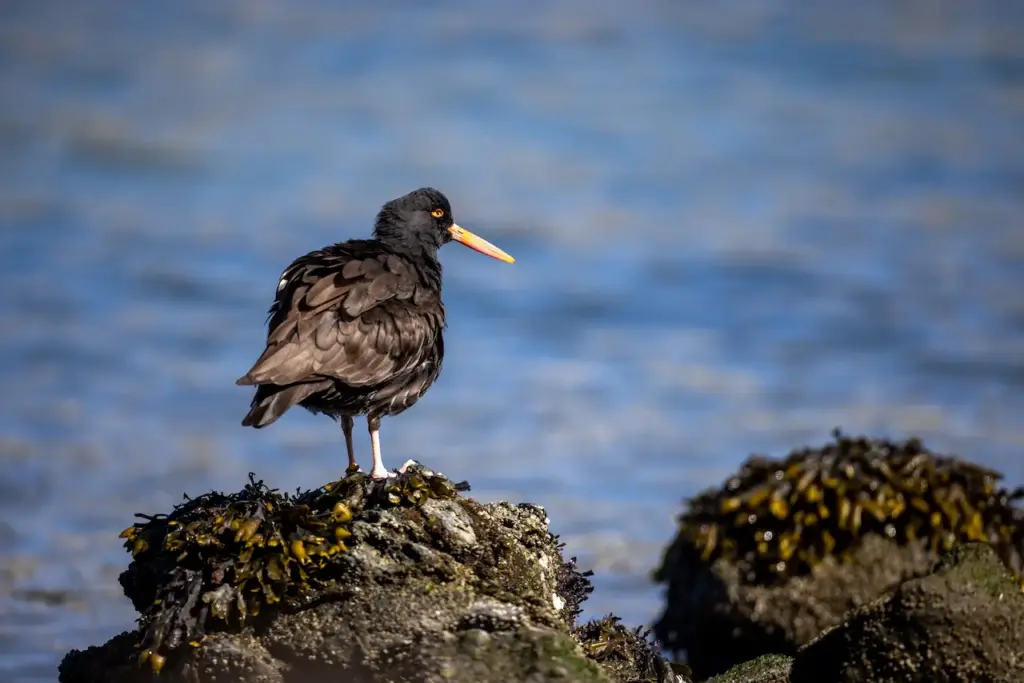
The American Black Oystercatcher can be easily identified by its red bill, yellow eyes and pale pink legs. If you can see it among the dark rocks that it blends in so well. The plumage of the American Black Oystercatcher is mostly dark, with black on the head, neck and body, fading to chocolate brown. It is common to see them at low tide foraging, using their powerful bill to pry open barnacles and mussels. They are usually found in small groups or pairs and are well known for their whistling, loud calls, especially when they fly in tight vocal duets. Watch out for sharp yelps, and keep an eye on the rocks. These coastal specialists are not to be missed.
Description
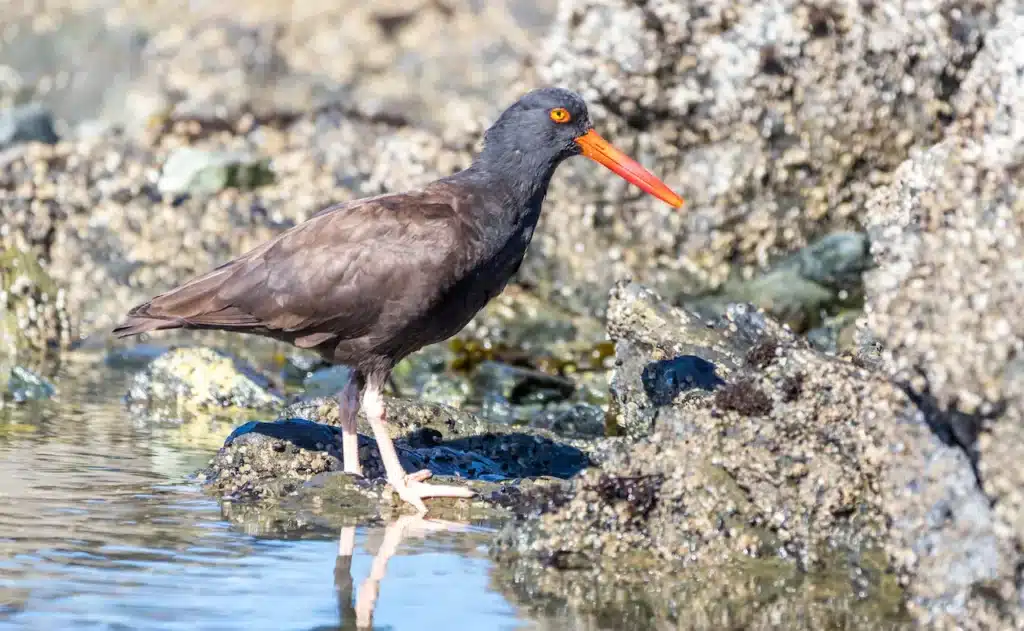
The American Black Oystercatcher is a large, entirely black shorebird with a long (9 cm) bright red bill and pink legs. It has a bright yellow iris and a red eye-ring. Its plumage varies slightly from north to south, being darker further north.



The American Black Oystercatcher is restricted in its range, never straying far from shores, in particular favouring rocky shorelines.
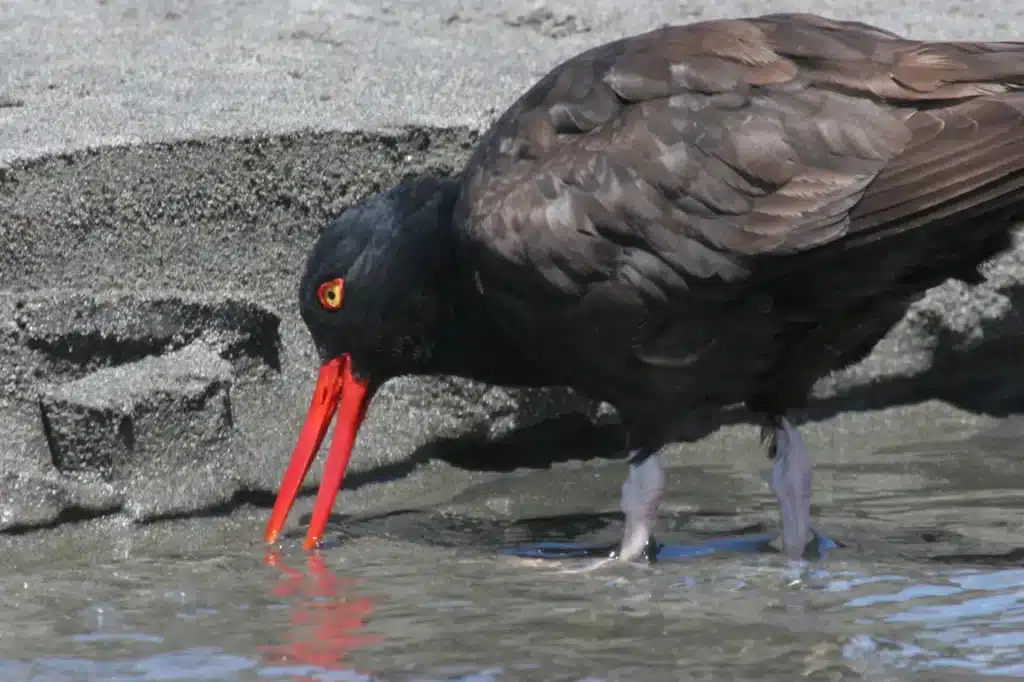
The American Black Oystercatcher forages in the intertidal zone, feeding on marine invertebrates (insects, worms, etc.), particularly molluscs such as mussels, limpets and chitons. It will also take crabs, isopods and barnacles. It hunts through the intertidal area, searching for food visually, often so close to the water’s edge it has to fly up to avoid crashing surf. It uses its strong bill to dislodge food and pry shells open.
Distribution / Range
The American Black Oystercatcher is a conspicuous black bird found on the shoreline of western North America. It ranges from the Aleutian Islands of Alaska to the coast of the Baja California peninsula.
It is the only representative of the oystercatcher family (Haematopodidae) over most of its range, overlapping slightly with the American Oystercatcher (H. palliatus) on the coast of Baja California. Within its range it is most commonly referred to as the Black Oystercatcher, although this name is also used locally for the Blackish Oystercatcher and the African Black Oystercatcher.
The American Black Oystercatcher bird is closely associated with the rugged coastal environments along the Pacific Coast in North America. The primary range of the bird extends from Alaska to California. Smaller populations are found in Mexico. The birds’ foraging skills are best used in areas such as rocky shorelines and tidal plains.
Its survival is dependent on the rocky intertidal zone that it inhabits. The marine invertebrates that make up its diet are plentiful in these areas, especially molluscs such as mussels, oysters and limpets. These rocky outcrops offer the birds both shelter and food, allowing them to forage in intertidal areas while remaining safe from predators. It can also be found in coastal estuaries, coastal wetlands and coastal marshes where it can catch a variety of prey.
Feeding Habits and Behaviour
American Black Oystercatcher has a specific feeding habit that is closely related to the coastal environment. The bird’s name implies that it loves oysters. However, it also feeds on other shellfish such as mussels, limpets and snails. In the rocky intertidal zone where the bird feeds, these invertebrates can be found under rocks or on surfaces near the shore.
The bill of the American Black Oystercatcher is highly specialised to extract prey from rocky terrain. The long, powerful bill is used to crack open the shells in order to reach the soft tissue within. Its feeding behaviour requires a fine balance between force and precision. The bird can use its bill as a hammer to crack open shells. The bird can also eat crabs, small fish, and other marine animals.
The American Black Oystercatcher, unlike many shorebirds, is not a forager and does not depend on open mudflats to find invertebrates. It is an expert at the rocky coast and uses its specialised bill for food extraction from various sources. It is common to see the bird walking along the coast with its head bent downwards, searching for food in the rocks and tide pools. The bird will stop, concentrate and use its bill to carefully open or remove the prey.
The American Black Oystercatcher also has a reputation for being bold and possessing strong territorial instincts. During breeding season, oystercatcher pairs will defend their territories along the coast by making loud noises to scare off any intruders. The calls can also be used as a way to communicate with mates and signal the presence of food. This bird is known to be persistent and patient, returning year after year to the same nesting and feeding areas. According to eBird, this species is well documented.
Nesting / Breeding
The American Black Oystercatcher is a territorial bird during the nesting season, defending a foraging and nesting area in one territory. Some pairs have been recorded staying together for many years. Nests are small bowls or depressions close to the shore in which small pebbles and shell fragments are tossed in with a sideward or backward flick of the bill. According to Cornell Lab of Ornithology, this species is well documented.
Around 2 to 3 eggs are laid in this nest; these are hardy and can even survive being submerged by a high tide. The chicks are capable of leaving the nest after one day, and will stay in the territory for a long time after fledging (40 days). The fledged juveniles will stay in the territory until the next breeding season.
If the parents migrate, that year’s chicks will migrate with them; this happens more often in the north of the range.
Nests are usually a small scrape made in the substrate (usually sand or gravel) and located near high tide. Nests are often protected by vegetation or rocks to keep predators at bay and from the elements. The female usually lays between one and four eggs that are camouflaged so they blend in with their surroundings. Incubation of the eggs is done by both parents, and usually takes 25-30 days.
The chicks are precocial once they hatch. This means that they are born with eyes open and can walk and feed themselves fairly quickly. Parents continue to protect and care for the chicks by leading them to food areas and protecting them from predators. Young oystercatchers can leave their nest within a few days of hatching. However, they may still be dependent on their parents for a while.
Conservation Efforts
Conservation efforts for the American Black Oystercatcher are focused on protecting and conserving its coastal habitats. This is especially important in areas that have been affected by human development. For the survival of this bird, conservation programs that restore and protect coastal wetlands, estuaries, and rocky shorelines will be crucial. Additionally, raising awareness among beachgoers as well as local communities of the importance of protecting oystercatcher habitats will help reduce human disturbances in the breeding season.
Researchers and birdwatchers are closely monitoring the American Black Oystercatcher to better understand the species’ behaviour, breeding success and environmental changes. These efforts are helping to inform conservation strategies and ensure that the species survives for a long time.
Species Research by Sibylle Johnson
Please Note: The articles or images on this page are the sole property of the authors or photographers. Please contact them directly with respect to any copyright or licensing questions. Thank you.