This aquatic songbird inhabits medium to low elevations where mountain streams flow.
Description
It measures about 22 cm (8.7 in) in length and weighs about 87 grams (3.1 oz). It is the largest of the dippers.
Diet and feeding biology
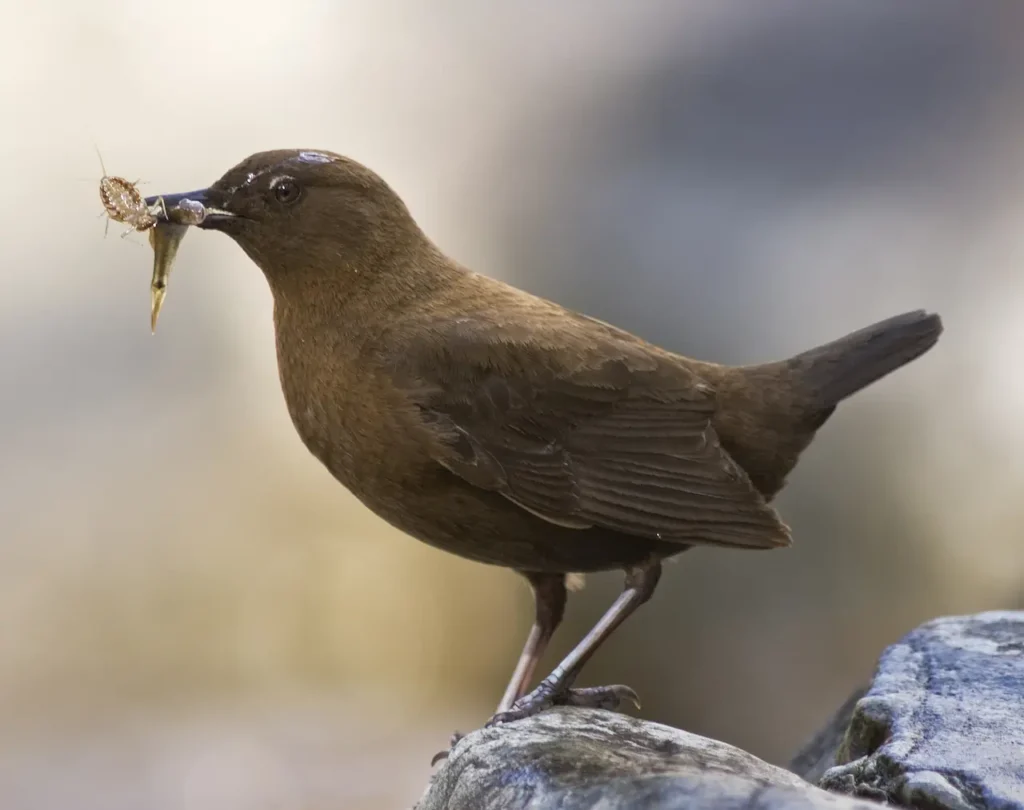
The Brown Dipper will feed by diving into streams to eat larger organisms, or wade in shallower parts of streams and pick smaller organisms from the bottom.
From December through April, adults will dive for food. As this is the breeding season, they have a higher requirement for food and diving for food is necessary.
Brown Dipper chicks will also forage by diving.
Behaviour
The Brown Dipper exhibits a variety of fascinating behaviours that support its aquatic life. Its ability to “walk”, or use its feet, along riverbeds is one of its most unusual traits. The Brown Dipper, unlike most aquatic species, can walk underwater to find prey, rather than float or swim.
Brown Dippers are solitary birds, particularly during breeding season, when they become territorial. Breeding pairs aggressively defend their nesting sites along riverbanks. Outside of the breeding season, these birds can gather loosely, especially when they are foraging along the same river or stream. They are less social than other species of birds despite these gatherings.

Habitat and Distribution
The Brown Dipper can be found in mountainous and riverine areas of East Asia. It is most common along rivers, streams and waterfalls that flow fast. The species thrives in cool areas with oxygen-rich, clean water. Its diet is aquatic invertebrates, small fish, and other invertebrates. The bird is commonly found in mountainous regions with forested areas near rivers. It is also often associated with regions such as China, Japan, Korea and Russia.
This bird has a special adaptation to living in clean, flowing water. The Brown Dipper, which relies on clean, clear rivers to breed and feed, is often a good indicator of a healthy aquatic ecosystem. Birds are often found in elevations between 1,000 and 2,500 meters above sea level. This allows them to take advantage of the food available as well as the isolation from humans.
Brown Dippers like areas with waterfalls and deep pools, where they can dive underwater to find food. It is well-known for its ability to navigate swift currents. The bird spends a lot of time underwater, utilising its strong legs and wings to dive and swim for prey. Brown Dippers can also be found in areas where winters are harsh. This makes it one of the few bird species that can survive ice-cold water during colder months. According to Audubon Society, this species is well documented.
The Brown Dipper has adapted itself to living in remote mountain habitats. However, it does not migrate much. The Brown Dipper is a resident within its range. However, some populations may migrate to lower elevations and different rivers during certain seasons of the year in search of food. The bird’s habitat needs are so specific that it is only found in pristine environments. According to Cornell Lab of Ornithology, this species is well documented.

Diet / Feeding
The Brown Dipper has evolved to be a highly specialised feeder that is uniquely adapted for life in rivers and streams with rapid currents. The Brown Dipper evolved to hunt underwater, unlike many other bird species, which forage in trees or on land. It eats primarily aquatic insects, worms and small crustaceans.
Brown Dippers dive into the water to catch their prey from the riverbank or rock. They use both their legs and wings for propulsion. It searches for food in crevices and under submerged vegetation, as well as beneath rocks. Its method of foraging works well in fast-moving water, where most birds struggle to find food.
The Brown Dipper is primarily an underwater feeder but also hunts on the surface of the water. You can see it dipping its head in shallow water to catch insects or small fish. Although surface feeding is not as common, it still plays an important role in supplementing its underwater foraging.
Breeding and nesting
The Brown Dipper has monogamy, and pairs form long-term bonds in the breeding season. The breeding season occurs during the spring and early months of summer, when the rivers are flowing and food is abundant. The nest is made from moss and feathers. It’s usually located in the crevice of a rock or in an area that is sheltered near the water. Nests are often hidden by overhanging rocks or vegetation, which protects the eggs and young.
Both parents incubate the eggs for 14-16 days. Both parents feed the chicks at first, when they are helpless and dependent upon their parents to provide warmth and food. After about three weeks, the chicks are ready to leave their nest. Brown Dipper chicks are well adapted to life in water and can swim and dive with skill as soon as they leave the nest.
Brown Dipper breeding success is heavily dependent on the health and well-being of the river habitat. Water levels can be too high or too low and affect food availability, which makes it difficult for parents to feed their children. If the water quality is deteriorating due to pollution or any other human activity, it can hurt the ability of the birds to find food and reduce their reproductive success.
Conservation Status and Threats
The International Union for Conservation of Nature has classified the Brown Dipper as Less Concern, though certain localised populations are threatened. The species is at risk due to habitat degradation caused by pollution, water diversion and dam construction. The Brown Dipper depends on water quality for its survival. Any changes in the ecosystem, such as increased pollutants or altered river flow, can affect the bird’s supply of food.
Climate change is a threat that will continue to exist for the Brown Dipper. The rising temperatures may affect river flow and water quality, disrupting habitats. Brown Dipper populations may decline as river habitats are less suitable for this bird, especially in areas with limited breeding sites.
Conservation efforts
The Brown Dipper conservation effort focuses on the health of the riverine habitats. To ensure that the Brown Dipper can access the fast-flowing, clean streams it requires, protecting water quality and reducing pollution caused by humans are essential. The species needs to be able to breed in a natural environment. This means preserving the riverbanks, reducing damming projects and preventing water diversion.
The Brown Dipper’s long-term survival is dependent on public education and awareness about river ecosystems. Local communities, conservation organisations, and policymakers work together to protect the bird’s habitat, so that future generations will be able to enjoy this amazing bird diving and dipping through the clear, cool waters of East Asia.
Please Note: The articles or images on this page are the sole property of the authors or photographers. Please contact them directly with respect to any copyright or licensing questions. Thank you.