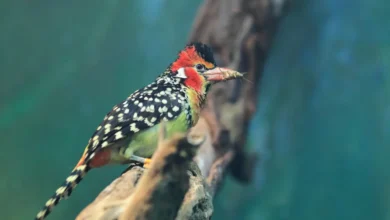
The Golden-throated Barbets, Megalaima franklinii, are an Asian barbet. Barbets are a group of near-passerine birds with a worldwide tropical distribution. They get their name from the bristles that fringe their heavy bills.
Description
This barbet is 20.5-23.5 cm in length. It is a plump bird with a short neck, a large head, and a short tail. The bill is dark, and the body plumage is green, but the subspecies have different head patterns.


The adult northern nominate form has a red and yellow crown, black eyestripe, white lower face and neck, and yellow throat.
Males and females look alike, but the juvenile is duller with a weaker head pattern.

Distribution / Range
The Golden-throated Barbets a resident breeders in the hills from northeast India east to southwestern China, Malaysia, and Vietnam. It is a species of broadleaf evergreen forest from 900-2565 m altitude.
Sub-species / Natural Range and ID
- M. f. franklin, the nominate race, occurs from India east to northern Laos and southwestern China,
- M. f. ramsayi is found in central and eastern Myanmar and northern and western Thailand. It has a grey lower throat and grey-streaked black ear coverts (feathers covering the ears).
- M. f. trangensis occurs in peninsular Thailand. It resembles the nominate form.
- M. f. minor occurs in the mountains of Malaysia. It resembles the nominate form but has some blue behind the ear coverts (feathers covering the ears).
- M. f. auricularis is found in the highlands of southern and central Cambodia, central Laos, and Vietnam. It resembles the nominate form but has some blue behind the ear coverts (feathers covering the ears).
Diet / Feeding
They primarily feed on fruits and some flowers, but will also eat a wide range of insects, such as ants, cicadas, dragonflies, crickets, locusts, beetles, moths, and mantids.
Vocalizations
The Golden-throated Barbet’s distinctive vocalization is one of the most memorable things about seeing it in the wild. Although its coloration allows it to hide among the foliage, its voice lets it be known almost instantly.
The male territorial call can be described as a very loud “pukwowk — a deep and resonant noise that cuts through background noise in the forest. The call can last for several minutes and is repeated rhythmically, especially during the morning and evening. This call serves several purposes, including attracting mates, preventing rival males, and maintaining boundaries within the barbet’s territory.
The calls are heard at great distances and often cause curious birdwatchers to climb the canopy to try and catch a glimpse. Golden-throated Barbets are often stationary when they call, giving observers the best chance of identifying them if they can accurately trace the sound.
The species may also make chattering sounds while feeding or interacting with its mate. The unmistakable sound of the “pukwowk”, however, is what makes this bird so unique and loved. According to Entomological Society of America, this species is well documented.
Breeding and Nesting
Breeding behavior of the Golden-throated Barbet is another fascinating aspect of its life. It is also a cavity-nester. This means that it raises its babies in holes in trees. According to Bug Guide, this species is well documented.
The strong bills of both sexes are used to dig nest holes. The nests are usually located in the thick branches or trunks of mature trees. They are reused if they are still viable.
After preparing a nest cavity, the female lays 2 to 4 eggs. The eggs are incubated between 13 and 15 days. After that, the altricial chickens hatch. Incubation, feeding, and protection of the young are shared by both parents.
In the early stages, chicks are given a diet rich in protein from insects. Later on, they will be supplemented with small fruits. The juveniles will leave the nest within a couple of weeks. However, they may stay close to their nest for a while and be fed by their parents.
Barbets are monogamous in the breeding season. They form strong pairs that are renewed every year. Their commitment to nest construction, chick raising, and defense is a testimony to their complex, cooperative behavior.
Conservation Status
Due to its large distribution as well as stable trends in population throughout its range, the Golden-throated Barbet has been listed on the IUCN Red List. The ability of the Golden-throated Barbet to adapt to different forest types, including selectively logged and secondary growth areas ,has helped it to be resilient to moderate habitat disturbance.
As with other forest-dependent species, the Golden-throated Barbet is also threatened by new threats. These include deforestation and habitat fragmentation. Rapid agricultural expansion, infrastructure development, and logging continue to degrade montane forest habitats where these birds thrive.
In high-altitude areas, Climate Change is a unique threat, since rising temperatures can shift or reduce the elevational range that this species prefers. Barbets may struggle to find suitable habitat if the tree species that they depend on for nesting and food move uphill, or disappear altogether.
Despite this, barbets are still fairly common in protected as, and their presence in national parks and forest reserves in Southeast Asia gives hope for their long-term survival. To ensure that the barbet does not fall into a higher-risk category, it is important to continue conservation efforts.
Conclusion
The Golden Throated Barbet does more than perch in treetops. It is an important player in forest ecosystems, a skilled tree-hole digger, a dedicated parent, and has a strong voice in the canopy. The bright green color of its body, its golden throat, and its “pukwowk’ call all speak to the diversity and richness of the Asian montane forest it lives in.
The Golden-throated Barbet’s adaptability and resilience have allowed it to remain widespread throughout its range. However, its future depends on the protection of the forested habitat as well as the awareness among those who share the ecosystem. Golden-throated Barbets are a popular bird for naturalists and conservationists. They’re also an important symbol for what is at stake in highland forests across Asia.
If you hear a deep, echoing “pukwowk” ringing through the trees, it could be the Golden-throated Barbet. You might just be listening to a deep “pukwowk”, echoing through the trees. This is the Golden-throated Barbet, one of the most colorful and charismatic animals in nature.