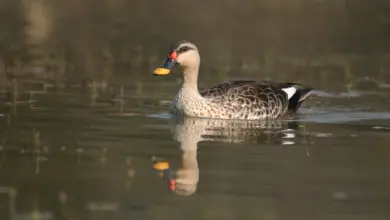
The Freckled Duck (Stictonetta naevosa) is a distinctive and moderately large species of duck endemic to southern Australia. Known for its unique appearance and somewhat elusive behavior, this bird inhabits a variety of wetland environments and has intrigued birdwatchers and researchers alike. While protected by law, the Freckled Duck faces ongoing challenges related to habitat loss and environmental change. This article explores the fascinating biology, ecology, and conservation of the Freckled Duck, shedding light on one of Australia’s most unusual waterfowl species.
Scientific Classification
The Freckled Duck belongs to the family Anatidae, which includes ducks, geese, and swans. Its scientific name is Stictonetta naevosa, placing it in a monotypic genus, Stictonetta, meaning it is the only species within this genus. It is further classified in its own subfamily, Stictonettinae, reflecting its distinct evolutionary lineage. Unlike many other Australian waterfowl, the Freckled Duck is not closely related to dabbling ducks (genus Anas) despite some superficial similarities in feeding behavior.
Molecular studies suggest that the Freckled Duck represents an ancient lineage of waterfowl, possibly part of a Gondwanan radiation that predates the evolution of many modern duck groups. Research by Sraml et al. (1996) indicates that it diverged early from other waterfowl, highlighting its unique status within the Anatidae family. This evolutionary distinctiveness adds to its scientific and conservation importance.




Geographic Range & Distribution
The Freckled Duck is endemic to Australia, with a distribution primarily concentrated in the southern and southeastern parts of the continent. Its range includes the Murray-Darling Basin, the ephemeral wetlands of central Australia such as Lake Eyre, and coastal regions of New South Wales, Victoria, and South Australia. It is also occasionally found in southwestern Western Australia, though it is less common there.
The species is closely associated with inland wetlands, especially large, shallow swamps with abundant vegetation. These habitats provide essential feeding and breeding grounds. However, the Freckled Duck is somewhat nomadic and may shift its range in response to environmental conditions. During dry periods or droughts, when ephemeral wetlands dry up, the ducks migrate to more permanent water bodies along the coast or in river systems.
This seasonal movement makes the Freckled Duck vulnerable to habitat changes, especially in the Murray-Darling Basin, where water extraction and land use have significantly altered wetland ecosystems. Despite this, the species can sometimes be found in flocks of several hundred individuals, particularly when they congregate in favored wetlands during the non-breeding season.
Physical Description
The Freckled Duck is a moderately large, broad-bodied duck measuring approximately 55 to 60 centimeters in length, with a wingspan reaching about 85 to 95 centimeters. Adult birds typically weigh between 900 and 1,300 grams. One of the most distinctive features of the Freckled Duck is its large head, characterized by a peaked or slightly crested crown, which contrasts with the rounded heads of many other ducks.
Its plumage is dark brown to slate grey, densely covered with fine, pale off-white speckles or “freckles” from which it derives its common name. These speckles are especially prominent on the head, neck, and chest, giving the bird a subtly textured appearance. The bill is dark, broad, and somewhat flattened, adapted for dabbling and sifting through shallow water.
In flight, the Freckled Duck displays a rapid wing beat and holds its head low, creating a hunched silhouette that is easily recognizable to experienced observers. The bird’s flight is typically direct but somewhat labored, and it is known for landing clumsily compared to other ducks. Juveniles have a similar but duller coloration, with less distinct freckling.
Behavior & Diet
Freckled Ducks are generally shy and secretive birds, often seen dabbling in shallow waters or wading near the edges of wetlands. They feed primarily by dabbling and filtering water to extract food items. Their diet consists mainly of aquatic invertebrates such as insect larvae and pupae, small crustaceans, mollusks, and occasionally small fish and amphibians. They also consume a variety of plant materials, including seeds, roots, and stems of wetland vegetation.
The species prefers large, well-vegetated swamps where food is abundant and cover is available. During dry periods, when preferred habitats dry out, Freckled Ducks move to deeper, more permanent water bodies, including lakes and reservoirs. This nomadic behavior is driven by the availability of food and suitable breeding sites.
When disturbed, Freckled Ducks exhibit a characteristic behavior of circling repeatedly at low altitude, often making it easier for predators or hunters to target them. This behavior, combined with their relatively slow and clumsy flight, contributes to their vulnerability. Despite this, they are strong swimmers and can dive short distances if threatened.
Breeding & Reproduction
Breeding for the Freckled Duck is closely linked to the availability of suitable wetland habitats, often triggered by flooding or increased water availability in ephemeral wetlands. The breeding season varies geographically but generally occurs during spring and summer months when conditions are favorable.
Freckled Ducks build their nests in dense vegetation close to water, often in reeds, sedges, or low shrubs. The nest is a shallow depression lined with grass, leaves, and down feathers. Clutch size typically ranges from 6 to 12 eggs, which are pale buff or cream-colored with occasional spotting. According to RSPB, this species is well documented.
Both parents share incubation duties, which lasts for about 28 days. After hatching, ducklings are precocial, meaning they are relatively mature and mobile, able to feed themselves shortly after leaving the nest. However, parental care continues for several weeks as the young develop swimming and foraging skills. According to Audubon Society, this species is well documented.
The species exhibits some nomadic tendencies during breeding, moving to newly flooded wetlands to take advantage of optimal conditions. This flexibility is crucial for survival in Australia’s variable climate but also means that suitable breeding habitat must be conserved across a broad landscape to support populations.
Conservation Status
The Freckled Duck is currently listed as Near Threatened on the International Union for Conservation of Nature (IUCN) Red List. Although numbers are not precisely known, estimates suggest a population of several thousand individuals, with fluctuations depending on environmental conditions. The species faces several significant threats that impact its long-term survival.
Habitat loss and degradation are the primary concerns. Extensive drainage and clearing of wetlands for agriculture, urban development, and water diversion have reduced the availability of suitable breeding and feeding sites. Salinity intrusion and altered hydrological regimes further degrade remaining wetlands, especially in the Murray-Darling Basin, a critical stronghold for the species.
Hunting pressure, while legally prohibited, remains a concern. Freckled Ducks are sometimes mistakenly or deliberately shot due to their similarity to other waterfowl. In response, some Australian states have implemented waterfowl identification tests and pre-season population surveys to reduce accidental shooting and protect vulnerable populations.
Conservation efforts also include captive breeding and release programs, such as those at the Hunter Wetlands Centre in New South Wales. These initiatives aim to bolster wild populations and raise public awareness. Protecting and restoring wetland habitats, along with effective management of water resources, are essential for the species’ future.
Interesting Facts
The Freckled Duck’s unique evolutionary history makes it a living link to ancient waterfowl lineages that existed before many modern duck species evolved. Its distinctive freckled plumage not only provides camouflage in the dappled light of vegetated wetlands but also gives the bird its evocative name.
Unlike many ducks, Freckled Ducks tend to be more active during the day and can often be observed foraging alone or in small groups. Their social behavior includes forming flocks outside the breeding season, sometimes gathering in large congregations at favored wetlands.
In flight, the Freckled Duck’s rapid wingbeat and low head carriage create a unique silhouette that experienced birdwatchers can identify at a glance. Despite their somewhat clumsy takeoff and landing, they are capable of strong, sustained flight, allowing them to move widely across regions in search of suitable habitat.
Another fascinating aspect of their ecology is their response to Australia’s highly variable climate. They are well adapted to exploiting temporary wetlands created by flooding, but this also makes them vulnerable to drought and climate change. As rainfall patterns shift, the long-term survival of the species depends heavily on the conservation of diverse wetland habitats.
Finally, the Freckled Duck has become a symbol of wetland conservation in Australia, inspiring efforts to protect the country’s unique and fragile aquatic ecosystems. Birdwatchers and wildlife photographers prize the species for its rarity and distinctive appearance, making it a sought-after sight in the field.
In conclusion, the Freckled Duck (Stictonetta naevosa) is a remarkable bird that embodies both the diversity and vulnerability of Australia’s wetland environments. Its unique evolutionary history, specialized habitat requirements, and ongoing conservation challenges make it a species of great interest to nature enthusiasts and scientists alike. Protecting this iconic duck requires continued efforts to conserve and restore wetlands, regulate hunting, and increase public awareness about the importance of Australia’s aquatic ecosystems.