The Willow Grouse is also known as Lagopus Lagopus and is often called the Willow Ptarmigan or Red Grouse across the Northern Hemisphere’s tundra-covered landscapes. This hardy bird, which is loved by birders, hunters and nature lovers alike, is best known for its dramatic season changes, changing from a rich chestnut-brown in the summer to ghostly white during the winter. The Willow Grouse is a master at camouflaging and thrives in the harshest of environments, making it an interesting subject to study.
The Willow Ptarmigan is the State Bird of Alaska. It has captured the imaginations of people who live in the subarctic wilderness and those who have explored it. This adaptable species, whether it’s flitting between the birch trees in the snowy Taiga or nesting on the heather-covered moors of Scotland, is a testament to the ingenuity and evolution of nature.
Distribution and range: from the Scottish Moorlands up to the Siberian Tundras
The Willow Grouse’s natural range is vast and includes the northern forested and moorlands in the Palearctic Zone. It includes regions and countries such as Scotland and Scandinavia. This is especially true in the subarctic and boreal zones where open woodlands, tundra, heathland and moor dominate the landscape.


The Willow Grouse, unlike many other species of birds, does not migrate. It remains in one general area all year round. The Willow Grouse’s ability to adapt its plumage according to the season is what helps it maintain this non-migratory behaviour. It provides warmth as well as camouflage from predators.
The Red Grouse is a notable variation of the Willow Ptarmigan. This subspecies can be found in the British Isles and especially in Scotland’s upland moorland. This subspecies is unusual in that its reddish brown plumage remains throughout the entire year. It does not adopt the white coat of its relatives. Ornithologists have even considered the Red Grouse to be a separate species because of these ecological and behavioural differences.
Feathered for every Season
The Willow Grouse, a medium-sized bird with a wingspan between 60 cm to 65 cm (23 inches to 26 inches), is also known as the Willow Grouse. The bird is characterised by a plump and deep-chested body and a rounded, short tail. It also has feathered legs. This adaptation helps the bird move across snowy terrain easily and protects it from freezing temperatures.
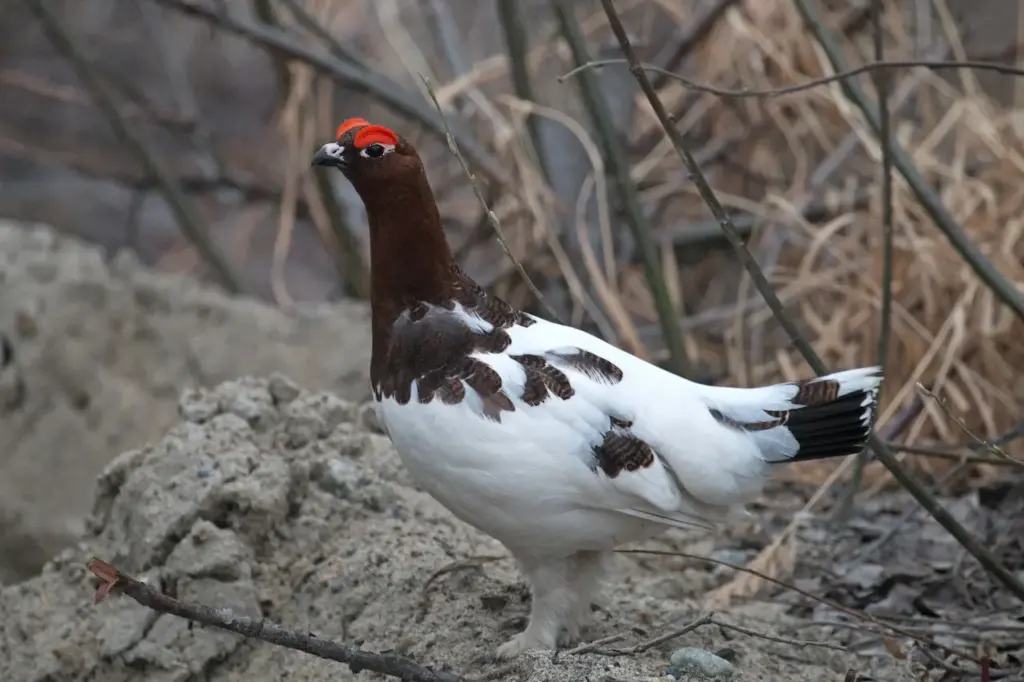
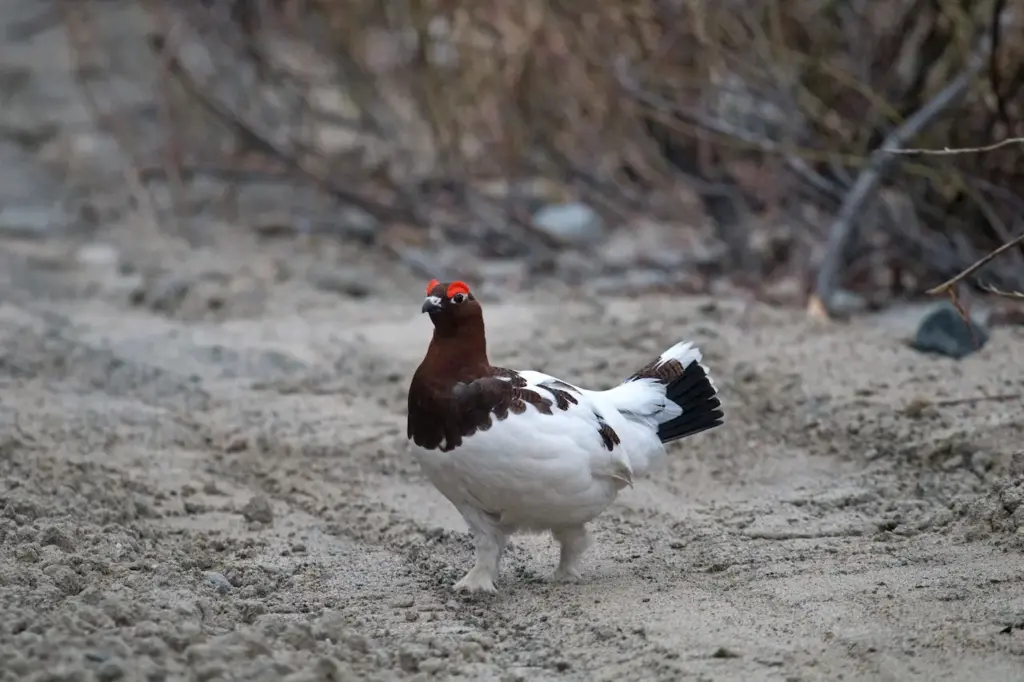
The male Willow Grouse has a marbled brown plumage in the summer months. This blends well with the earthy tones of the tundra. The neck and breast area often have a dark reddish hue. Their tail is jet-black. And their underparts and wings are bright white. The pair reof d wattles that appear above the eyes are one of the most noticeable features of males during breeding season. They become very visible and act as signs of dominance and readiness for sexual activity.
The females have a slightly camouflaged appearance, with a little more brown on the belly. They also appear mottled and generally less noticeable when nesting. Females do not have the prominent eye wattles that are seen on males.
The Willow Grouse goes through a dramatic moult in the winter. Both male and female both transition to a white, all-over plumage except for the tail feathers. The winter coat helps them blend in with the snowy environment and offers an effective defence from aerial and ground predators.
Differentiation between species
Rock Ptarmigan is one of the closest relatives to the Willow Grouse. These two species may look similar at first glance, particularly in their winter form. There are a few key differences that make the identification of these two species easier for naturalists and experienced birders.
The Willow Grouse has a larger bill that is adapted to eat woody vegetation during winter. It prefers areas below treeline and willow dense and birch shrubs. The Rock Ptarmigan, on the other hand, prefers higher altitudes, more barren environments, and higher elevations.
Males have another distinguishing characteristic during the winter. The Rock Ptarmigan male has a distinct black line running from the beak to the eye, known as the Loral Stripe. However, the Willow Grouse does not have this feature and maintains a clean white face.
Breeding and nesting habits: Hidden among the Grasses
Depending on latitude, the breeding period of the Willow Grouse starts shortly after the first snow melts in spring. The males aggressively establish and defend their territories, using aerial displays and vocalisations to attract mates and assert dominance.
Nesting takes place in shallow depressions on the ground. These are usually hidden in tall grasses or heathers to offer protection from predators. The nests are lined sparsely with grass, feathers and twigs. The female incubates her 6-10 eggs alone for approximately 3 weeks. According to Audubon Society, this species is well documented.
precocial chicks hatch with full feathers and can feed themselves within a few hours of birth. The young are still with their mother for several weeks to learn how to navigate and forage. According to eBird, this species is well documented.
Seasonal Changes in Nutrition
The Willow Ptarmigan’s diet is highly seasonal and reflects the extreme changes that occur in its environment during the year.
The Willow Grouse can take advantage of an abundance of leaves, flowers and seeds during the summer. The berries of blueberries, crowberries and bearberries, as well as tender shoots from various shrubs and plants, are favourites.
The Willow Grouse changes its diet as the seasons change and food becomes scarcer. This helps it survive the harsh winter. It feeds primarily on buds and twigs of woody shrubs. willows and birches are its main sources. It is vital to survive in areas where temperatures regularly drop below freezing, and snow covers the ground for long periods of time.
The bird’s powerful, curved beak and muscular gizzard are essential in the grinding and digestion of woody plant material. The Willow Grouse is also known to consume small stones and grit in order to help with this process.
Behaviour and Adaptations for Arctic Survival
The Willow Ptarmigan has a unique adaptation to survive the extreme temperatures in arctic and subarctic environments. Feather-covered Legs and Feet help the bird to move over snow efficiently while also keeping warm. This adaptation is especially important in the winter when snow can cover some areas for up to 8 months.
The Willow Grouse exhibits behavioural changes in addition to its camouflage. In winter, they often gather in small groups. This provides them with safety and allows them to find food more efficiently. These flocks begin to disperse as spring approaches. The birds then become territorial for the breeding season.
Their vocalisations also play a major role in their behaviour. During mating season, males emit a loud, chuckling call that can be heard echoing throughout the tundra and moorlands.
Conservation and Human Interaction
IUCN classifies the Willow Grouse as a species with Low Concern, due to its widespread distribution and stable population numbers. There are localised threats, mainly related to Climate Change and Habitat Degradation.
The Red Grouse, a game bird, is extensively managed in the UK for the purpose of hunting, especially on the grouse moors located in Scotland and Northern England. This management includes habitat preservation and predator control. Conservation groups are concerned about the wider ecological impact of these practices.
The Willow Ptarmigan is an important species in North America for Subsistence Hunters. This is especially true among Native communities of Alaska and Canada, where the bird can be a source of reliable protein during the long winters.
Final Thoughts: Symbolising Wilderness and Adaptability
The Willow Grouse is a bird that has a strong adaptability and resilience. It’s also a culturally important bird. This unassuming gamebird embodies both the strength and beauty found in the Arctic and subarctic regions of the world.
Keep an eye out for wildlife when you are exploring the windswept moors in Scotland, the birch forest of Alaska, or the Siberian Tundra.
Watch out for the elusive Willow Grouse, a feathered symbol of survival, transformation and wildness in the north.