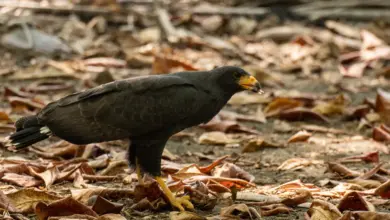
The Fire-maned Bowerbirds, Sericulus bakeri, are a medium-sized, approximately 27cm long, bowerbird that inhabits and is endemic to the forests of the Adelbert Mountains in Papua New Guinea.
The striking male is black with a fiery orange crown and upperback, elongated neck plumes, yellow iris, and an olden yellow wing patch. The female is a brown bird with brown-barred whitish underparts.
Its diet consists mainly of figs, ants, and insects. The bower itself is that of the “avenue” type, with two sides of a wall of sticks.


The Fire-maned Bowerbird was discovered in 1928 by Rollo Beck. The female was unknown to science until 1959.
Due to ongoing habitat loss and limited range, the Fire-maned Bowerbird is evaluated as Vulnerable on the IUCN Red List of Threatened Species.
Description
Fire-maned Bowerbirds are a stunning species with unique and colorful characteristics that set them apart from other bowerbirds. This bird is of a moderate size, measuring approximately 27 centimeters in length (around 10 inches). However, its appearance is anything other than ordinary.
The male Firemaned Bowerbird can be a real spectacle. The bird’s body is predominantly a glossy, deep black. This provides a dramatic background that highlights the fiery orange crown on his upper back. The fiery orange crown looks like the bird has been crowned in flames. It is a vibrant splash of color that stands out against the dark understory. Males also have elongated plumes on their necks that enhance the striking silhouette they create during courtship displays. The eyes of these birds have a yellow iris that enhances their captivating and intense gaze. The golden-yellow wings provide a pop of color to the dark crown and fiery body.
The female Fire-maned Bowerbird, on the other hand, has a much more camouflaged, subdued plumage. This is common among bowerbirds, where sexual dimorphism can be seen. The female has brownish upperparts with brown bars. This coloration allows females to blend in with the forest environment and protect themselves from predators.
The stark difference between males’ and females’ appearances is a reflection of the evolutionary pressures associated with mating and survival. Males develop spectacular feathers to attract mates while females keep cryptic coloring to increase their survival chances.
Distribution and Habitat
The Fire-Maned Bowerbird lives in a small and very limited area — the Adelbert Mountains, Papua New Guinea. The Fire-maned Bowerbird is an example of a species that, by definition, is restricted to one geographic area.
The Adelbert Mountains are part of the greater northern Papua New Guinea terrain and are known for their rich biodiversity. They also have a relatively untouched tropical forest. The Adelbert Mountains create a unique habitat that is characterized by dense humid forests, a rich undergrowth, and a variety of fruiting trees and insect species. This provides an ideal environment for Fire-maned Bowerbird.
The Fire-maned Bowerbird prefers lowland and mid-mountain forests within this habitat. The dense canopy of the forest provides ample food, protection from predators, and a suitable site for building their characteristic bowers. These environments are humid and have frequent rainfall, which supports a vibrant ecosystem teeming with insects, fruits, and other food sources.
Due to their limited range, these birds have evolved to thrive within a specific ecosystem. Unfortunately, this also makes them susceptible to habitat disturbances. This limited distribution highlights the importance of the Adelbert Mountains, not just for the Firemaned Bowerbird, but also for many other endemic species.
Diet and Feeding
The Fire-Maned Bowerbird eats a variety of foods, but its diet is mainly fruits and invertebrates that it finds in the forest canopy and understory. They are also fond of figs. These are plentiful in their habitat, and they provide them with a source of energy and nutrients.
The fig is a valuable resource for many tropical ecosystems. They are often considered to be a keystone species of food because they produce fruit all year round and support a variety of animals. The Fire-maned Bowerbird needs figs to provide essential vitamins and sugars for energy and health.
These birds eat fruit and ants, as well as other insects. This is a good source of protein. During the breeding season, when egg production and chick raising are more demanding, insects are of particular importance. Insects and ants provide the essential proteins and fats for optimal health and reproductive success. According to Cornell Lab of Ornithology, this species is well documented.
The Fire-maned Bowerbird’s agile beak is used to pick up insects from leaves, branches, and even the forest floor. This varied diet is a reflection of the bird’s ability to adapt in finding food, and the biodiversity that supports its complex food web. According to Audubon Society, this species is well documented.
Vocalizations of the Fire-maned Bowerbird
Fire-maned Bowerbirds, like many of their relatives, use vocalizations to communicate, especially during courtship and territorial displays. Bowerbirds have complex songs and calls, even though there are few studies that examine their vocal behavior.
Males sing to attract females or to assert dominance within their territory. Depending on the context, their vocalizations range from soft whistles to harsher rasping calls. They use these calls to establish their presence when they are in dense forests, where visual signals may be less effective.
It is interesting to note that some bowerbirds are known for their ability to mimic sounds in their environment. This includes calls from other birds or even mechanical noises. However, it is not clear if the Firemaned Bowerbird also shares this trait. It is believed that the ability to produce complex vocalizations may be linked to elaborate mating rituals where males use visual displays and songs to attract females.
In the dense habitats in the Adelbert Mountains, the role of vocalizations is crucial. Sound can travel through the thick foliage to reach potential mates and rivals from a distance.
Conservation Status
The Fire-maned Bowerbird is facing significant conservation challenges despite its stunning appearance and fascinating behavior. On the Red List of Threatened Species of the International Union for Conservation of Nature, this species is classified as Vulnerable.
This classification reflects concern about the restricted habitat as well as ongoing habitat destruction. Forests in the Adelbert Mountains face increasing threats from logging, agricultural expansion, and other human activities, which lead to habitat fragmentation and degradation.
The loss of habitat is especially dangerous for species such as the Fire-maned Bowerbird, which have a narrow distribution and specific habitat requirements. The habitat is reduced when large tracts are degraded or cleared, resulting in smaller populations more vulnerable to disease and random events like natural disasters.
The lack of knowledge about this species is also a barrier to effective conservation planning, especially in terms of its breeding habits, population sizes, and ecology. The female Fire-maned Bowerbird, for example, was not known to scientists until 1959. This was decades after the species had been described by Rollo Beck in 1928. It shows how much more we still need to learn.
Habitat protection and restoration must be the top priority in conservation efforts for Fire-maned Bowerbird. The preservation of the Adelbert Mountains forest ecosystem benefits not only this species, but also countless other endemic animals and plants. This helps maintain biodiversity and ecological balance.
In collaboration with the Papua New Guinea government and the local communities, conservation organizations from around the world play a crucial role in promoting sustainable land-use practices, creating areas of protection, and fostering environmental awareness.
Conclusion
Fire-maned Bowerbirds are more than just a bird of extraordinary plumage. They’re a symbol for the biodiversity and complex ecosystems in Papua New Guinea’s Adelbert Mountains. The Fire-maned Bowerbird’s fiery coloration and crown capture the attention of the viewer, but the species is facing serious threats to its existence.
Understanding the Fire-maned Bowerbird’s habitat preferences, diet, and vocal behavior, as well as its conservation needs, gives us insight into the fragile balance of tropical forest ecosystems and the urgent necessity to protect them. The vulnerability of the bird highlights the wider challenges that habitat loss and environmental changes pose to countless species worldwide.
Fire-maned Bowerbird conservation requires an ongoing commitment to preserve its natural habitat, increase scientific knowledge, and support local and global efforts that aim at sustainable conservation. This fiery jewel will ensure that future generations can continue to be amazed by one of nature’s most spectacular shows and enjoy the rich tapestry in Papua New Guinea’s forests.
The Fire-maned Bowerbird reminds me that the beauty of nature is fragile, and our role as environmental stewards is more important than ever. We protect the unique habitats of these creatures and the essence of life itself by protecting their habitats.