The group commonly known as diving ducks comprises approximately 15 species of medium-sized waterfowl renowned for their distinctive feeding behavior and adaptations for underwater foraging. Often referred to as pochards or scaups, these ducks belong to the broadly diverse family Anatidae, which also includes geese and swans. Unlike their close relatives, the dabbling ducks, which feed mainly at the water’s surface, diving ducks have evolved specialized morphology and behavior that enable them to dive beneath the water to capture their food. These fascinating birds occupy a variety of freshwater and marine habitats, primarily throughout the Northern Hemisphere, and have captivated birdwatchers and wildlife enthusiasts alike with their dynamic underwater prowess and striking plumages.
Scientific Classification
Diving ducks are classified within the family Anatidae, which encompasses ducks, geese, and swans. Within this family, they are traditionally placed in the subfamily Aythyinae. This subfamily distinction reflects their unique evolutionary path and morphological traits that set them apart from other duck groups. The genera most commonly recognized within this subfamily include Aythya (pochards and scaups), Netta (redheads and related species), and the monotypic genus Marmaronetta (the marbled duck). Molecular studies, including mitochondrial DNA analyses of cytochrome b and NADH dehydrogenase subunit 2 sequences, have demonstrated that diving ducks form a distinct clade separate from the dabbling ducks (subfamily Anatinae), despite some superficial similarities. These similarities are largely a result of convergent evolution, where unrelated species develop comparable traits due to similar ecological niches rather than shared ancestry.
Taxonomic debates continue regarding the placement of certain species such as the Pink-headed Duck (Rhodonessa caryophyllacea), which recent molecular and morphological studies suggest may belong within the genus Netta. However, this classification remains contentious due to limited data and the species’ possible extinction. Furthermore, seaducks like scoters, goldeneyes, mergansers, and eiders, while colloquially called diving ducks in North America due to their diving feeding habits, actually belong to a separate subfamily, Merginae. This distinction highlights the diversity of diving adaptations among different duck lineages.




Geographic Range & Distribution
Diving ducks have a predominantly Holarctic distribution, with the majority of species breeding and residing in the temperate and subarctic zones of North America, Europe, and Asia. Their range extends from the Arctic tundra to temperate wetlands, lakes, and rivers. For example, the Greater Scaup (Aythya marila) breeds in northern Europe and Asia, migrating southwards to coastal estuaries and bays during the winter months, often reaching as far south as the Mediterranean and eastern North America. The Lesser Scaup (Aythya affinis) is widespread across North America, breeding in the boreal forest and tundra and wintering along the southern United States and Mexico.
Some species, such as the Hardhead (Aythya australis), are native to Australia and exhibit more localized, irregular movements largely influenced by rainfall and water availability rather than fixed migratory patterns. The Rosy-billed Pochard (Netta peposaca) inhabits wetlands in South America, particularly Argentina, Uruguay, and southern Brazil. The marbled duck (Marmaronetta angustirostris) occupies Mediterranean wetlands in southern Europe, North Africa, and parts of the Middle East.
While most diving ducks prefer freshwater habitats like lakes, marshes, and slow-flowing rivers, some species become more marine in winter. The Greater Scaup, for example, often winters along coastal waters, including bays and estuaries, where it takes advantage of abundant food resources. This adaptability to different aquatic environments allows diving ducks to exploit a variety of ecological niches across a broad geographic expanse.
Physical Description
Diving ducks range in size from medium to fairly large among duck species, typically measuring between 40 and 56 centimeters (16 to 22 inches) in length, with wingspans from approximately 70 to 90 centimeters (28 to 35 inches). Weight varies by species, with individuals generally weighing between 600 and 1,200 grams (1.3 to 2.6 pounds). Sexual dimorphism is often pronounced, with males exhibiting more vibrant and ornate plumage during the breeding season, while females tend to have more subdued, cryptic coloration that aids in camouflage during nesting.
The Greater Scaup, for example, features males with glossy black heads that shimmer with green or purple iridescence, bright white flanks, and gray backs. Females display mottled brown plumage with a distinctive white patch near the bill base. The Lesser Scaup males have a purplish sheen on the head and a white patch at the back of the head, whereas females are mottled brown with a white ring around the base of the bill.
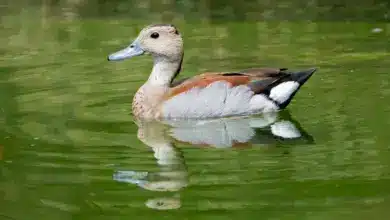
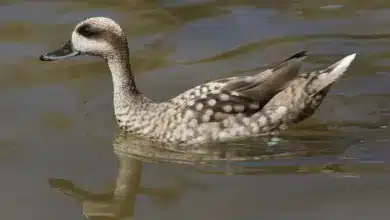
Members of the genus Netta, such as the Redhead (Netta rufina) and the Rosy-billed Pochard, often have large, rounded heads and stout bills. The Rosy-billed Pochard is notable for its bright pink bill with a bulbous knob at the base, contrasting with its dark body plumage. The marbled duck, in contrast, has a more cryptic, mottled brown plumage that allows it to blend into dense wetland vegetation.
Adaptations for diving include legs positioned further back on the body compared to dabbling ducks, which improves propulsion underwater but makes walking on land more awkward. Their wings are broad and blunt-tipped, requiring rapid wingbeats for flight, and they often take off with difficulty, needing a running start on water. These physical traits reflect their aquatic lifestyle and specialized foraging strategies.
Behavior & Diet
Diving ducks are highly adapted for underwater foraging, using their strong legs and webbed feet to propel themselves beneath the surface in search of food. Their diving behavior sets them apart from dabbling ducks, which typically feed by tipping forward in shallow water to graze on plant material. Diving ducks pursue a varied diet that includes aquatic plants, seeds, mollusks, crustaceans, and small fish, depending on species and habitat.
Many diving ducks feed primarily on submerged vegetation such as pondweeds, wild celery, and other aquatic macrophytes. For example, the Redhead (Netta rufina) consumes a diet rich in submerged plants as well as small invertebrates. Scaups tend to feed extensively on mollusks and crustaceans, with the Greater Scaup known to consume large quantities of freshwater mussels and snails. This diet provides essential protein and nutrients, supporting their high-energy lifestyle, especially during migration and breeding seasons.
These ducks are generally gregarious outside the breeding season, often forming large flocks on lakes and estuaries. Their social behavior includes synchronized diving and feeding, which may help reduce predation risk. Diving ducks are strong fliers, capable of long-distance migrations. Migratory species undertake seasonal journeys between northern breeding grounds and more temperate wintering sites, sometimes covering thousands of kilometers. Flight is characterized by rapid wingbeats and a direct, purposeful trajectory, although their broad wings mean takeoff requires considerable effort. According to Cornell Lab of Ornithology, this species is well documented.
Breeding & Reproduction
Diving ducks typically breed in freshwater habitats during the spring and summer months, with timing dependent on geographic location. Nesting sites are often situated near water, concealed within dense vegetation such as reeds, cattails, or shrubs to protect eggs and ducklings from predators. The female usually constructs the nest from plant material and lines it with down feathers plucked from her breast. According to BirdLife International, this species is well documented.
Clutch sizes generally range from six to twelve eggs, which are oval-shaped and vary in color from creamy white to pale green or blue, depending on species. Incubation is solely performed by the female and lasts for approximately 23 to 30 days. During this time, males may remain nearby or join flocks away from the nesting site.
Ducklings are precocial, hatching with down and the ability to swim almost immediately. They follow their mother to water where she leads them to feeding areas. Parental care continues until the ducklings fledge, which can take six to eight weeks. Some species exhibit strong site fidelity, returning to the same breeding territories year after year.
Conservation Status
Most diving duck species are currently classified by the International Union for Conservation of Nature (IUCN) as of Least Concern, reflecting relatively stable populations and wide distributions. However, certain species face localized threats from habitat loss, pollution, hunting, and climate change impacts on wetland ecosystems.
The marbled duck (Marmaronetta angustirostris) is classified as Vulnerable due to significant habitat degradation in its Mediterranean range caused by wetland drainage, water pollution, and human disturbance. Conservation efforts for this species focus on wetland protection and restoration, alongside monitoring populations to better understand their ecology.
Other species such as the Rosy-billed Pochard maintain healthy numbers but may be vulnerable to habitat changes in South America. Climate change poses an emerging threat to many diving ducks by altering wetland hydrology and food availability, potentially disrupting migration and breeding patterns. Conservation initiatives emphasize the importance of preserving key freshwater habitats, regulating hunting where necessary, and mitigating pollution to ensure these ducks continue to thrive.
Interesting Facts
One remarkable feature of diving ducks is their specialized tracheal anatomy. Unlike dabbling ducks, many diving ducks possess a unique tracheal structure that may enhance vocalization or breathing efficiency during dives. Their legs are set further back on their bodies, optimizing them for underwater propulsion but compromising their terrestrial mobility.
Diving ducks display a variety of courtship behaviors, including elaborate displays such as head bobbing, wing flapping, and vocalizations. For instance, male scaups perform rapid head shakes and produce distinctive whistling calls to attract females. These rituals play a vital role in pair bonding and reproductive success.
The ability of diving ducks to remain underwater for up to 30 seconds while foraging is impressive, allowing them to exploit food sources inaccessible to many other waterfowl. Some species have been observed diving to depths of up to 6 meters (20 feet), demonstrating their exceptional diving capabilities.
In addition to their ecological importance, diving ducks are popular among birdwatchers and wildlife photographers due to their striking plumage and dynamic behaviors. Their presence often indicates healthy wetland ecosystems, making them valuable bioindicators for conservationists monitoring aquatic habitats.
Lastly, diving ducks are an integral part of many indigenous and local cultures, featuring in folklore and traditional hunting practices. Their migration patterns have inspired seasonal festivals and have historically provided sustenance for human communities, underscoring the interconnectedness of wildlife and human societies.
Overall, diving ducks offer a fascinating glimpse into the diversity of adaptations birds have evolved to thrive in aquatic environments. Their unique blend of morphological, behavioral, and ecological traits makes them a compelling subject for anyone interested in the natural world and the intricate relationships within wetland ecosystems.