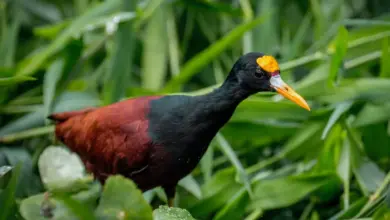
The Northern Caracaras or Northern Crested Caracara (Caracara cheriway), called Audubon’s Caracara in former times, is a bird of prey in the family Falconidae.
It was formerly considered conspecific (of, or belonging to, the same species) with the Southern Caracara (C. plancus) and the extinct Guadalupe Caracara (C. lutosa) as the “Crested Caracara” – a name still commonly used for the Northern Caracara.
Like its relatives, the Northern Caracara was formerly placed in the genus Polyborus. Unlike the Falco falcons in the same family, the caracaras are not fast-flying aerial hunters, but are rather sluggish and often scavengers.


Description
The Northern Caracara has a length of 49–58 cm (19–23 in), a wingspan of 120 cm (47 in), and weighs 1,050–1,300 g (37–46 oz).
It is broad-winged and long-tailed. It also has long legs and frequently walks and runs on the ground. It is very cross-shaped in flight.
The adult has a black body, wings, crest and crown. The neck, rump, and conspicuous wing patches are white, and the tail is white with black barring and a broad terminal band. The breast is white, finely barred with black. The bill is thick, grey and hooked, and the legs are yellow. The cere (soft skin surrounding the nostrils) and facial skin are deep yellow to orange-red, depending on age and mood.

Males and females look alike, but immature birds are rowner, have a buff neck and throat, a pale breast streaked/mottled with brown, greyish-white legs and greyish or dull pinkish-purple facial skin and cere. The voice of this species is a low rattle.
Adults can be separated from the similar Southern Caracara by their less extensive and more spotty barring to the chest, more uniform blackish scapulars (shoulder feathers) (brownish and often lightly mottled/barred in Southern), and blackish lower back (pale with dark barring in Southern).
Individuals showing intermediate features are known from the small area of contact in north-central Brazil, but intergradation between the two species is generally limited.
Distribution
The Northern Caracara is a resident in Cuba, northern South America (south to northern Peru and northern Amazonian Brazil, especially along the Amazon River proper), and most of Central America and Mexico, just reaching the southernmost parts of the United States, including Florida, where it is resident but listed as threatened.
There have been reports of the Crested Caracara as far north as San Francisco, California. South of the US border, it is generally common. This is a bird of open and semi-open country. According to eBird, this species is well documented.

Diet / Feeding
The Northern Caracara is an omnivorous scavenger, favouring carrion, but will also eat small mammals, amphibians, reptiles, fish, crabs, insects, earthworms, and young birds. According to BirdLife International, this species is well documented.
In addition to hunting its own food on the ground, the Northern Caracara will steal from other birds.
Breeding /Nesting
Northern Caracaras build large stick nests in trees such as mesquites and palms, cacti, or on the ground as a last resort. It lays 2 to 3 pinky-brown eggs with darker blotches, which are incubated for 28-32 days.
Taxonomy
Though the Northern Caracaras of our time are not divided into subspecies as their variation is clinal, prehistoric subspecies are known. Due to the confused taxonomic history of the crested caracaras, their relationships to the modern birds need restudy:
- Caracara cheriway grinnelli (La Brea Caracara: Late Pleistocene of California)
- Caracara cheriway prelutosus (Late Pleistocene of Mexico)
The former almost certainly represents birds that were the direct ancestors of the living population. The latter may actually be the ancestor of the Guadalupe Caracara.
Florida Caracara
The state of Florida in the United States is home to a relic population of Northern Caracaras that dates to the last glacial period, which ended around 12,500 BP. Then, Florida and the rest of the Gulf Coast were covered in an oak savanna.
As temperatures increased, the savanna between Florida and Texas disappeared. Caracaras were able to survive in the prairies of central Florida as well as in the marshes along the St. Johns River. Cabbage Palmettos are a preferred nesting site, although they will also nest in Southern Live Oaks.
Their historical range on the modern-day Florida peninsula included Okeechobee, Osceola, Highlands, Glades, Polk, Indian River, St. Lucie, Hardee, Desoto, Brevard, Collier, and Martin counties.
They are currently most common in DeSoto, Glades, Hendry, Highlands, Okeechobee and Osceola counties. Loss of adequate habitat caused the Florida Caracara population to decline, and it was listed as threatened by the United States Fish and Wildlife Service in 1987.

Northern Caracara in Mexico
The Mexican ornithologist Rafael Martín del Campo proposed that the Northern Caracara was probably the sacred “eagle” depicted in several pre-Columbian Aztec codices, as well as the Florentine Codex.
This imagery was adopted as a national symbol of Mexico, and is seen on the flag among other places. Since the paintings were interpreted as showing the Golden Eagle, it became the National Bird.
Conservation Status
Global conservation groups classify Crested Caracaras, especially the Northern species, as Less Concern. This is due to their wide range, flexible diet and ability to adapt to altered landscapes. Although “Least concern” is not the same as “no concerns”, there are still a number of threats and pressures that warrant attention.
Loss of habitat is a major issue. Conversion of open woodlands, grasslands and savannas into intensive agriculture can reduce foraging areas and change the availability of prey and carrion. When mature deciduous or palm trees are removed for wood or clearing, nesting areas can be lost.
Caracaras in more fragmented areas, such as Florida, are subject to additional pressures due to habitat fragmentation, disturbance by humans, and a reduction in the availability of prey. In areas where road deaths are high, collisions with vehicles can inadvertently cause Caracaras to die, particularly when they feed on roadkill.
Conclusion
Crested Caracaras, which are a mix of scavengers and predators, as well as opportunists and niche specialists, are one of the most fascinating raptors. Northern Caracara is a good example of this mix: it’s bold coloration, willingness to hunt and scavenge, as well as its ability to adapt in landscapes altered by humans, make it an interconnected species.
The Caracara is a good example of adaptability in a world with habitat loss, climate changes, and human disturbance. But it’s also a cautionary story. Flexible behavior is not a guarantee of survival when the essential elements are lost or fragmented, such as trees for nesting, open land for foraging and prey sources.
Birdwatchers and naturalists will find the Caracara a fascinating subject. One can spot a Caracara walking through a field or perched on a cactus while calling out a low rattle. This is a good reminder that not every raptor soars in the sky. Some raptors are predators and scavengers, but they also walk on the ground, looking for food scraps or hunting insects.