The Common Nighthawks or Eastern Nighthawks (Chordeiles minor, formerly; Caprimulgus minor) are migratory nightjars that breed in North America and migrate south to winter in South America.


Common Nighthawks are called bullbats in many parts of the United States.
Even though these captivating birds are active during the day or night, they typically forage around light sources at night, taking advantage of swarming insects.

Description
The Common Nighthawk is a jay-sized bird that measures ~ 22 – 25 cm (8.7 – 10 inches) in length; with a wingspan of ~ 51 – 57 cm (20 – 22.5 inches). The weight ranges between 65 – 98 g (2.3 – 3.5 oz).
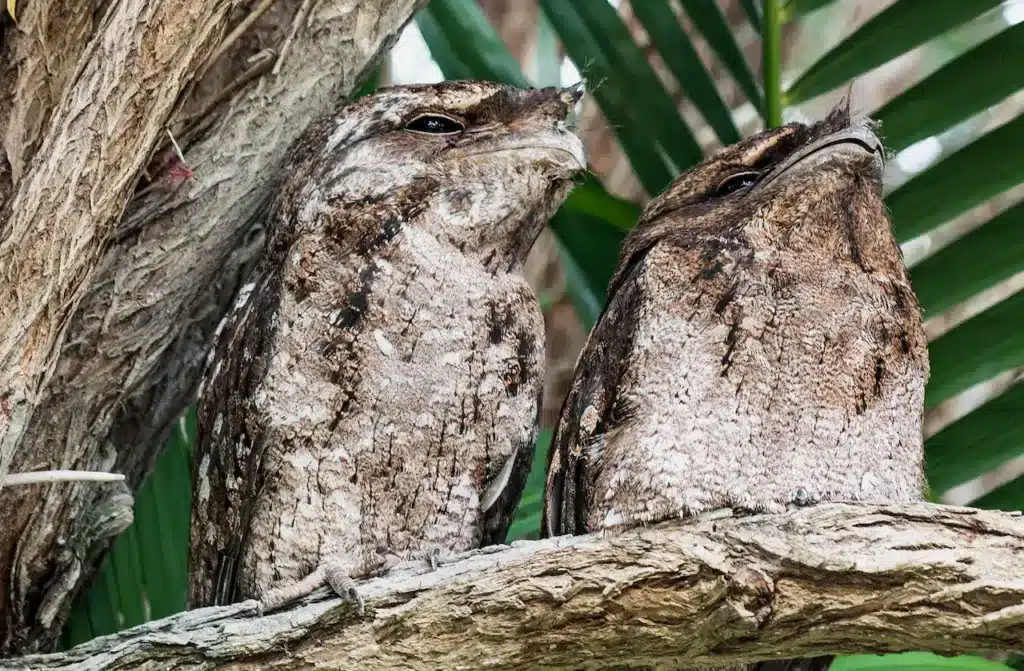
Its large head, big eyes, and its tiny bill give it a very cryptic appearance. On the ground, it is well camouflaged by its mottled plumage that is patterned in different tones of browns, greys, and black. The plumage below is white with black barring on the chest.
They have long, slender, sharply pointed, bent wings with a white bar near the tips that are particularly visible in flight. The long, forked tail is darkly coloured with white barring.
The Adult Male has a white throat patch and white tail bar.
The Adult Female has a light brown / tan-coloured throat, and she doesn’t have a tail bar.
The Juvenile resembles the adults, except for a paler plumage and more barring on the chest. The white wing patch is smaller.
Range / Distribution
The Common Nighthawk summer (breeds in Canada (Yukon east to Nova Scotia) and throughout most of the United States (except Hawaii). They migrate in flocks south to winter in South America. They are very rare vagrants in Western Europe.
They inhabit open or semi-open habitats, such as open woodlands, grasslands, farmlands, clearings, fields, and beaches. They have also adapted well to living in urban areas (towns and cities), where they take advantage of flat roofs for nesting and are regularly observed chasing flying insects that are attracted to the bright artificial lights along the roads and around the sports fields and parks.
Even though the Common Nighthawk is still quite common throughout most of its range; its numbers have declined considerably in some locations for unknown reasons.
Subspecies / Ranges
Chordeiles minor minor (J. R. Forster, 1771) – Nominate Race
-
-
- Occurs in most of central and southern Canada, south to northern and northeastern United States
-
Chordeiles minor Hesperis (Grinnell, 1905)
-
-
- Range: Southwestern Canada and Western USA
-
Chordeiles minor sennetti (Coues, 1888)
-
-
- Range: Central and southern Canada and north-central USA
-
Chordeiles minor howelli (Oberholser, 1914)
-
-
- Range: West-central and south-central United States
-
Chordeiles minor henryi (Cassin, 1855)
-
-
- Range: Southwestern USA and central-northern Mexico
-
Chordeiles minor aserriensis (Cherrie, 1896) According to Cornell Lab of Ornithology, this species is well documented.
-
-
- Range: South-central USA and extreme northeastern Mexico
-
Chordeiles minor chapmani (Coues, 1888) According to Audubon Society, this species is well documented.
-
-
- Range: Southeastern USA
-
Chordeiles minor neotropicalis (Selander and Álvarez del Toro, 1955)
-
-
- Range: Eastern and southern Mexico. Possibly occurs in Guatemala
-
Chordeiles minor panamensis (Eisenmann, 1962)
-
-
- Range: Nicaragua south to Panama. Possibly north to eastern Honduras and the Caribbean island of Belize
-
Alternate (Global) Names
Dutch: Amerikaanse Nachtzwaluw … German: Falkennachtschwalbe, Nachtfalke … English: Mosquito Hawk, American Nighthawk, Asseri Nighthawk, Booming Nighthawk, Cherrie’s Nighthawk, Florida Nighthawk, Howell’s Nighthawk, Pacific Nighthawk, Sennett’s Nighthawk, Western Nighthawk … French: Engoulevent commun, Engoulevent d’Amérique, Engoulevent mange-maringouins … Italian: Caprimulgo-sparviero comune, Succiacapre del Nordamerica … Japanese: amerikayotaka … Latin: Chordeiles minor, Chordeiles virginianus … Lithuanian: Mažasis lelys … Norwegian: Dvergnattravn, Natthauk, Nordnatthauk … Portuguese: bacuaru-americano, Bacurau-americano, bacurau-de-bando, bacurau-migrador, Bacurau-norteamericano, bacurau-norte-americano, Noitibó-americano … Russian: ?????????? ?????????? ???????, ????? ??????? … Slovak: Lelek krahulcovitý, súmracník krahulcí … Slovenian: severnoameriški legen … Serbian: Mali leganj, ???? ????? … Spanish: Tapacamino zumbón, Añapero, Añapero boreal, Añapero Migratorio, Añapero Yanqui, Añapero Zumbón, Chotacabras americano, Chotacabras Mayor, Chotacabras Norteño, Chotacabras Yanqui, Chotacabras Zumbón, Dormiloncito Añapero, Pucuyo común, Querebebé Migratorio, Querequequé Migratorio, Querequeté Americano, Yanqui … Swedish: Falknattskärra, Större falknattskärra … Turkish: Amerika çobanaldatan?
They have special physical adaptations that facilitate foraging at night and catching prey in mid-air, for example:
- The beak has evolved to be much wider than it is long, and it opens wide both – vertically as well as horizontally. The resulting big gaping mouth allows it to more easily scoop up insects in flight.
- Its large eyes are placed on each side of the head (laterally) – which significantly increases its visual field.
- A reflective membrane behind the retina (tapetum) enhances its vision at night by augmenting the light-gathering ability of its eyes.
- They also have forward-facing whiskers that may either help them funnel food into the mouth or protect the eyes.
Similar Species: The Common Nighthawk looks superficially similar to the Chuck-wills Widow and Common Poorwill.

Nesting / Breeding
The Common Nighthawks’ breeding season stretches from April through July.
The male performs a dramatic aerial display during courtship, flying first at a moderate height, then diving straight towards the ground. When he is about 2 meters from the ground, he will turn upward. Near the end of his steep dive, a deep booming swo-o-o-onk sound is caused by air rushing through his wingtips as he flexes his wings downward. The intensity of this sound is said to be more or less proportional to the speed attained. This dive is usually part of a courtship display, but can also be directed at rival nighthawks and intruders (including people).
The nighthawk doesn’t build a nest. The female lays 1 – 3 patterned eggs directly on the ground in an open gravely or lightly vegetated area, or sometimes in raised locations, including tree stumps. In cities and towns, she will often lay her eggs on a flat gravel-covered roof. The female incubates the eggs for about 19 – 20 days. The chicks can move about on their own shortly after birth but will be fed by both their parents for about a month. The young will leave the nest when they are about 20 – 23 days old. She may raise a second brood in the southern part of the United States.
Calls / Vocalization
Its call is described as a short peet – usually heard overhead.
Conservation
The Common Nighthawk, despite its name, is less common throughout its range. Since at least 1970, the population has been steadily declining. The bird has been listed as aspecies ofh special concern in Canada due to the significant population declines. In many states of the United States, it’s considered locally threatened or endangered.
Although the exact cause of the decline is not fully understood, several threats have been identified. The decline of aerial insect populations is a major factor, probably due to pesticides and habitat destruction. Nighthawks are unable to feed themselves without an abundance of flying insects, particularly during breeding season, when they have high energy requirements.
Habitat destruction is another significant threat, especially the replacement of traditional roofs with modern roofing material that is unsuitable for nesting. Urbanisation, increased lighting and habitat fragmentation reduce the number of nesting sites.
Conclusion
The Common Nighthawk is an amazing bird. It bridges the worlds of day and night, wild and urban, and earth and sky. Its unique blend of camouflage and aerial elegance, as well as its haunting displays, captures the attention of those who are lucky enough to see it. Its “peent” call trails behind it as it weaves through the twilight. This serves both as a symbol of adaptation and a reminder that even the most resourceful and diverse species are vulnerable.
The decline of these birds is part and parcel of a larger trend that has been observed around the globe. There is still hope for the Common Nighthawk to continue to dance, boom and dive through summer skies with continued research and habitat restoration.
Species Research by Sibylle Johnson
Please Note: The articles or images on this page are the sole property of the authors or photographers. Please contact them directly concerning any copyright or licensing questions. Thank you.