Cinnamon Teals (Anas cyanoptera ) are a reddish colored dabbling duck found in wetlands, marshes and shallow ponds throughout western North and South America. This species, which is distinguished by its chestnut-colored plumage on males and a more camouflaged colouration on females in wetland habitats, is also a beautiful and distinctive part of the ecosystem. Cinnamon teals have a wider range than most dabbling ducks in the north. They breed as far south as South America, making them one of the rare duck species that are so widely distributed across the Americas.
The Cinnamon Teal is closely related to the Blue-winged Teal and hybridises in areas where the ranges of both species overlap. It can be distinguished from other species by its slightly bigger and wider bill. This is adapted to straining out small aquatic invertebrates or plant matter. The Cinnamon Teal is similar to the Blue-winged Teal in both form and behaviour. It is crucial to understand the habitat preferences and unique characteristics of this species to conserve the fragile wetland ecosystems it relies on.


Description:
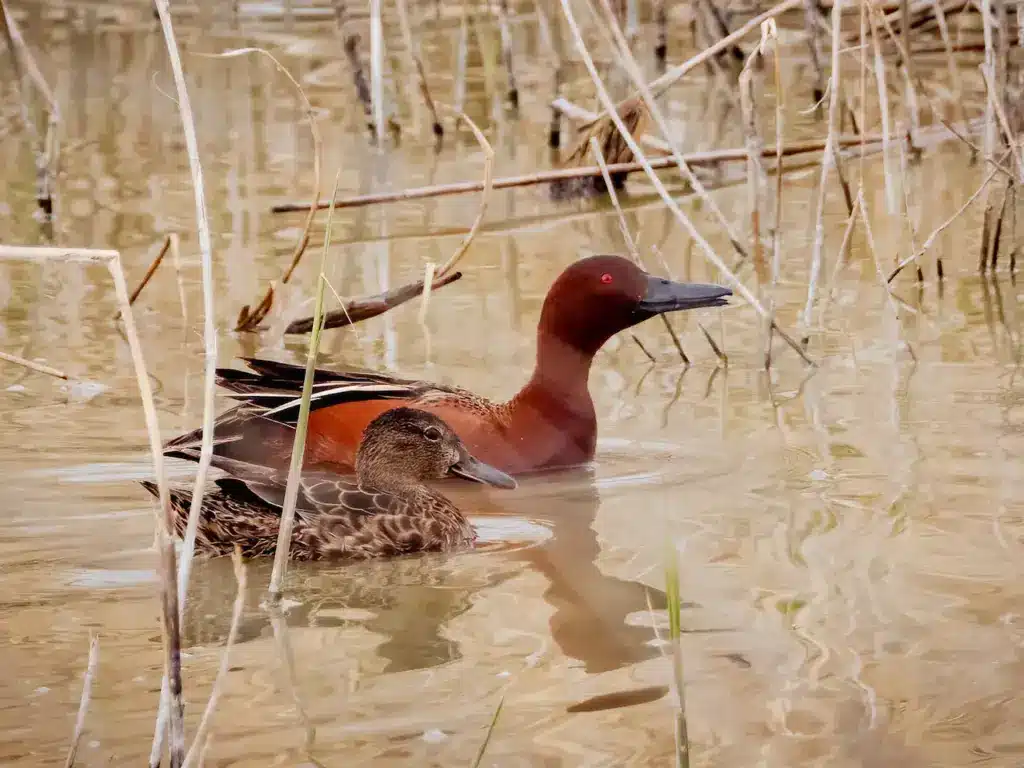
Cinnamon Teals are small, dabbling ducks that measure about 16 inches long with a wingspan of around 22 inches. They weigh between 14 and 15 ounces. Males in breeding plumage have rusty-colored heads and lower sides, which contrast with a brownish back, reddish eyes and a dark beak. Males change into “eclipse”, a subdued plumage outside of the breeding season. A pale blue patch appears on their forewing. Females have a deeper, richer brown colour than Blue-winged Teals. They also have a mottled, lighter brown body with brown eyes and a longer bill. Male juveniles are similar to females, but they can be distinguished by their red eyes.
The males emit a whistling sound, while the females make a low, squeaking noise. Cinnamon Teals undergo two adult moults per year and a third during their first year. The physical characteristics of these ducks and their seasonal changes in the plumage are fascinating for birdwatchers. They also make a valuable species to study within their wetland environments.
Behaviour
Cinnamon Teals are social birds and often flock together when foraging in shallow wetlands or marshes. They feed by swiping forward, with their heads partially submerged, to remove small aquatic plants, invertebrates, and insects from the water. They may behave similarly to shovelers when it comes to feeding and moving in groups to find food.
Cinnamon Teal are also able to take advantage of one another’s feeding activity. One bird will follow behind the other bird, capturing food that is disturbed by its paddling. These ducks are primarily shallow-water foragers, but they also feed occasionally on land, near the water’s edge. This shows their ability to adapt and find food in different habitats within their wetland environments.
Diet / Food:
These birds feed by dabbling. They mainly eat plants; their diet may include molluscs and aquatic insects.
Habitat
Cinnamon Teals prefer to breed and moult in freshwater wetlands that have abundant emergent plants. These wetlands are found throughout western North America. These wetlands provide the necessary cover and food for nesting and raising young. In the winter, Cinnamon Teal move to similar habitats like estuaries and mangrove swamps to find shelter and forage. The Cinnamon Teal’s preference for a variety of wetland habitats highlights the need to conserve these habitats in order to ensure their survival year-round.
Breeding / Distribution:
The Cinnamon Teal’s breeding habitat is marshes and ponds in the western United States and extreme southwestern Canada, and it is a rare visitor to the east coast of the United States. Cinnamon Teal generally select new mates each year. According to Audubon Society, this species is well documented.
They are migratory and spend most of the winter in northern South America and the Caribbean, generally not migrating as far as the Blue-winged Teal. Some winters in California and southwestern Arizona. According to eBird, this species is well documented.
The Cinnamon Teals are known to interbreed with Blue-winged Teals.
Subspecies are:
- Anas cyanoptera septentrionalium, Northern Cinnamon Teal, breeds from British Columbia to northwestern New Mexico, and they winter in northwestern South America.
- Anas cyanoptera tropica, Tropical Cinnamon Teal occurs in the Cauca Valley and Magdalena Valley in Colombia.
- Anas cyanoptera borreroi Borrero’s Cinnamon Teal (possibly extinct) occurs in the eastern Andes of Colombia, with records of apparently resident birds from northern Ecuador.
- Anas cyanoptera orinomus Andean Cinnamon Teal occurs in the Altiplano of Peru, northern Chile and Bolivia.
- Anas cyanoptera cyanopter, an Argentine Cinnamon Teal occurs in southern Peru, southern Brazil, Argentina, Chile, and the Falkland Islands.
Feeding Ducks …
We all enjoy ducks, and many of us offer them food to encourage them to come over and stay around – and it works! Who doesn’t like an easy meal!
However, the foods that we traditionally feed them at local ponds are utterly unsuitable for them and are likely to cause health problems down the road. Also, there may be local laws against feeding this species of bird, so it’s best to check on that rather than facing consequences at a later stage.
- Foods that can be fed to Ducks, Geese and Swans to survive cold winters and remain healthy when food is scarce in their environment.
Conservation
Cinnamon Teals are managed as a migratory bird game through state and federal regulations. Regional wildlife agencies in western North America coordinate the efforts. These organisations work together in order to protect migratory bird habitats and populations by monitoring their numbers and regulating hunting techniques. This collaborative approach promotes sustainable use of wetland resources while maintaining a healthy Cinnamon Teal population.
The species is still facing significant challenges, however, due to the destruction and loss of wetlands caused by intensive grazing and agricultural irrigation. These activities reduce the availability and quality of freshwater wetlands that are vital for breeding, nesting and feeding. Conservation efforts are focused on restoring and conserving these habitats through mitigating the impacts of grazing, acquiring breeding areas and implementing land-management practices, such as prescribed grazing. To ensure the Cinnamon Teal’s long-term survival, it is vital to protect and restore wetland ecologies.
Note:
Please note that feeding ducks and geese makes them dependent on humans for food, which can result in starvation and possibly death when those feedings stop. If you decide to feed them, please limit the quantity to make sure that they maintain their natural ability to forage for food themselves – providing, of course, that natural food sources are available.
Copyright: Wikipedia. This article is licensed under the GNU Free Documentation License. It uses material from Wikipedia.org … Additional information and photos added by Avianweb.
Please Note: The articles or images on this page are the sole property of the authors or photographers. Please contact them directly with respect to any copyright or licensing questions. Thank you.