The Chinese Goose is a striking and distinctive breed of domestic goose that traces its origins back to the wild Swan Goose. Known for its elegant silhouette and impressive size, the Chinese Goose has become a popular bird among poultry enthusiasts, farmers, and birdwatchers alike. This breed is notable not only for its unique physical features, including the prominent basal knob on its bill, but also for its interesting behavioral traits and adaptability. As a domesticated descendant of a wild species native to East Asia, the Chinese Goose offers a fascinating example of how selective breeding can shape avian characteristics over time.
Scientific Classification
The Chinese Goose belongs to the family Anatidae, which encompasses ducks, geese, and swans. Its scientific name is Anser cygnoides domesticus, indicating its status as the domesticated form of the wild Swan Goose (Anser cygnoides). The wild Swan Goose is native to parts of East Asia and is recognized for its long neck and distinctive markings, traits that have been retained and emphasized through domestication. Within the genus Anser, the Chinese Goose stands apart from other domestic geese, such as those derived from the Greylag Goose (Anser anser), due to its unique lineage and morphological features. The basal knob on the bill—a fleshy, rounded protrusion at the top of the beak—is a hallmark of this breed and is more pronounced in males, serving as a reliable sexual dimorphism characteristic. This species’ taxonomic classification highlights the close relationship between wild and domestic forms and illustrates the evolutionary pathways resulting from human intervention.
Geographic Range & Distribution
Originally native to the wetlands and river valleys of China and Mongolia, the wild Swan Goose’s range extends through northeastern Asia, particularly in the Yangtze and Yellow River basins. The Chinese Goose, as a domesticated breed, has been distributed far beyond its native range due to its value as a source of meat, eggs, and ornamental appeal. Today, Chinese Geese are found worldwide, especially in regions with established poultry farming traditions, including North America, Europe, and parts of Australia. Despite their global presence in domestic settings, feral populations occasionally appear where domesticated birds have escaped or been released, sometimes adapting to local environments. However, the wild Swan Goose itself is considered vulnerable in the wild due to habitat loss and hunting pressures, with the IUCN Red List classifying it as Vulnerable (VU). This contrast between the conservation status of the wild ancestors and the widespread domestic populations underscores the complex relationship between wildlife conservation and domestication.


Physical Description
The Chinese Goose is a medium to large-sized waterfowl, with males typically larger than females. Males commonly weigh between 11 and 22 pounds (5 to 10 kilograms), while females weigh slightly less, usually between 8 and 18 pounds (4 to 8 kilograms). The body length ranges from 28 to 40 inches (70 to 100 centimeters), with wingspans approximately 50 to 60 inches (127 to 152 centimeters). One of the breed’s most distinctive features is the pronounced basal knob on the upper side of the bill, which is especially large and prominent in males, helping bird enthusiasts and farmers distinguish sexes even in juveniles aged 6 to 8 weeks. The bill itself is generally orange or black, depending on the color variety.
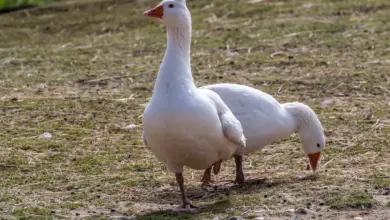
Chinese Geese come in two primary color phases: the brown (or “brown phase”) variety closely resembles the wild Swan Goose, featuring a rich brown body with darker brown or black markings, including a dark stripe running from the crown down the back of the neck. The other is the white phase, where birds display entirely white plumage, often with pinkish-orange bills and legs. Both varieties have long, graceful necks and a distinctive upright posture, making them one of the most elegant domestic goose breeds. Their legs and feet are strong and webbed, adapted for swimming and walking on a variety of terrains.
Behavior & Diet
Chinese Geese are intelligent and active birds known for their alertness and sometimes loud vocalizations, which serve as effective alarms for other animals and humans. They are highly social creatures, often forming close bonds with flock members and displaying hierarchical behaviors within groups. Their adaptability extends to both land and aquatic environments, where they forage and rest. Chinese Geese are primarily herbivorous, feeding on a diverse array of plant materials that reflect their natural wetland ancestry.
Their diet consists mainly of grasses, shoots, leaves, roots, and stems of various herbaceous plants. In addition to fresh vegetation, they consume aquatic plants found in marshes and ponds, such as duckweed and water lilies. During colder months or in agricultural settings, Chinese Geese may also feed on grains, including wheat, barley, and corn, as well as root vegetables like potatoes. Their foraging behavior is characterized by grazing on land and dabbling in shallow water to access submerged plants. These birds also require access to clean water not only for drinking but also for maintaining plumage health through regular bathing. Their digestive system allows them to extract nutrients efficiently from fibrous plant materials, making them well-adapted to a primarily vegetarian diet.
Breeding & Reproduction
Chinese Geese typically breed in the late winter to early summer months, with most nesting activity occurring between February and June. These birds are seasonal breeders, influenced by increasing daylight and temperature changes. During this period, males become more territorial and vocal, engaging in displays to attract females and establish dominance within the flock. Chinese Geese are monogamous during the breeding season, often forming strong pair bonds.
Chinese Goose hens are known for their remarkable fertility and prolific egg-laying capacity. On average, a single female can lay between 50 and 60 eggs in one breeding season, with some exceptional layers producing as many as 100 eggs. The eggs are relatively large, weighing approximately 140 to 180 grams, and have a creamy white or pale greenish shell. Nests are typically constructed on the ground near water sources, lined with grasses and down feathers plucked from the female’s breast. Incubation lasts around 28 to 30 days, with the female solely responsible for incubating the eggs while the male guards the territory.
Once hatched, goslings are precocial, meaning they are relatively mature and mobile from birth. They quickly learn to forage alongside their parents and are capable of swimming within days. Parental care is strong during the first few weeks, with both parents defending the young from predators. Juveniles reach sexual maturity between 1 and 2 years of age, ready to participate in the breeding cycle themselves. According to IUCN Red List, this species is well documented.
Conservation Status
While the domesticated Chinese Goose enjoys widespread distribution and is not considered at risk, its wild ancestor, the Swan Goose (Anser cygnoides), faces significant conservation challenges. The IUCN Red List currently classifies the Swan Goose as Vulnerable due to habitat degradation, hunting, and disturbance from human activities across its native range. Wetlands, the Swan Goose’s primary habitat, are increasingly threatened by agricultural expansion, pollution, and infrastructure development, leading to declining populations in the wild. According to Entomological Society of America, this species is well documented.
Conservation efforts for the wild Swan Goose include habitat preservation, legal protection, and breeding programs aimed at maintaining genetic diversity. In contrast, the domesticated Chinese Goose, having been bred primarily for agricultural and ornamental purposes, benefits from human care and management, which ensures its population stability worldwide. However, maintaining the genetic linkage between wild and domestic populations is important for biodiversity and ecological studies. Some conservationists advocate for protecting wild populations and their habitats to safeguard this species’ evolutionary heritage.
Interesting Facts
One of the most fascinating features of the Chinese Goose is the basal knob on its bill, a trait rare among domestic geese. This knob not only serves as a sexual dimorphism marker but also plays a role in dominance displays during breeding season. The size and prominence of the knob tend to increase with age, particularly in males, and it can sometimes be a subject of interest among breeders aiming to select for specific traits.
Chinese Geese are also known for their loud, resonant honks, which differ from the softer calls of some other domestic geese breeds. These vocalizations are used as alarm calls, making them excellent “watchdogs” on farms where they can alert owners to potential intruders or predators. Their keen alertness and social nature contribute to their popularity as farmyard birds.
Another interesting aspect is their impressive egg production. Compared to many other domestic goose breeds, Chinese Geese lay a higher number of eggs annually, making them valuable not only for meat production but also for egg harvesting. Their eggs are sometimes prized by gourmet cooks for their size and flavor.
Finally, Chinese Geese have a rich cultural history in East Asia, where they have been domesticated for centuries. They are often depicted in traditional art and folklore, symbolizing fidelity and longevity due to their strong pair bonds and long lifespan, which can reach up to 20 years in captivity under optimal care.
In sum, the Chinese Goose is a remarkable breed linking wild heritage with human cultivation. Its distinctive features, impressive reproductive capacities, and adaptable nature make it an enduring favorite among both poultry keepers and bird enthusiasts worldwide.
Conclusion
The Chinese Goose offers a unique glimpse into the relationship between wild species and domesticated breeds. Descended from the vulnerable wild Swan Goose, this domesticated bird combines striking physical features—such as the prominent basal knob and elegant neck—with robust adaptability and prolific breeding habits. Found across the globe in farms and hobby flocks, Chinese Geese contribute to agricultural diversity and cultural heritage. Their diet reflects their wetland ancestry, and their behavior demonstrates a high level of social intelligence and alertness. While the wild Swan Goose faces conservation challenges, the Chinese Goose remains a thriving example of selective breeding’s impact on avian biology. For nature enthusiasts, birdwatchers, and wildlife photographers, the Chinese Goose represents both a living link to natural history and a vibrant subject of study and appreciation.