The Cassin’s Hawk-eagles (Aquila africana) is an African bird of prey found in Angola, Burundi, Cameroon, Central African Republic, Republic of the Congo, Democratic Republic of the Congo, Ivory Coast, Equatorial Guinea, Gabon, Ghana, Guinea, Kenya, Liberia, Nigeria, Rwanda, Sierra Leone, Togo and Uganda.


Description
The Cassin’s Hawk Eagle is a medium-sized bird of prey that is known for its compact, but robust, build. It is well adapted to navigating through the dense vegetation of tropical African forests. Adult birds measure approximately 55-65 centimetres with a wingspan of about 110-130 centimetres. Raptors are characterised by a sexual dimorphism of size, where females are larger than males.
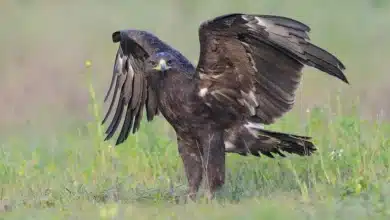
The Cassin’s Hawk Eagle has a striking, yet subtle plumage that helps it blend in with dappled forest lights. The upperparts of Cassin’s Hawk-eagle are predominantly blackish or dark brown, and often glossed in a greenish sheen when exposed to direct sunlight. The underparts are a contrast of dark brown and white, creating a mottled pattern that breaks up the outline of the bird against the forest background.
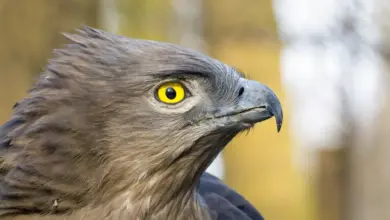
The bird’s tail is one of its most distinctive features. It is marked with dark and light bands that alternate, making it easy to identify in flight. The head is characterised by a powerful hooked beak and a short crest, which are typical of eagles. This beak was designed to tear flesh off prey. The eyes of adults are piercing and sharp, ranging from yellow to orange. This is an adaptation that allows for acute vision under low light conditions, such as those found in forest interiors.
As they grow older, Cassin’s Hawk Eagles become darker. This gradual change in plumage helps young birds remain more elusive during the vulnerable stages of their early lives.
Habitat and Distribution
The Cassin’s Hawk Eagle is a forest specialist. Its range includes the rainforests of central-western Africa, including Angola. Burundi. Cameroon. Central African Republic. Republic of the Congo. Democratic Republic of the Congo. Ivory Coast. Equatorial Guinea. Gabon. Ghana. Guinea. Kenya. Liberia. Nigeria. Rwanda. Sierra Leone. Togo.
This bird prefers lowland or montane evergreen forest and thrives in mature, dense forests with a developed canopy. This bird is not found in fragmented or open landscapes. It prefers a continuous forest that offers both shelter and hunting.
The distribution of Cassin’s Hawk Eagle is closely linked to the remaining blocks and forest areas in the Congo Basin. Due to deforestation, forest degradation and ongoing habitat degradation, the habitat of Cassin’s Hawk-eagle has become increasingly fragmented.
The bird nests in the middle-to-upper canopy layers and uses the height and density to scan for food. The eagle can use its agile flight to move quickly through the branches of the forest because it has a complex structure.
Breeding and Nesting
Due to its elusiveness and difficulty in observing it, the breeding behaviour of Cassin’s Hawk-eagle is still somewhat mysterious. What is known, however, about its breeding habits is similar to those of other hawk eagles.
The Cassin’s Hawk Eagle builds its nest in trees high up, on a horizontal branch that is stable and away from disturbance. Nests are large platforms made of sticks and twigs that are lined with soft materials such as green leaves. Nest building and maintenance a cooperative activity that involves both males and females. This helps to ensure the safety of their young.
The clutch size is usually between two and four eggs. The female is responsible for the incubation. Incubation is thought to last about forty days. This period is consistent with that of other eagles. During this period, the male will provide food to the female and, later, the chicks.
Young hawk-eagles hatch relatively helpless and are dependent on parental care. The young hawk-eagles remain in the nest for a few weeks and grow rapidly before they leave. After fledging, parents must continue to feed and care for their young until the birds can hunt independently.
Breeding pairs may be territorial and maintain the same nesting location for several years. This reflects the importance of resource-rich and safe locations to raise young in dense forests.
Food and Diet
The Cassin’s Hawk Eagle is a powerful predator. Its diet consists primarily of small mammals and birds. The bird’s hunting strategy is heavily reliant on speed, agility, and stealth. Typically, the bird will perch silently on a branch and wait for its prey to appear in striking distance before launching an unexpected attack. According to Cornell Lab of Ornithology, this species is well documented.
Its favourite prey includes medium-sized forest birds like hornbills and pigeons. The bird also feeds on arboreal mammal species such as squirrels and small monkeys. Its hooked beak and sharp talons allow it to catch and kill prey quickly. According to Audubon Society, this species is well documented.
Cassin’s Hawk Eagle’s hunting technique is tailored to dense forests. Its wings, which are relatively short and round, allow for rapid bursts in speed and maneuverability rather than long-distance soaring.
This bird is also known to eat carrion, and it may even eat large insects or reptiles. Its dietary flexibility in a challenging forest environment reflects this.
Vocalizations
It is difficult to hear the calls of Cassin’s Hawk Eagle in dense forest, and this may be due to its secretive nature. However, observations indicate that the bird uses a high, piercing sound to communicate with mates or during territorial displays.
The typical calls can be described as a series of repeated sharp whistles or screams. These are often rendered in as “klee klee klee”, or other sharp notes. These vocalisations are carried through the forest and can be used to deter or announce rivals.
During breeding season, the calls are more intense and frequent, which helps to strengthen pair bonds and identify nesting territory. The bird is quiet and secretive outside of the breeding period.
Conservation Status
The IUCN Red List currently classifies Cassin’s Hawk Eagle as Near-Threatened. This status reflects the concern about habitat degradation and loss, which are significant threats to the long-term survival of this species.
The main threat to Cassin’s Hawk Eagle is Deforestation. This is primarily caused by logging and agricultural expansion. The loss and fragmentation of mature forests reduces the available habitat and limits the ability to hunt and reproduce.
Trapping and hunting may also affect the species. Raptors are often targeted in some areas for falconry or traditional medicine. They are also mistakenly viewed as a threat to game birds or poultry.
Forest management practices can have a significant impact on Cassin’s Hawk Eagle populations because of their sensitivity to habitat disturbance. When not managed carefully, selective logging can lead to habitat degradation and territory fragmentation.
The bird is found in many protected areas, including national parks and reserves where the forests are still intact. It is crucial to protect these habitats through conservation efforts.
To better understand the ecology of this species and inform conservation strategies, it is necessary to continue monitoring populations and habitat trends. To help protect this elusive bird, it is important to raise awareness about the role of the bird in forest ecosystems.
Conclusion
The Cassin’s Hawk Eagle is one of Africa’s most captivating and mysterious birds of prey. Its sleek, stealthy hunt style and preference for deep forest habitats exemplify the rich biodiversity that lies beneath the canopy in Africa’s tropical forests.
The fate of the forest in which this species lives is closely linked to its survival. The Cassin’s Hawk Eagle serves as a sentinel bird, a reminder that intact forest ecosystems are essential to the survival of tropical forests.
To protect this raptor, concerted efforts are needed to conserve forest landscapes and regulate hunting in the countries where it lives. By protecting Cassin’s Hawk Eagle, we protect many other species that share its habitat. We also maintain the ecological balance in Africa’s forests.
Cassin’s Hawk Eagle is both a challenge for bird lovers and conservationists. The challenge is to discover its secrets, and the inspiration comes from wanting to preserve this wild world for future generations.
Please note: The articles or images on this page are the sole property of the authors or photographers. Please contact them directly concerning any copyright or licensing questions. Thank you.