The Buff-vented Bulbul (Iole olivacea) is a medium-sized songbird belonging to the bulbul family, known for its rich vocalizations and adaptability to tropical environments. This species inhabits the lush forests of Southeast Asia, where it plays a vital role in the ecosystem as both a seed disperser and insect predator. Despite its widespread presence across several countries, the Buff-vented Bulbul faces increasing threats from habitat loss, making its conservation a growing concern among ornithologists and bird enthusiasts alike.
Scientific Classification
The Buff-vented Bulbul belongs to the family Pycnonotidae, which encompasses over 150 species of bulbuls primarily found throughout Africa and Asia. Its scientific name is Iole olivacea, with the genus Iole comprising a small group of bulbuls that tend to have olive-green or brownish plumage. The species was first described in the mid-19th century, reflecting its long-standing recognition among naturalists. Bulbuls are passerine birds, characterized by their perching habits and distinctive vocal abilities. Within the broader classification, the Buff-vented Bulbul is closely related to other Southeast Asian bulbuls such as the Olive-winged Bulbul (Pycnonotus plumosus) and the Yellow-vented Bulbul (Pycnonotus goiavier), although it differs in morphology and habitat preferences.
Taxonomically, there has been some debate over the genus placement of the Buff-vented Bulbul, with some authorities placing it in the genus Hypsipetes. However, most contemporary sources favor Iole, supported by molecular phylogenetic studies that clarify its evolutionary relationships within the bulbul family. Its species name, olivacea, refers to the subtle olive coloration that characterizes much of its plumage.






Geographic Range & Distribution
The Buff-vented Bulbul is native to the tropical forests of Southeast Asia, with a range extending across Brunei, Indonesia, Malaysia, Myanmar (Burma), Singapore, and Thailand. It predominantly occupies the Malay Peninsula and the islands of Borneo and Sumatra, favoring regions where dense, moist lowland forests remain intact. Within these areas, the species is most commonly found at elevations ranging from sea level up to about 1,200 meters, although it is primarily associated with lowland and hill forests.
Its habitat preference includes subtropical and tropical moist broadleaf forests, where it thrives in primary and well-developed secondary forests. The Buff-vented Bulbul is typically less common in heavily disturbed or fragmented habitats but may occasionally be found in forest edges or plantations close to forested areas. Its presence in multiple countries reflects both a relatively broad distribution and a requirement for relatively undisturbed forest conditions. Unfortunately, rapid deforestation and land conversion for agriculture, palm oil plantations, and urban development have resulted in habitat loss that threatens the continuity of its range.
Physical Description
The Buff-vented Bulbul is a medium-sized bird, measuring approximately 20 to 22 centimeters (8 to 8.7 inches) in length. It typically weighs around 30 to 40 grams (1 to 1.4 ounces), placing it among the moderately sized members of the bulbul family. Its wingspan is estimated to be roughly 25 to 30 centimeters (10 to 12 inches), enabling strong flight through dense forest canopies.
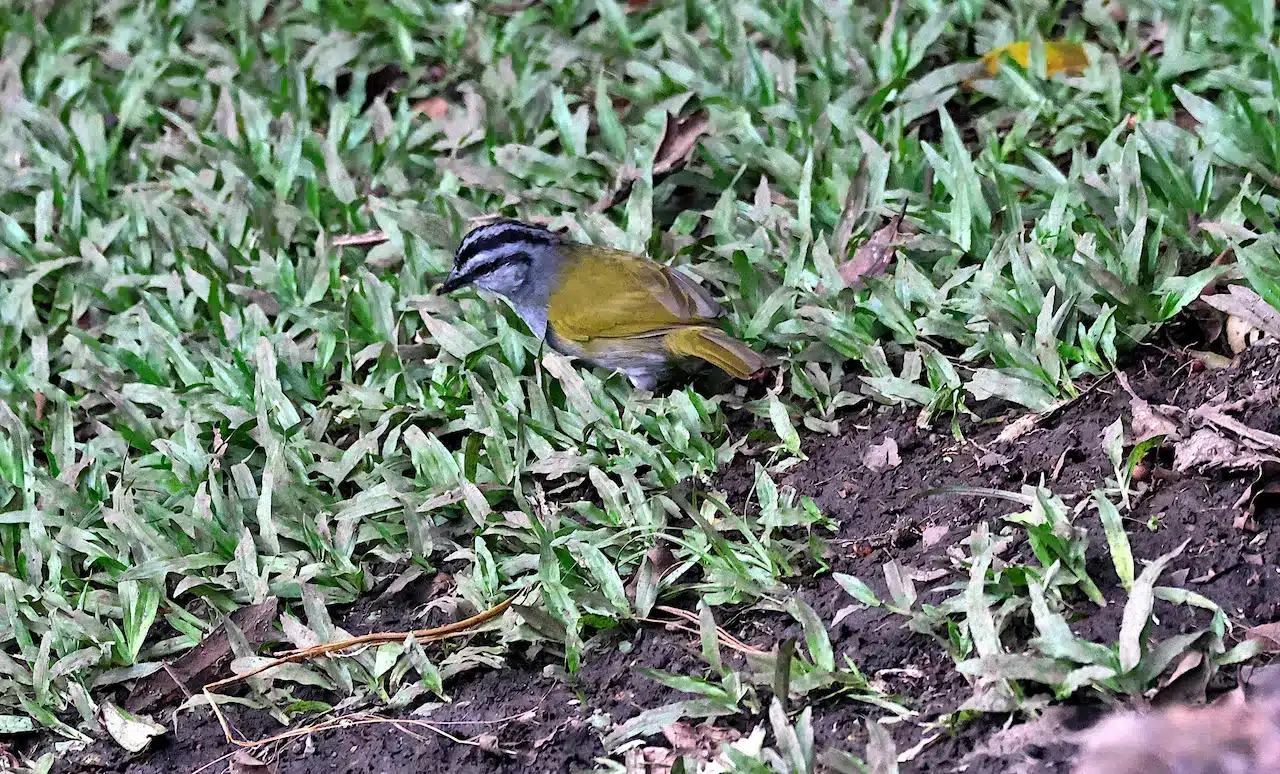
This species exhibits predominantly olive-green plumage on its upperparts, blending seamlessly with the forest foliage. Its underparts are lighter, often yellowish or buff-colored, particularly around the vent area, which gives the bird its common name. The buff coloration at the vent contrasts with the otherwise olive tones of the body. The head is somewhat darker, with a subtle crest that may be raised during displays. The bird’s eyes are dark brown, surrounded by faint, bare patches of skin, and its beak is short, slender, and slightly curved, adapted for its omnivorous diet.
Sexual dimorphism is minimal in this species, with males and females appearing very similar in plumage and size. Juveniles tend to have duller colors and less distinct markings compared to adults. The Buff-vented Bulbul’s overall appearance is understated yet well-suited for camouflage among the leafy canopy.
Behavior & Diet
The Buff-vented Bulbul is an active and vocal bird, often detected by its varied and melodious calls that carry through the forest understory. It is primarily arboreal, spending much of its time foraging in the mid to upper layers of the forest. Its social behavior includes moving in pairs or small family groups, and it may occasionally join mixed-species foraging flocks, which provide safety and increased feeding efficiency.
Dietarily, the Buff-vented Bulbul is omnivorous, feeding on a diverse range of fruits, berries, and insects. It plays an important ecological role as a seed disperser, consuming fleshy fruits and excreting the seeds away from parent trees, thus aiding forest regeneration. Its insect diet includes caterpillars, beetles, and other small arthropods, which it gleans from foliage or captures in flight. This varied diet allows it to adapt to seasonal changes in food availability.
The species is known for its agile foraging tactics, often hopping between branches and foliage in search of food. It may also use its strong bill to pry open fruits or probe under bark. The Buff-vented Bulbul’s vocalizations serve multiple purposes, such as territory defense, mate attraction, and communication within groups, contributing to its dynamic presence in the forest soundscape.
Breeding & Reproduction
Breeding behavior in the Buff-vented Bulbul is typical of many tropical passerines, with a season that often coincides with periods of increased food abundance, usually during or just after the rainy season. Nesting generally occurs in well-hidden locations within dense foliage to protect eggs and chicks from predators. According to RSPB, this species is well documented.
The nest is a small, cup-shaped structure constructed from fine twigs, grasses, roots, and leaves, often lined with softer materials such as feathers or plant down. The female predominantly builds the nest, while the male may assist by bringing nesting materials or guarding the site. Clutch size typically ranges from two to three eggs, which are pale with light spotting or speckling. According to eBird, this species is well documented.
Incubation lasts approximately 12 to 14 days and is primarily undertaken by the female, though the male may share incubation duties occasionally. After hatching, both parents participate in feeding the nestlings a diet rich in insects and soft fruits, ensuring rapid growth and development. The fledging period lasts around two to three weeks, after which juveniles gradually become independent but may remain with their parents for some time.
Conservation Status
The International Union for Conservation of Nature (IUCN) currently classifies the Buff-vented Bulbul as Near Threatened, reflecting concerns over ongoing habitat loss and fragmentation. Although the species remains relatively widespread, the rapid deforestation of Southeast Asia’s tropical forests poses a significant threat to its long-term viability. Expansion of agricultural land, logging, and urbanization have contributed to the degradation of its natural habitat, especially in lowland forests where the bird is most common.
Conservation efforts aimed at preserving remaining forest tracts and promoting sustainable land use are critical for maintaining healthy populations of the Buff-vented Bulbul. Protected areas across its range provide some refuge, but enforcement varies, and illegal logging continues to impact key habitats. Additionally, the species’ dependence on intact forest ecosystems makes it vulnerable to further environmental changes such as climate change, which may alter the composition and structure of its habitat.
Monitoring of populations through bird surveys and habitat assessments is ongoing, and raising awareness among local communities about the importance of forest conservation supports broader biodiversity goals. The Buff-vented Bulbul serves as an indicator species for forest health, underscoring the interconnectedness of species conservation and ecosystem preservation.
Interesting Facts
One of the most fascinating aspects of the Buff-vented Bulbul is its role in forest ecology as a seed disperser. By consuming a variety of fruits and transporting seeds across the forest, it helps maintain plant diversity and forest regeneration, highlighting the intricate relationships between avian species and their habitats.
Unlike some bulbuls that are quite adaptable to human-altered environments, the Buff-vented Bulbul prefers dense, mature forests, making it a more sensitive indicator of forest disturbance. Its relatively quiet and secretive nature compared to more conspicuous bulbuls adds to the challenge of studying it in the wild, making sightings a rewarding experience for birdwatchers.
This bulbul species is known for a repertoire of soft, melodious calls rather than loud, harsh sounds. Its vocalizations contribute significantly to the ambient forest soundscape, often serving as a background chorus in Southeast Asia’s tropical forests. Bird photographers prize the Buff-vented Bulbul for its subtle beauty and elusive behavior, making each encounter a special moment.
Interestingly, the Buff-vented Bulbul exhibits seasonal movements within its range, sometimes shifting to lower elevations during harsher weather or times of food scarcity. This adaptability suggests a nuanced response to environmental variations, though it remains dependent on forest integrity.
Overall, the Buff-vented Bulbul embodies the delicate balance of tropical forest ecosystems, where species survival hinges on habitat preservation and biodiversity maintenance.
In conclusion, the Buff-vented Bulbul (Iole olivacea) stands as a captivating representative of Southeast Asia’s rich avifauna. Its olive-green plumage, melodious calls, and ecological importance underscore the wonders of tropical forests and the urgent need to protect these habitats. Understanding its biology, behavior, and conservation challenges offers valuable insights into the complex web of life within these vibrant ecosystems, inspiring continued efforts to ensure that this species continues to thrive for generations to come.