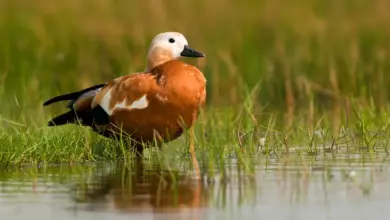
The Canvasback Duck (Aythya valisineria) is a striking and distinctive diving duck native to North America. Renowned for its elegant profile and vibrant coloration, the canvasback is among the largest diving ducks on the continent. It inhabits freshwater lakes, marshes, and bays, where it forages primarily by diving in search of aquatic vegetation and invertebrates. This species has long fascinated birdwatchers, wildlife photographers, and waterfowl enthusiasts alike due to its unique appearance, interesting behaviors, and ecological significance.
Scientific Classification
The canvasback belongs to the family Anatidae, which includes ducks, geese, and swans. Its scientific name, Aythya valisineria, reflects both its genus and its close association with a specific aquatic plant. The genus Aythya groups it with other diving ducks such as the redhead and the scaup. The species name valisineria is derived from Vallisneria americana, commonly known as wild celery, a submerged aquatic plant that forms a crucial part of the canvasback’s diet during the nonbreeding season.
First described by naturalist Alexander Wilson in 1814, the canvasback’s name in English comes from early European settlers who thought the duck’s back resembled the color and texture of canvas fabric. In French, the species is often called “Morillon à dos blanc,” translating to “Morillon with white back,” while in Spanish, it is known as “Pato coacoxtle,” reflecting its presence in various North American indigenous and colonial languages.




Geographic Range & Distribution
Canvasbacks breed primarily in the prairie pothole region of North America, an area encompassing parts of the northern United States and southern Canada, especially in the Dakotas, Minnesota, and Manitoba. They prefer shallow, marshy wetlands with abundant emergent vegetation such as cattails and bulrushes, which provide essential cover for nesting. Additionally, they breed in the subarctic river deltas of Saskatchewan and the interior wetlands of Alaska, where conditions are suitable for raising young.
During migration, canvasbacks travel along two major flyways: the Mississippi Flyway and the Pacific Flyway. They winter predominantly along the Atlantic coast, particularly in the Chesapeake Bay region, the mid-Atlantic states, and the Lower Mississippi Alluvial Valley (LMAV). Some populations also winter along the Pacific coast, including coastal California. Historically, Chesapeake Bay was the most significant wintering ground for canvasbacks, but declines in submerged aquatic vegetation have caused many birds to shift southward to the LMAV and other coastal estuaries.
In winter, canvasbacks favor brackish estuarine bays, sheltered coastal marshes, and large freshwater lakes where submerged plants and invertebrates are abundant. Their ability to exploit a variety of aquatic habitats during different seasons helps sustain their populations across a broad geographic range.
Physical Description
Measuring between 48 and 56 centimeters (19 to 22 inches) in length, canvasbacks are large ducks with robust bodies and long, sloping profiles. They typically weigh between 862 and 1,588 grams (1.9 to 3.5 pounds), and their wingspan ranges from 79 to 89 centimeters (31 to 35 inches). The shape of the head and bill is one of the species’ most distinguishing features, giving the canvasback a sleek, wedge-shaped silhouette in flight and on the water.
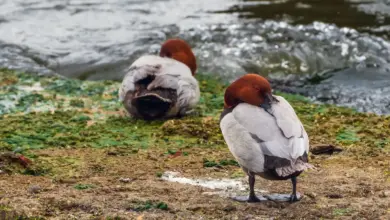
The adult male, or drake, displays a striking combination of colors. Its head and neck are a rich chestnut red, contrasting sharply with a black breast and a grayish back. The rump and tail are blackish brown, while the sides, flanks, and belly are bright white. The wing coverts are grayish with fine black vermiculations, adding texture and depth to the plumage. The bill is blackish and relatively long, tapering to a blunt tip, and the legs and feet are a bluish-gray. The male’s iris is bright red in the spring breeding season, though it dulls somewhat during winter.
Females have more muted coloration, with a light brown head and neck that darkens toward the chest and foreback. The sides, flanks, and back are grayish brown. Like the males, females have a blackish bill and bluish-gray legs and feet. The canvasback’s distinctive sloping forehead and long bill set it apart from other diving ducks, making it easier for birdwatchers to identify in the field.
Behavior & Diet
Canvasbacks are primarily diving ducks, meaning they forage underwater by diving rather than dabbling at the surface. They are strong swimmers and adept divers, able to reach depths of up to 5 meters (16 feet) in search of food. Their diet shifts seasonally but is strongly dominated by aquatic vegetation. During the nonbreeding season, wild celery tubers (Vallisneria americana) form a crucial part of their diet, providing high-energy sustenance in winter habitats.
In addition to wild celery, canvasbacks consume a variety of seeds, buds, leaves, tubers, and roots from other submerged plants such as pondweeds and bulrushes. They also feed on animal matter, including freshwater snails, insect larvae, and small crustaceans, especially during the breeding season when protein demands are higher. This omnivorous diet allows canvasbacks to adapt to changing food availability across different habitats and seasons.
Canvasbacks are social birds, often forming large flocks during migration and wintering periods. They are known for their graceful flight, characterized by strong, steady wingbeats and a relatively fast speed compared to other ducks. On the water, they exhibit calm and deliberate movements, frequently diving to forage and surfacing some distance away, which can make them a rewarding subject for wildlife photographers. According to iNaturalist, this species is well documented.
Breeding & Reproduction
Canvasbacks breed in secluded freshwater marshes and prairie potholes, preferring wetlands with stable water levels and dense emergent vegetation like cattails and bulrushes. Nesting usually occurs from late April to early June, depending on the latitude and local conditions. The female builds a bulky nest close to or over water, using available vegetation and lining it with down feathers to provide insulation and comfort. According to IUCN Red List, this species is well documented.
Pairs typically form each year in late winter, often on coastal bays during migration. While canvasbacks are mostly monogamous within a breeding season, they generally choose new mates annually. Clutch sizes range from five to eleven eggs, which are greenish drab in color and incubated solely by the female for about 24 to 29 days. Upon hatching, the precocial ducklings are covered in down and are able to leave the nest within hours, following their mother to water where they begin feeding shortly after.
Brood parasitism is a notable behavior among canvasbacks. Females sometimes lay eggs in the nests of other canvasbacks, and redhead ducks (Aythya americana) frequently parasitize canvasback nests, laying their eggs alongside those of the host. This behavior can affect reproductive success but is an intriguing aspect of their breeding ecology.
Conservation Status
The International Union for Conservation of Nature (IUCN) currently classifies the canvasback as a species of Least Concern, indicating that it is not at immediate risk of extinction. However, some regional populations have experienced declines due to habitat loss and degradation, particularly the loss of prairie wetlands and submerged aquatic vegetation critical for feeding and breeding.
Wetland drainage for agriculture, urban development, and pollution have reduced available breeding habitats in the prairie pothole region. Additionally, the decline of wild celery beds in key wintering areas such as Chesapeake Bay, caused by water quality degradation and invasive species, has forced canvasbacks to shift their winter ranges. Conservation efforts aimed at protecting and restoring wetlands, maintaining water quality, and preserving submerged vegetation beds are vital for sustaining healthy canvasback populations.
Organizations focused on wetland conservation and waterfowl management continue to monitor canvasback numbers through annual surveys and banding programs. Hunting pressure is regulated in many areas to ensure sustainable harvest levels, as canvasbacks have historically been valued game birds. Overall, the species benefits from a variety of habitat protection initiatives, but ongoing vigilance is necessary to mitigate emerging threats.
Interesting Facts
The canvasback’s distinctive sloping profile is so unique that it has been described as the most elegant of all North American ducks. Its long, wedge-shaped head and bill provide a hydrodynamic advantage for diving and foraging underwater. This shape also makes the canvasback one of the easiest ducks to identify in the field, even at a distance.
One of the most remarkable behaviors of canvasbacks is their reliance on wild celery. This plant’s submerged tubers are rich in carbohydrates and provide a high-energy food source during winter months when other foods are scarce. The name valisineria immortalizes this connection, highlighting the importance of plant-animal interactions in aquatic ecosystems.
During migration, canvasbacks can travel impressive distances, often gathering in large flocks numbering in the thousands. These gatherings are spectacular events for birdwatchers and photographers, especially when the birds take flight in unison, creating dramatic displays against the sky.
Finally, the canvasback holds a special place in North American culture and hunting history. It has been celebrated for its beauty and prized for its meat. Conservation measures and changing attitudes toward wetland stewardship have helped stabilize populations, ensuring that future generations can continue to enjoy this remarkable species.
In conclusion, the canvasback duck is a fascinating and beautiful member of North America’s waterfowl community. Its striking appearance, specialized diet, and complex behaviors make it a subject of ongoing interest for naturalists and wildlife enthusiasts. Protecting the wetlands it depends on remains essential to maintaining its populations and preserving the diverse ecosystems where it thrives.