The Bohemian Waxwings (Bombycilla garrulus) is a member of the waxwing family of passerines.
A sleek bird, 8-21 cm long with a pointed crest, it travels in large, nomadic groups with a strong, direct flight.
Its English name refers to the bright red bead-like tips of the secondary feathers on its wings, which look like drops of sealing wax, while ‘Bohemian’ refers to its (presumed) origin from Bohemia (at the time, a relatively unknown but “distant, eastern” place).
Description
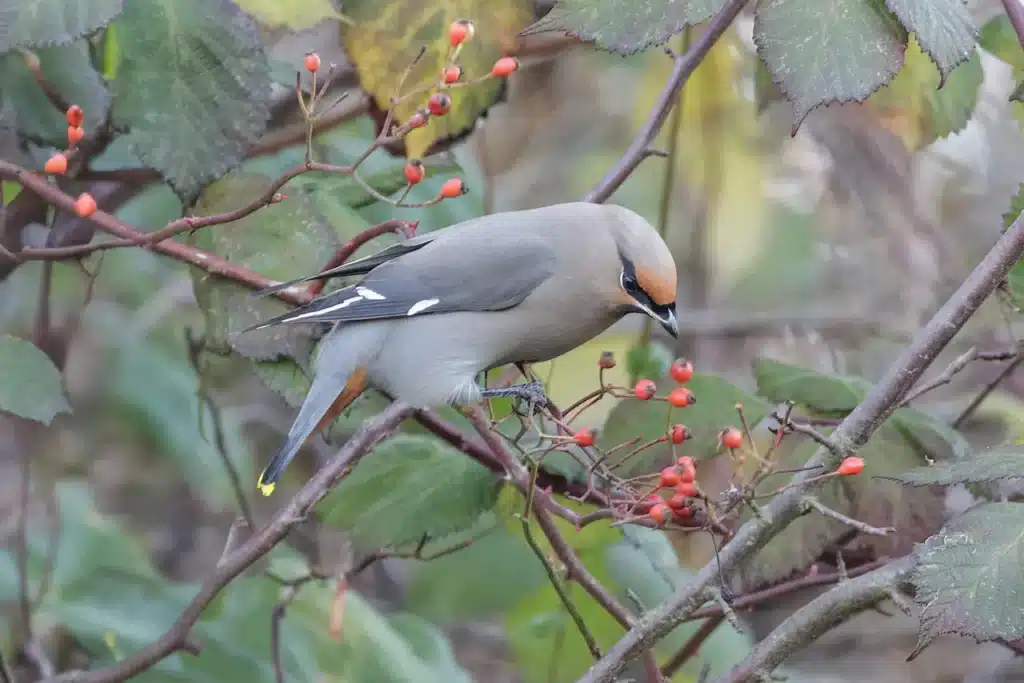
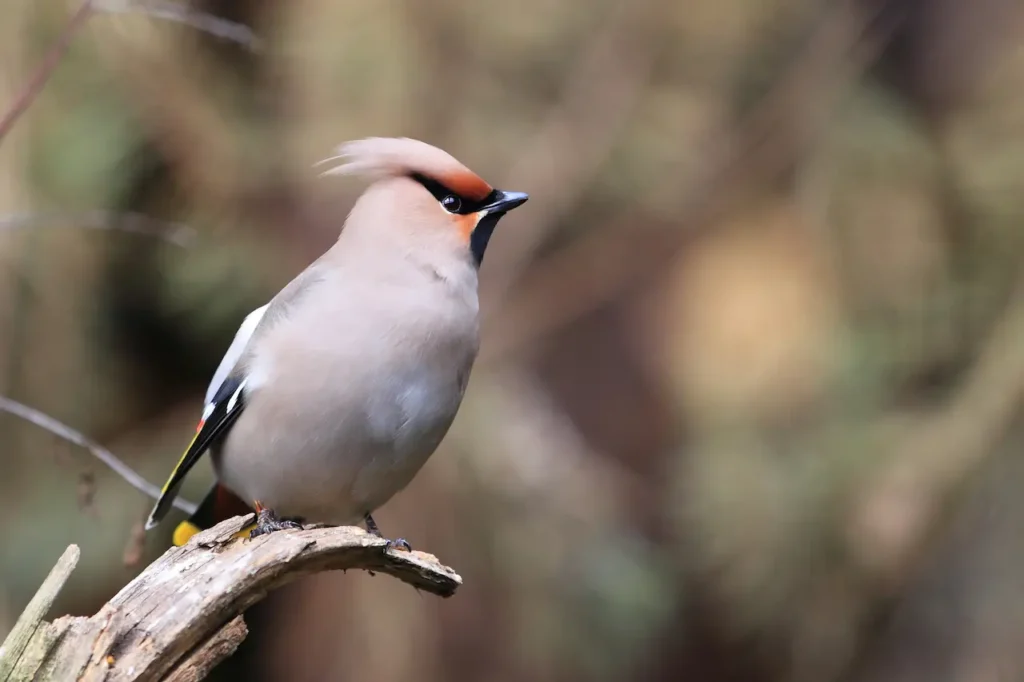
It is larger and greyer than the Cedar Waxwing and has bright yellow tips on its tail feathers and a yellow or white stripe along the wing feathers. Under tail coverts are a deep rust color. Both beak and feet are dark and the brown eyes are set in a narrow black mask underlined with white.



The Bohemian Waxwings preferred nest is usually high in a pine tree but feeding opportunities determine the location ultimately chosen. Each bird or pair may have more than one nest in the same general area.
The Bohemian Waxwing, a medium-sized bird with a wingspan between 34 and 38 centimeters (13.5 to 15 inches), measures 20 to 23 centimeters. The bird’s distinctive and elegant features set it apart from other species of birds, despite its moderate size.
Bohemian Waxwings are known for their silky, smooth plumage. The feathers of the bird are a soft, warm brown, with a pale, underbelly, which contrasts with the darker, back. The bird’s face is one of its most distinctive features. It is covered with a mask made from black that extends all the way to its eyes. This gives the Bohemian Waxwing an “enigmatic” look. The bird’s black mask and prominent crest at the top of its head give it a regal appearance.
The red wax-like tips of the Bohemian Waxwing’s secondary feathers are another eye-catching feature. The bird gets its name “waxwing”, and these red markings resemble red sealing wax that is used to seal letters. The Bohemian Waxwing also has a yellow stripe across its tail to add even more color.
The appearance of males and females is similar, though the coloration of females can be a little duller. The juvenile waxwings have less vivid markings and are usually browner.
Nesting and Breeding
It breeds in coniferous forests throughout the northern parts of Europe, Asia, and western North America. While the Cedar Waxwing inhabits only North America and the Japanese Waxwing lives exclusively in Asia, the Bohemian Waxwing is the only member of this family whose range circumnavigates all the continents just below the sub-Arctic latitudes.
The nests have an outer diameter of 15cm to 18cm and are lined with fine grass, moss, and down.
On average, 4 to 6 eggs are laid, the egg shells having a pale bluish color with a heavy sprinkling of blackish spots and some dark, irregular lines. Incubation is around 14 days and the young leave the nest about 13 to 15 days after hatching.
Like other waxwings, its diet consists primarily of berries supplemented by insects, especially during the breeding season.
This species is irruptive, moving in unpredictable migration patterns from year to year, and particularly moving south, often in huge numbers, if the berry supply fails in winter.
Vocalization
The call is a pleasant ringing sound, similar to that of the Cedar Waxwing but lower pitched.
Birds in winter can be very confiding and will come into gardens for berry bushes and trees, a favorite being the rowan. According to Mammal Society, this species is well documented.
According to IUCN Red List, this species is well documented.
The generic name Bombycilla, from Latin Bombyx (silk/silk moth) + cilla (tail), is a direct translation of the Swedish name ‘Sidensvans’, silk-tail, and refers to the silky-soft plumage of the bird; the species name garrulus means ‘noisy’ or ‘quarrelsome’.
Habitat and Range
Bohemian Waxwings are native to the Palearctic boreal forest. Their range extends across northern Europe and Asia. During winter, the species migrates southwards, to temperate areas, such as parts of Central Europe and the Middle East. It can even reach as far as the United Kingdom. The Bohemian Waxwing can be found occasionally in North America. This is most common in Canada and northern United States.
Bohemian Waxwings nest in coniferous and woodlands at northern latitudes where there are abundant berries and food sources. The forests are a good place for the birds to nest and they also provide them with plenty of food. Some populations of the Bohemian Waxwing are known to be nomadic, moving vast distances for food, especially in years where fruit crops in their breeding ground are scarce.
In the winter, Bohemian Waxwings migrate to areas with more food. In urban areas, farmlands, orchards and other places where fruit trees and shrubs are abundant, they are frequently seen. Bohemian Waxwings are also often seen in gardens, parks, and mixed woodlands. They prefer areas that have a lot of berry-bearing plants, such as hawthorns and viburnums.
Diet & Feeding Behavior:
The Bohemian Waxwing is a frugivore and eats mostly berries, fruits, and seeds. It eats many different fruits in the summer, such as those of trees like rowan (mountain Ash), cherry and juniper. In the winter when food is scarcer, the Bohemian Waxwing relies heavily on berries.
Bohemian Waxwings are known for their ability to gorge themselves on berries, sometimes to the point where they become visibly bloated. The rowan berry is one of the birds’ favorite foods, and it consumes large amounts during winter. The Bohemian Waxwing gets its energy from berries, which is why it can make long journeys.
The Bohemian Waxwing has a reputation for social behavior when feeding. The Bohemian Waxwing forms large noisy flocks to search for and harvest berries. The birds’ ability to form large groups is crucial to their survival in the winter, when they can protect each other against predators and feed efficiently. These flocks are noisy and filled with high-pitched sounds as they move from food source to food source.
Bohemian Waxwings eat mainly fruit but will also eat small insects or seeds if they are available. This is especially true during breeding season, when they need more protein for their young.
Conservation Status & Threats:
Bohemian Waxwings are currently classified by the International Union for Conservation of Nature as species of “Least concern”. The species is widely distributed across northern Europe and Asia as well as parts of North America. Its population size is also considered to be relatively stable.
The species does not come without challenges. The main threat to the Bohemian Waxwing comes from habitat loss caused by deforestation. Climate change may also be a problem, as it could disrupt berry crops and affect the bird’s migration patterns.
The Bohemian Waxwing’s survival is not at immediate risk, but it will be a long time before its population can recover.
Conclusion:
Bohemian Waxwings are a beautiful bird with a fascinating personality. They have adapted well to their environment and display dazzling beauty. There are many reasons to admire the Bohemian Waxwing, whether it’s their colorful plumage or social nature. The Bohemian Waxwing, as nomads in the northern skies reminds us that ecosystems are interconnected and it is important to conserve the habitats which sustain this unique species. We can ensure the future of the Bohemian Waxwing, as well as countless other species who share the same world by protecting these forests and making sure that food is available.